fen
English
Etymology 1
From Middle English fen, fenne, from Old English fenn (“fen; marsh; mud; dirt”), from Proto-Germanic *fanją (compare West Frisian fean, Dutch veen, German Fenn, Norwegian fen), from Proto-Indo-European *pen- (“bog, mire”). Compare Middle Irish en (“water”), enach (“swamp”), Old Prussian pannean (“peat-bog”), Sanskrit पङ्क (paṅka, “marsh, mud, mire, slough”).
Pronunciation
- IPA(key): fɛn
- Rhymes: -ɛn
Noun
fen (plural fens)
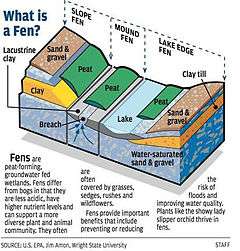
- A type of wetland fed by ground water and runoff, containing peat below the waterline.
- 1807, William Wordsworth, "England, 1802," collected in Poems (1807):
- Milton! thou shouldst be living at this hour:
- England hath need of thee: she is a fen
- Of stagnant waters […]
- 1842, Henry Wadsworth Longfellow, The Slave in the Dismal Swamp, from Poems on Slavery
- In dark fens of the Dismal Swamp / The hunted Negro lay; [...]
- 1986, John le Carré, A Perfect Spy:
- He was freezing to death in the flat mud of the Suffolk fens, too proud to go home without a catch.
- 1807, William Wordsworth, "England, 1802," collected in Poems (1807):
Derived terms
Translations
See also
Etymology 2
Noun
fen (plural fens)
Translations
Etymology 3
From fan, by analogy with men as the plural of man.
Noun
fen pl (normally plural, singular fan)
- (dated, fandom slang) fans; a plural form used by enthusiasts of science fiction, fantasy, and anime, partly from whimsy and partly to distinguish themselves from fans of sport, etc.
- 1951 May 21, Sargeant, Winthrop, “Through the Interstellar Looking Glass”, in Life, volume 30, number 21, page 127:
- Sad to relate, some of the European delegates were probably insurgents rather than true fen. […] But the Europeans could be counted on to take the long view, and many of them would probably turn out to be real fen and fenne after all.
- 2016 September 3, lurkertype, “Worldcon 75 Chair Responds”, in File 770, Comments:
- So I’m glad the attached hotel block is entirely reserved for disabled fen! Traveling on mass transit is tiring even when everything’s up to code.
-
Coordinate terms
Derived terms
Anagrams
Catalan
Verb
fen
- third-person singular present indicative form of fendre
- second-person singular imperative form of fendre
Chuukese
Adjective
fen
Synonyms
Adverb
fen
- past tense marker for verbs
- already
Czech
Pronunciation
- IPA(key): [ˈfɛn]
- Rhymes: -ɛn
Etymology 1
- fen (unit of currency in China, one-hundredth of a yuan).
- 1962, Časopis Národního muzea, volume 131, page 165:
- Čínská poštovní správa v roce 1961 vydala ke Dni armády, tj. k 1. srpnu 1961 dvě známky, a to v hodnotách 8 fenů a 10 fenů […]
-
Declension
Etymology 2
Noun
fen
- genitive plural of fena
Dalmatian
Etymology
Adjective
fen (feminine faina)
Faroese
Etymology
From Old Norse fen, from Proto-Germanic *fanją.
Pronunciation
- IPA(key): /feːn/
- Rhymes: -eːn
Noun
fen n (genitive singular fens, plural fen)
Declension
| Declension of fen | ||||
|---|---|---|---|---|
| n3 | singular | plural | ||
| indefinite | definite | indefinite | definite | |
| nominative | fen | fenið | fen | fenini |
| accusative | fen | fenið | fen | fenini |
| dative | feni | feninum | fenum | fenunum |
| genitive | fens | fensins | fena | fenanna |
Derived terms
- fenbressa
- fendíki
- fenjutur
Friulian
Etymology
Noun
fen m (plural fens)
Related terms
Hungarian
Etymology
From Proto-Finno-Ugric *pänɜ (“grindstone; grind”).[1]
Pronunciation
- IPA(key): [ˈfɛn]
Audio (file) - Hyphenation: fen
Verb
fen
- (transitive) to sharpen
Conjugation
| Infinitive | fenni | |||||||
|---|---|---|---|---|---|---|---|---|
| Past participle | fent | |||||||
| Present participle | fenő | |||||||
| Future participle | fenendő | |||||||
| Adverbial participle | fenve | |||||||
| Potential | fenhet | |||||||
| 1st person sg | 2nd person sg informal | 3rd person sg, 2nd person sg formal |
1st person pl | 2nd person pl informal | 3rd person pl, 2nd person pl formal | |||
| Indicative mood | Present | Indefinite | fenek | fensz | fen | fenünk | fentek | fennek |
| Definite | fenem én téged/titeket fenlek |
fened | feni | fenjük | fenitek | fenik | ||
| Past | Indefinite | fentem | fentél | fent | fentünk | fentetek | fentek | |
| Definite | fentem én téged/titeket fentelek |
fented | fente | fentük | fentétek | fenték | ||
| Conditional mood | Present | Indefinite | fennék | fennél | fenne | fennénk | fennétek | fennének |
| Definite | fenném én téged/titeket fennélek |
fennéd | fenné | fennénk | fennétek | fennék | ||
| Subjunctive mood | Present | Indefinite | fenjek | fenj or fenjél |
fenjen | fenjünk | fenjetek | fenjenek |
| Definite | fenjem én téged/titeket fenjelek |
fend or fenjed |
fenje | fenjük | fenjétek | fenjék | ||
| Conjugated infinitive | fennem | fenned | fennie | fennünk | fennetek | fenniük | ||
Derived terms
References
- ↑ Entry #728 in Uralonet, online Uralic etymological database of the Research Institute for Linguistics, Hungarian Academy of Sciences.
Istriot
Etymology
Noun
fen
Mandarin
Romanization
fen
- Nonstandard spelling of fēn.
- Nonstandard spelling of fén.
- Nonstandard spelling of fěn.
- Nonstandard spelling of fèn.
Usage notes
- English transcriptions of Mandarin speech often fail to distinguish between the critical tonal differences employed in the Mandarin language, using words such as this one without the appropriate indication of tone.
Old Norse
Etymology
From Proto-Germanic *fanją.
Noun
fen n (genitive fens, plural fen)
Declension
Serbo-Croatian
Etymology
Noun
fȇn m (Cyrillic spelling фе̑н)
Declension
Swedish
Noun
fen
- definite singular of fe
Turkish
Etymology
Noun
fen (definite accusative fenni, plural fenler)
Declension
| Inflection | ||
|---|---|---|
| Nominative | fen | |
| Definite accusative | fenni | |
| Singular | Plural | |
| Nominative | fen | fenler |
| Definite accusative | fenni | fenleri |
| Dative | fenne | fenlere |
| Locative | fende | fenlerde |
| Ablative | fenden | fenlerden |
| Genitive | fennin | fenlerin |