Satan
Translingual
Etymology
From Hebrew שָׂטָן (Śāṭān). Use of refer to the genus of cave fish references the idea of Hell being underground. Compare Ophisternon infernale, another cave fish named by C. L. Hubbs.[1]
Proper noun
Satan m
- A taxonomic genus within the family Ictaluridae – the widemouth blindcat.
Hypernyms
- (genus): Vertebrata - subphylum; Gnathostomata - infraphylum; Osteichthyes - superclass; Actinopterygii - class; Neopterygii - subclass; Teleostei - infraclass; Ostariophysi - superorder; Siluriformes - order; Ictaluridae - family
Hyponyms
- (genus): Satan eurystomus - sole known species
References



- Satan on Integrated Taxonomic Information System.
- Satan at World Register of Marine Species
English
Alternative forms
Etymology
From Middle English Sathan, Satan, from Old English Satan, from Latin Satān, from Ancient Greek Σατάν (Satán), from Hebrew שָׂטָן (Sātān, “adversary, accuser”).
Pronunciation
- IPA(key): /ˈseɪtən/
- Rhymes: -eɪtən
- Homophone: seitan
Proper noun
Satan
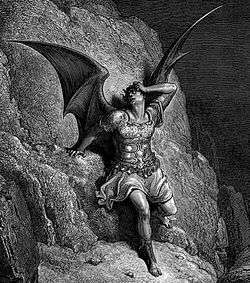
- (religion) The supreme evil spirit in the Abrahamic religions, who tempts humanity and rules Hell; the Devil; (in Theistic Satanism) the same figure, regarded as a deity to be revered and worshipped.
- 1997, Martin Schuldiner, Puritan Casuistry, Martin Schuldiner (editor), The Tayloring Shop: Essays on the Poetry of Edward Taylor in Honor of Thomas M. and Virginia L. Davis, page 125:
- Having been captured by the forces of Christ, the souls are now attacked for the first time by their former captain in “Satans Rage at them in their Conversion.″ Satan′s basic line of attack is to accuse the souls of being unreliable converts. Just as the souls turned from Satan to Christ, so too they will turn back again when it suits them, says Satan.
- 1998, Wendy Griswold, 8: The Devil, social change, and Jacobean theatre, Philip Smith (editor), The New American Cultural Sociology, page 127:
- The conventional role of Satan in English mystery plays was the Trickster archetype adapted for a theatre that was both popular and religious but constrained by traditional Christian theology.
- The Satan of the mystery plays was a Trickster, but a dignified one.
- 2005, John Bradshaw, Healing the Shame That Binds You, page 2:
- Biblical scholars tell us that the idea of a purely evil being like the Devil or Satan was a late development in the Bible. In the book of Job, Satan was the heavenly district attorney whose job it was to test the faith of those who, like Job, were specially blessed.
- During the Persian conquest of the Israelites, the Satan of Job became fused with the Zoroastrian dualistic theology adopted by the Persians, where two opposing forces, one of good, Ahura Mazda, the Supreme Creator deity, was in a constant battle with Ahriman, the absolute god of evil. This polarized dualism was present in the theology of the Essenes and took hold in Christianity where God and his Son Jesus were in constant battle with the highest fallen angel, Satan, for human souls. This dualism persists today only in fundamentalist religions (Muslim terrorists, the Taliban, the extreme Christian Right and a major part of evangelical Christianity).
- Many Satanists reject the notion that Satan is bad.
- 1997, Martin Schuldiner, Puritan Casuistry, Martin Schuldiner (editor), The Tayloring Shop: Essays on the Poetry of Edward Taylor in Honor of Thomas M. and Virginia L. Davis, page 125:
- (religion, LaVeyan Satanism) The personification or symbol of pride, carnality, and liberty.
- A person or animal regarded as particularly malignant, detestable, or evil; used as an epithet or as a name for an animal.
Synonyms
(supreme evil spirit of Abrahamic religions): the Adversary, Azazel, Beelzebub, the Devil, Diabolus, the Dragon, Iblis, Lucifer, Mephistopheles, Old Nick, Old Scratch, the Old Serpent, the Prince of Demons
Related terms
Derived terms
Translations
|
|
Noun
Satan (plural Satans)
- (countable) A demon follower of Satan (principal evil spirit); a fallen angel.
- 1992, Clinton E. Arnold, Powers of Darkness: Principalities & Powers in Paul′s Letters, page 67,
- This literature refers to a major figurehead of evil called “Satan,” the leader of a group of angels also referred to as “Satans.” These Satans accuse people and lead them astray.
- 2007, Abdullah Yusuf Ali (translator), M. A. H. Eliyasee (Roman script transliteration), Osman Taha (Arabic script), The Qur′an, II, 102,[in other editions, 96] page 15,
- They followed what the Satans recited over Solomon′s Kingdom. Solomon did not disbelieve but Satans disbelieved, teaching men, magic, and such things as came down at Babylon to the angels Hārūt and Mārūt.
- 1992, Clinton E. Arnold, Powers of Darkness: Principalities & Powers in Paul′s Letters, page 67,
See also
References
Translations
Anagrams
French
Pronunciation
- IPA(key): /sa.tɑ̃/
Noun
Satan m (plural Satans)
German
Alternative forms
Pronunciation
Audio (file)
Noun
Satan m (genitive Satans, plural Satane)
Synonyms
Further reading
- Satan in Duden online
Latin
Etymology
From Ancient Greek Σατάν (Satán), from Hebrew שָׂטָן (Śāṭān, “adversary, accuser”).
Pronunciation
- (Classical) IPA(key): /ˈsa.tan/, [ˈsa.tã]
- (Ecclesiastical) IPA(key): /ˈsa.tan/, [ˈsaː.tan]
Proper noun
Satan m (indeclinable)
Synonyms
References
- Satan in Gaffiot, Félix (1934) Dictionnaire Illustré Latin-Français, Hachette
Middle English
Proper noun
Satan
- Alternative form of Sathan
Swedish
Proper noun
Satan
- the devil