界
| ||||||||
Translingual
| Stroke order | |||
|---|---|---|---|
 | |||
| Japanese stroke order | |||
|---|---|---|---|
 | |||
Han character
界 (radical 102, 田+4, 9 strokes, cangjie input 田人中中 (WOLL), four-corner 46128, composition ⿱田介)
References
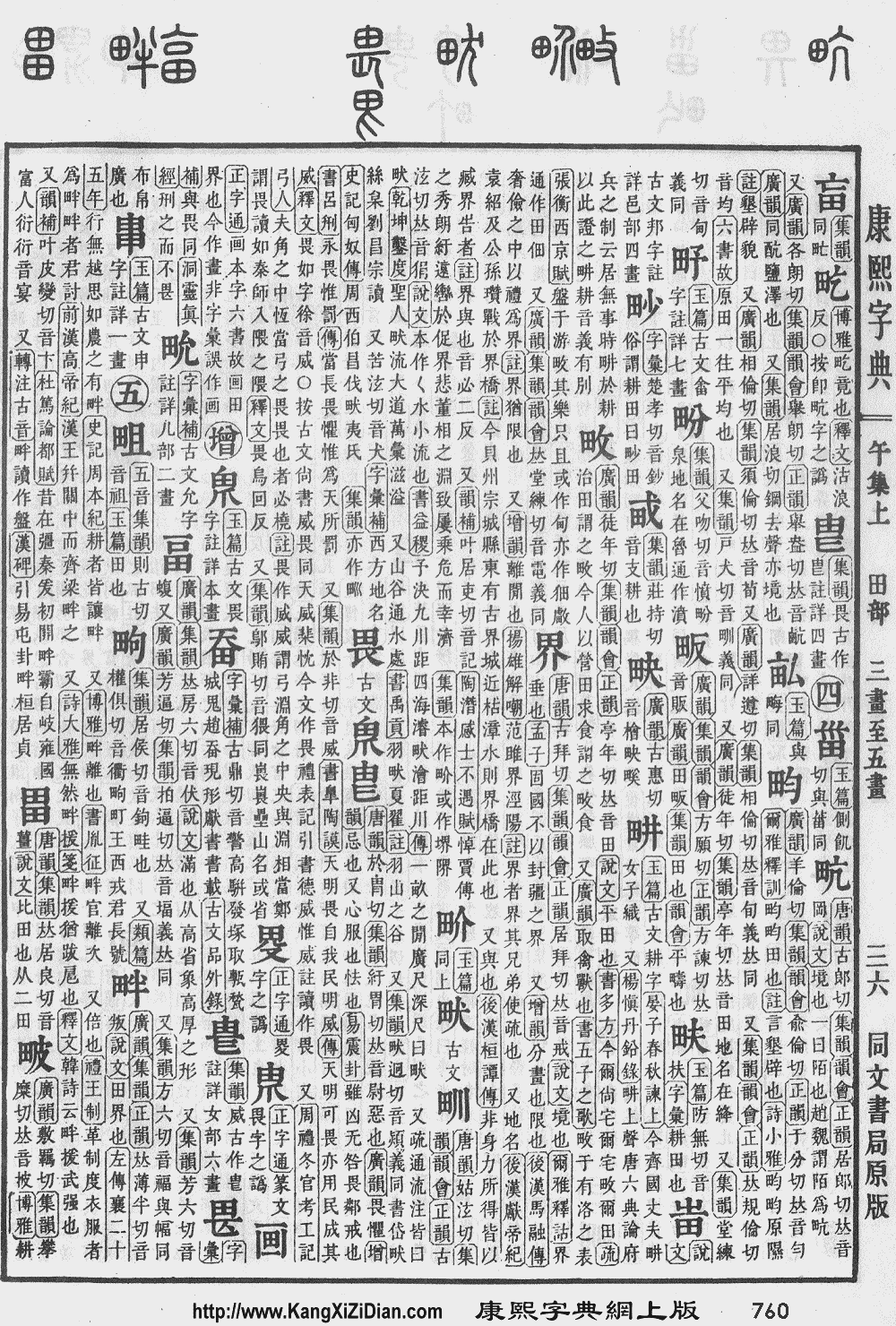
- KangXi: page 760, character 18
- Dai Kanwa Jiten: character 21775
- Dae Jaweon: page 1170, character 11
- Hanyu Da Zidian: volume 4, page 2534, character 2
- Unihan data for U+754C
Chinese
| simp. and trad. |
界 | |
|---|---|---|
| alt. forms | 畍 | |
Glyph origin
| Historical forms of the character 界 |
|---|
| Shuowen Jiezi (compiled in Han) |
| Small seal script |
 |
| Characters in the same phonetic series (介) (Zhengzhang, 2003) | |
|---|---|
| Old Chinese | |
| 妎 | *ɡaːds, *ɡeːds |
| 芥 | *kreːds |
| 尬 | *kreːds |
| 界 | *kreːds |
| 介 | *kreːds |
| 疥 | *kreːds |
| 玠 | *kreːds |
| 砎 | *kreːds, *kreːd, *ɡraːd |
| 魪 | *kreːds |
| 价 | *kreːds |
| 衸 | *kreːds, *ɡreːds |
| 齘 | *ɡreːds |
| 骱 | *ɡaːd, *kreːd |
| 扴 | *kreːd |
| 圿 | *kreːd |
| 忦 | *kreːd |
Phono-semantic compound (形聲, OC *kreːds) : semantic 田 (“field”) + phonetic 介 (OC *kreːds).
Pronunciation
Definitions
界
Compounds
|
|
|
Japanese
Kanji
- world
- border
Readings
(Can we verify(+) this pronunciation?)
Etymology 1
| Kanji in this term |
|---|
| 界 |
| かい Grade: 3 |
| on’yomi |
From Middle Chinese 界 (MC kˠɛiH, “boundary”).
In Buddhist contexts, derived from the Middle Chinese term used as a translation of Sanskrit धातु (dhātu, “layer, stratum”).[1]
Pronunciation
Noun
- boundary
- a bounded area or region
- a bounded group of people, a society, a world as a social grouping
- Used both as a standalone noun, and in compounds. Use in compounds is more common in this sense.
- 自然の界、自然界
- shizen no kai, shizenkai
- the natural world
- 美術界
- bijutsukai
- the art world
- the border edge of a thing
- (Buddhism) the category of a thing
- (Buddhism) the world or realm of a thing
- lines drawn between the lines of a text, as on lined writing paper
- lines drawn to lay out a draft of a piece of artwork: a sketch
- (biology, taxonomy) a kingdom
- (geology) a stratum corresponding to a geologic age
Derived terms
Etymology 2
| Kanji in this term |
|---|
| 界 |
| さかい Grade: 3 |
| kun’yomi |
/sakapi/ → /sakaɸi/ → /sakahi/ → /sakai/
The 連用形 (ren'yōkei, “continuative or stem form”) of obsolete verb 境う (sakau, “to divide, to form a boundary between things”).[1][2]
Some sources[1] further derive the verb as Old Japanese element 境 (saka, “division, border, boundary”) + auxiliary verb ふ (fu) indicating repetition or ongoing state. However, given the semantics, this could also be analyzed as the repetitive or ongoing aspect of Old Japanese-derived verb saku with an underlying meaning of “to split apart, to separate, to put distance between”, spelled variously as 割く, 裂く, 離く, or 放く, and cognate with 咲く (saku, “to bloom”, from the idea of the blooms splitting open), 栄える (sakaeru, “to prosper”, extended from the bloom sense), 盛ん (sakan, “prospering, fluorishing”).
Pronunciation
Alternative forms
Noun
界 (hiragana さかい, rōmaji sakai)
Usage notes
More commonly spelled 境. Derived terms primarily use that spelling, so see that entry for more details.
References
Korean
Hanja
界 • (gye) (hangeul 계, revised gye, McCune–Reischauer kye, Yale kyey)
- This term needs a translation to English. Please help out and add a translation, then remove the text
{{rfdef}}.
Vietnamese
Han character
界 (giới)
- This term needs a translation to English. Please help out and add a translation, then remove the text
{{rfdef}}.