慈姑
See also: 慈菇
Chinese
compassionate; gentle; merciful; kind; humane |
paternal aunt | ||
|---|---|---|---|
| simp. and trad. (慈姑) |
慈 | 姑 | |
| alt. forms | 慈菇 “arrowhead” 茨菰 “arrowhead” | ||
Etymology
Concerning the name of the plant, Compendium of Materia Medica says:
Pronunciation
Noun
慈姑
Derived terms
Japanese
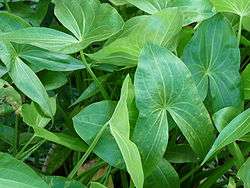
慈姑 (kuwai): the arrowhead plant.
| Kanji in this term | |
|---|---|
| 慈 | 姑 |
| Grade: S | Hyōgaiji |
| Irregular | |
Etymology
Unknown. One theory suggests that this is an alteration from 川芋 (kawa imo, “river tuber”), but the old kana spelling of くわゐ (kuwawi) for 慈姑 does not match the old kana spelling of かはうも (kafaumo) for 川芋. This is more likely a compound of 鍬 (kuwa, “plow”), from the shape of the leaves, plus an unknown element ゐ (wi).
The kanji are ateji, borrowed from the Chinese name for this plant.
Pronunciation
Noun
慈姑 (hiragana くわい, katakana クワイ, rōmaji kuwai, historical hiragana くわゐ)
- (botany) the arrowhead plant, Sagittaria trifolia var. edulis, cultivated since ancient times for its edible bulb
Usage notes
As with many terms that name organisms, this term is often spelled in katakana, especially in biological contexts, as クワイ.
References
This article is issued from
Wiktionary.
The text is licensed under Creative Commons - Attribution - Sharealike.
Additional terms may apply for the media files.