妹
| ||||||||
Translingual
Han character
妹 (radical 38, 女+5, 8 strokes, cangjie input 女十木 (VJD), four-corner 45490, composition ⿰女未)
| Stroke order | |||
|---|---|---|---|
 | |||
References
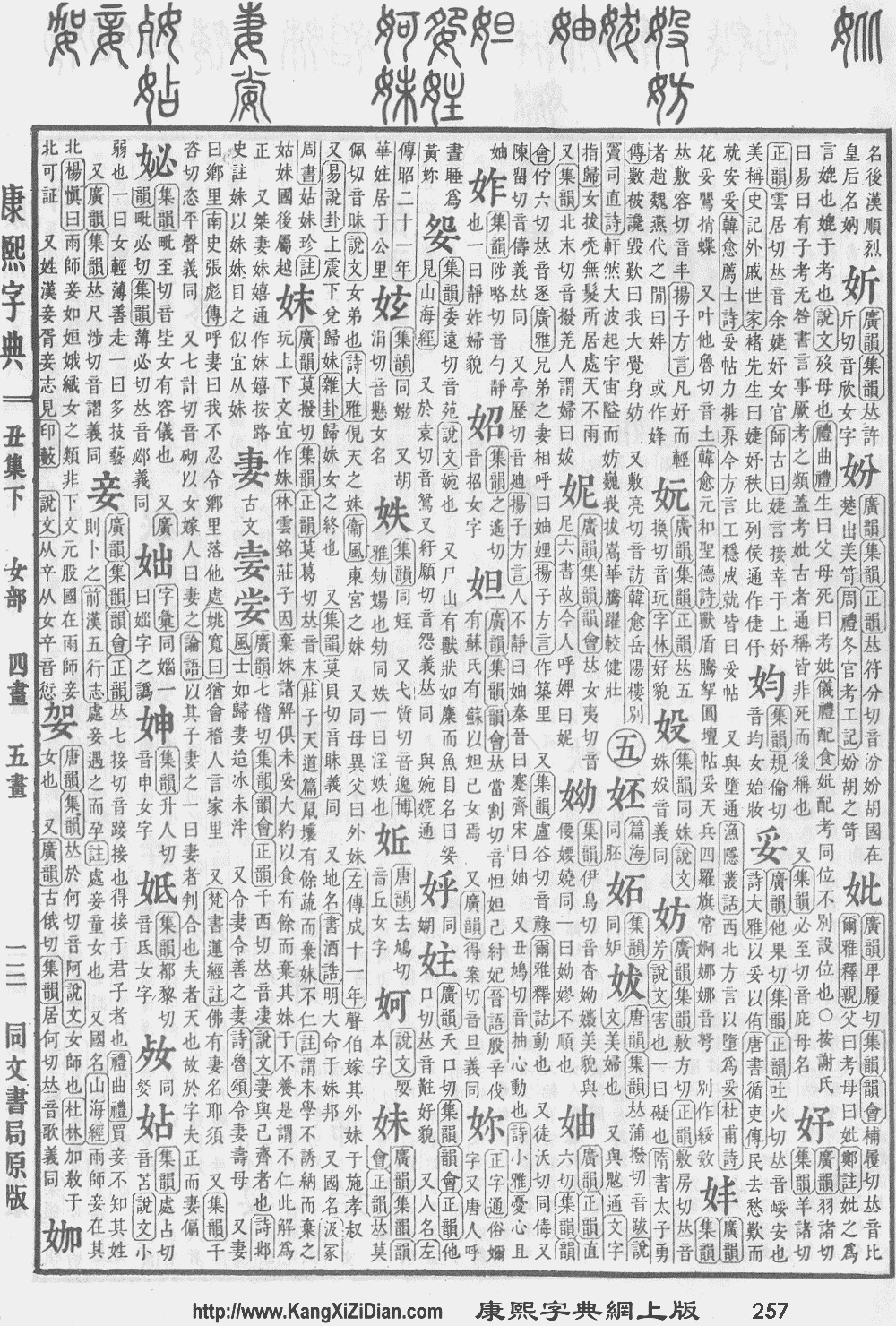
- KangXi: page 257, character 28
- Dai Kanwa Jiten: character 6138
- Dae Jaweon: page 522, character 23
- Hanyu Da Zidian: volume 2, page 1034, character 6
- Unihan data for U+59B9
Chinese
| simp. and trad. |
妹 | |
|---|---|---|
Glyph origin
| Characters in the same phonetic series (未) (Zhengzhang, 2003) | |
|---|---|
| Old Chinese | |
| 寐 | *mids |
| 魅 | *mrɯds |
| 鬽 | *mrɯds |
| 昧 | *mɯːds |
| 妹 | *mɯːds |
| 眛 | *maːds, *mɯːds |
| 沬 | *maːds, *hmɯːds, *mɯds |
| 未 | *mɯds |
| 味 | *mɯds |
| 鮇 | *mɯds |
| 菋 | *mɯds |
Phono-semantic compound (形聲, OC *mɯːds) : semantic 女 (“female, woman”) + phonetic 未 (OC *mɯds).
Pronunciation
Definitions
妹
Compounds
Japanese
Kanji
Readings
Compounds
Etymology 1
| Kanji in this term |
|---|
| 妹 |
| いも Grade: 2 |
| kun’yomi |
⟨imo1⟩ → /imo/
From Old Japanese.
The medial /-m-/ means "woman, female", found in a number of related terms such as 女 (me, onna, “woman”), 嫗 (omina, “elderly woman”), and 母 (omo, “mother”, archaic).
Pronunciation
Noun
- (archaic, usually from a male's viewpoint) a close female companion
- (archaic, usually from a female's viewpoint) a woman
Antonyms
Derived terms
- 妹 (imōto, “one's younger sister”)
- 妹ら (imora)
- 妹が家に (imo ga ie ni, pillow word)
- 妹が績む (imo ga umu, pillow word)
- 妹が髪 (imo ga kami, pillow word)
- 妹が着る (imo ga kiru, pillow word)
- 妹が袖 (imo ga sode, pillow word)
- 妹が手を (imo ga te o, pillow word)
- 妹が紐 (imo ga himo, pillow word)
- 妹が目を (imo ga me o, pillow word)
- 妹許 (imogari)
- 妹姑 (imo-shūtome)
- 妹兄, 妹背 (imose)
- 妹に恋ひ (imo ni koi, pillow word)
- 妹山 (imoyama)
- 汝妹 (nanimo)
- 継妹 (mamaimo)
- 吾妹 (wagimo)
Etymology 2
⟨imo(1) pi1to2⟩ → */imopitə/ → /imofito/ → /imowito/ → */imowuto/ /imoːto/
Originally a compound of 妹 (imo, close female companion) + 人 (hito, “person”).[2][3]
The shift from /imofito/ → /imoːto/ is an instance of ウ音便 (u onbin, “u sound shift”), found in terms with bilabial consonants (/m/, /b/, /w/) followed by i; commonly seen in terms such as 玄人 (kurōto, “professional”), 素人 (shirōto, “amateur”), or possibly, 相撲 (sumō, “sumo”).
Pronunciation
Noun
妹 (hiragana いもうと, rōmaji imōto)
- one's own younger sister
- Antonym: 姉 (ane)
- the wife of one's younger brother; one's sister-in-law
- Synonym: 義妹 (gimai)
- a younger female
Derived terms
Etymology 3
| Kanji in this term |
|---|
| 妹 |
| いもと Grade: 2 |
| kun’yomi |
/imopitə/ → */imoputə/ → */imobutə/ → */imomutə/ → */imontə/ → /imoto/
Likely a variant shift from derived compound 妹 (imo, close female companion) + 人 (hito, “person”), appears in The Tale of Heiji, written around the mid-12th century.
Noun
妹 (hiragana いもと, rōmaji imoto)
Proper noun
妹 (hiragana いもと, rōmaji Imoto)
Etymology 4
| Kanji in this term |
|---|
| 妹 |
| まい Grade: 2 |
| on’yomi |
From Middle Chinese 妹 (MC muʌiH).
Proper noun
- a female given name.
References
- 1 2 1974, 新明解国語辞典 (Shin Meikai Kokugo Jiten), Second Edition (in Japanese), Tōkyō: Sanseidō
- ↑ 2006, 大辞林 (Daijirin), Third Edition (in Japanese), Tōkyō: Sanseidō, →ISBN
- ↑ 1995, 大辞泉 (Daijisen) (in Japanese), Tōkyō: Shogakukan, →ISBN
- ↑ 2006, 大辞林 (Daijirin), Third Edition (in Japanese), Tōkyō: Sanseidō, →ISBN
- ↑ 1998, NHK日本語発音アクセント辞典 (NHK Japanese Pronunciation Accent Dictionary) (in Japanese), Tōkyō: NHK, →ISBN
Korean
Hanja
妹 • (mae) (hangeul 매)
- This term needs a translation to English. Please help out and add a translation, then remove the text
{{rfdef}}.
Vietnamese
Han character
妹 (muội)
- This term needs a translation to English. Please help out and add a translation, then remove the text
{{rfdef}}.