saw
English
Pronunciation
- (Received Pronunciation) enPR: sô, IPA(key): /sɔː/
- Homophones: (in some non-rhotic accents): soar, sore
- Rhymes: -ɔː
- (US) enPR: sô, IPA(key): /sɔ/
- (cot–caught merger) enPR: sä, IPA(key): /sɑː/
- (idiosyncratic, past tense of 'see') IPA(key): /sɑːl/
Audio (US) (file)
Etymology 1
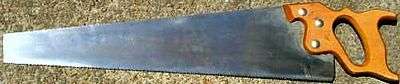
Noun from Middle English sawe, sawgh, from Old English saga, sagu (“saw”), from Proto-Germanic *sagô, *sagō (“saw”), from Proto-Indo-European *sek- (“to cut”). Cognate with West Frisian seage (“saw”), Dutch zaag (“saw”), German Säge (“saw”), Danish sav (“saw”), Swedish såg (“saw”), Icelandic sög (“saw”), and through Indo-European, with Latin secō (“cut”).
Verb from Middle English sawen.
Noun
saw (plural saws)
- A tool with a toothed blade used for cutting hard substances, in particular wood or metal
- A musical saw.
- A sawtooth wave.
Derived terms
- backsaw
- band saw, bandsaw
- buzz saw
- chainsaw
- chop saw
- circular saw
- concrete saw, consaw
- coping saw
- crosscut saw
- fretsaw
Translations
|
|
Verb
saw (third-person singular simple present saws, present participle sawing, simple past sawed, past participle sawed or sawn)
- (transitive) To cut (something) with a saw.
- 1611, Bible (King James Version), Hebrews 11:37:
- They were stoned, they were sawn asunder, were tempted, were slain with the sword: they wandered about in sheepskins and goatskins; being destitute, afflicted, tormented;
-
- (intransitive) To make a motion back and forth similar to cutting something with a saw.
- The fiddler sawed away at his instrument.
- (intransitive) To be cut with a saw.
- The timber saws smoothly.
- (transitive) To form or produce (something) by cutting with a saw.
- to saw boards or planks (i.e. to saw logs or timber into boards or planks)
- to saw shingles; to saw out a panel
Derived terms
Translations
|
|
Etymology 2
From Middle English sawe, from Old English sagu, saga (“story, tale, saying, statement, report, narrative, tradition”), from Proto-Germanic *sagō, *sagǭ (“saying, story”), from Proto-Indo-European *sekʷe-, *skʷē- (“to tell, talk”). Cognate with Dutch sage (“saga”), German Sage (“legend, saga, tale, fable”), Danish sagn (“legend”), Norwegian soga (“story”), Icelandic saga (“story, tale, history”). More at saga, say.
Noun
saw (plural saws)
- (obsolete) Something spoken; speech, discourse.
- 1485 July 31, Thomas Malory, “(please specify the chapter)”, in [Le Morte Darthur], (please specify the book number), [London: William Caxton], OCLC 71490786; republished as H[einrich] Oskar Sommer, editor, Le Morte Darthur, London: Published by David Nutt, in the Strand, 1889, OCLC 890162034:, Bk.V:
- And for thy trew sawys, and I may lyve many wynters, there was never no knyght better rewardid […].
- And for your true discourses, and I may live many winters, there was never no knight better rewarded […].
- And for thy trew sawys, and I may lyve many wynters, there was never no knyght better rewardid […].
-
- (often old saw) A saying or proverb.
- 1599, William Shakespeare, As You Like It, Act II Scene VII, lines 152-5.
- And then the justice, / In fair round belly with good capon lined, / With eyes severe and beard of formal cut, / Full of wise saws and modern instances.
- 1902, Charles Robert Ashbee, Masque of the Edwards of England, page 8.
- At his crowning […] the priest in his honour preached on the saw, 'Vox populi, vox Dei.'
- 2017, Andrew Marantz, "Becoming Steve Bannon's Bannon", The New Yorker, Feb 13&20 ed.
- There’s an old saw about Washington, D.C., that staffers in their twenties know more about the minutiae of government than their bosses do.
- 1599, William Shakespeare, As You Like It, Act II Scene VII, lines 152-5.
- (obsolete) Opinion, idea, belief; by thy ~, in your opinion; commune ~, common opinion; common knowledge; on no ~, by no means.
- Polychronicon Ranulphi Higden
- Þe more comoun sawe is þat Remus was i-slawe for he leep ouer þe newe walles of Rome.
- The more common opinion is that Remus was slain for he lept over the new walls of Rome.
- Þe more comoun sawe is þat Remus was i-slawe for he leep ouer þe newe walles of Rome.
- Polychronicon Ranulphi Higden
- (obsolete) Proposal, suggestion; possibility.
- Earl of Toulouse
- All they assentyd to the sawe; They thoght he spake reson and lawe.
- Earl of Toulouse
- (obsolete) Dictate; command; decree.
- Spenser
- [Love] rules the creatures by his powerful saw.
- Spenser
Synonyms
- See also Thesaurus:saying
Translations
Etymology 3
Verb
saw
- simple past tense of see
Interjection
saw
- (slang) what's up (either as a greeting or actual question)
- — Saw, dude?
— Not much.
Anagrams
Atong (India)
Pronunciation
- IPA(key): /sʰaw/
Adjective
saw
Kurdish
Noun
saw ?
Scots
Pronunciation
Verb
saw
- (South Scots) simple past tense of sei
- (North Scots and Central Scots) simple past tense of see
Zhuang
Pronunciation
- (Standard Zhuang) IPA(key): /θaɯ˨˦/
- Tone numbers: saw1
- Hyphenation: saw
Etymology 1
From Proto-Tai *sɯːᴬ (“writing; book”), from Middle Chinese 書 (MC ɕɨʌ, “writing; book”). Cognate with Lao ສື (sư̄, “letter, writing symbols”), Thai สือ (sʉ̌ʉ).
Noun
saw (old orthography saɯ, Sawndip forms 𭨡, 字)
Derived terms
|
|
|
Etymology 2
From Proto-Tai *saɰᴬ (“clear; clean”). Cogante with Thai ใส (sǎi, “clear; transparent”).
Adjective
saw (old orthography saɯ, Sawndip forms 𢙣, 㳏)
Etymology 3
Verb
saw (old orthography saɯ, Sawndip forms 賒)
- to lose