sore
English
Etymology
From Middle English sor, from Old English sār (“ache, wound”, noun) and sār (“painful, grievous”, adjective), from Proto-Germanic *sairą (noun) (compare Dutch zeer (“sore, ache”), Danish sår (“wound”)), and *sairaz (“sore”, adjective) (compare German sehr (“very”)), from Proto-Indo-European *sh₂eyro-, enlargement of *sh₂ey- (“to be fierce, afflict”) (compare Hittite [script needed] (sāwar, “anger”), Welsh hoed (“pain”), Ancient Greek αἱμωδία (haimōdía, “sensation of having teeth on edge”)).
Pronunciation
- (Received Pronunciation) enPR: sô, IPA(key): /sɔː/
- (General American) enPR: sôr, IPA(key): /sɔɹ/
- (rhotic, without the horse–hoarse merger) enPR: sōr, IPA(key): /so(ː)ɹ/
- (non-rhotic, without the horse–hoarse merger) IPA(key): /soə/
- Homophone: soar; saw (in non-rhotic accents)
- Rhymes: -ɔː(ɹ)
Audio (US) (file)
Adjective
sore (comparative sorer, superlative sorest)
- Causing pain or discomfort; painfully sensitive.
- Her feet were sore from walking so far.
- Sensitive; tender; easily pained, grieved, or vexed; very susceptible of irritation.
- Tillotson
- Malice and hatred are very fretting and vexatious, and apt to make our minds sore and uneasy.
- Tillotson
- Dire; distressing.
- The school was in sore need of textbooks, theirs having been ruined in the flood.
- (informal) Feeling animosity towards someone; annoyed or angered.
- Joe was sore at Bob for beating him at checkers.
- (obsolete) Criminal; wrong; evil.
- 1603, William Shakespeare, Hamlet:
- ...Your water is a sore decayer of your whoreson dead body.
- 1603, William Shakespeare, Hamlet:
Derived terms
Translations
|
|
|
|
|
Adverb
sore (not comparable)
- (archaic) Very, excessively, extremely (of something bad).
- They were sore afraid. The knight was sore wounded.
- 1879, R[ichard] J[efferies], chapter II, in The Amateur Poacher, London: Smith, Elder, & Co., […], OCLC 752825175, page 071:
- Orion hit a rabbit once; but though sore wounded it got to the bury, and, struggling in, the arrow caught the side of the hole and was drawn out. Indeed, a nail filed sharp is not of much avail as an arrowhead; you must have it barbed, and that was a little beyond our skill. Ikey the blacksmith had forged us a spearhead after a sketch from a picture of a Greek warrior; and a rake-handle served as a shaft.
- Sorely.
- 1919, Edgar Rice Burroughs, Jungle Tales of Tarzan
- [… they] were often sore pressed to follow the trail at all, and at best were so delayed that in the afternoon of the second day, they still had not overhauled the fugitive.
- 1919, Edgar Rice Burroughs, Jungle Tales of Tarzan
Noun
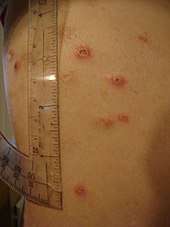
sore (plural sores)
- An injured, infected, inflamed or diseased patch of skin.
- They put ointment and a bandage on the sore.
- Grief; affliction; trouble; difficulty.
- Sir Walter Scott
- I see plainly where his sore lies.
- Sir Walter Scott
- A group of ducks on land. (See also: sord).
- A young hawk or falcon in its first year.
- A young buck in its fourth year.
Translations
|
|
Verb
sore (third-person singular simple present sores, present participle soring, simple past and past participle sored)
Derived terms
See also
Anagrams
Friulian
Etymology
Preposition
sore
Adverb
sore
Derived terms
- disore
- parsore
Indonesian
Noun
sore
- afternoon (part of the day between noon and evening)
Istro-Romanian
Etymology
From Latin sōl, sōlem (compare Romanian soare); from Proto-Italic [Term?], from pre-Italic *sh₂wōl, ultimately from Proto-Indo-European *sóh₂wl̥. Compare Romanian soare.
Noun
sore m (definite singular sorele, plural sori)
Japanese
Romanization
sore
Malay
Alternative forms
- سوري
Etymology
From Indonesian sore.
Pronunciation
- IPA(key): /sore/
- Rhymes: -re, -e
Noun
sore
- afternoon (part of the day between noon and evening)
Synonyms
Middle English
Etymology 1
From Old French seür.
Adverb
sore
- Alternative form of sure
Etymology 2
From Old English sār, from Proto-Germanic *sairą (noun), *sairaz (adjective)
Alternative forms
Pronunciation
Adjective
sore (comparative sorer, sorrer, superlative sorest)
- Senses associated with pain:
- Senses associated with anguish:
- Harmful; creating or producing anguish, sadness or torment.
- Upset, distressed; currently in agony or anguish or affected by it.
- Challenging, complicated, laborious; requiring a large expenditure of one's energies:
- Challenging to deal with on the battlefield; violent, intense, mighty.
- Challenging to deal with; inducing great anguish.
- (Used with words relating to pain, soreness, or anguish) Very, strongly, bad, grievously.
- Malicious, iniquitous, malign; not morally or spiritually in the right.
Derived terms
Descendants
References
- “sōr(e (n.(1))” in MED Online, Ann Arbor, Mich.: University of Michigan, 2007, retrieved 2018-06-08.
Noun
sore (plural sores)
- The condition of bodily painfulness or hurting.
- A condition of anguish or affliction of the thought; injury of the mind:
- An issue or difficulty, especially one that causes great distress or evil.
- Regret; remorsefulness; anguish over one's past actions.
- (rare) The state of being scared or frightened.
- A specific affliction or condition:.
Descendants
References
- “sōr(e (adj.(2))” in MED Online, Ann Arbor, Mich.: University of Michigan, 2007, retrieved 2018-06-09.
Adverb
sore (comparative sorer, sorrer, superlative sorest)
- Hurtfully, harmfully; in a way which creates wounds, painfulness, or anguish:
- Strictly, mercilessly, remorselessly; without attention to kindness or mercy.
- Expensively; in a way which creates a monetary or resource setback.
- With intense effort, prowess, or capability:
- Viciously, mightily, ruthlessly, strongly; using intense strength or prowess in battle.
- Nimbly, powerfully, quickly; using intense dexterity or physical force.
- Toilingly; backbreakingly, painstakingly; with much work.
- With great patience and focus; diligently; patiently.
- (Especially used with words relating to feelings or thought) Very, extremely, incredibly, a lot.
- Taut, secure; held strongly and with security.
- While suffering or experiencing an injury or pain.
Descendants
References
- “sōre (adv.)” in MED Online, Ann Arbor, Mich.: University of Michigan, 2007, retrieved 2018-06-09.
Etymology 3
From Old French essorer.
Verb
sore
- Alternative form of soren
Etymology 4
From Old French sor.
Noun
sore
- Alternative form of sor
Etymology 5
From Anglo-Norman soree.
Noun
sore
- Alternative form of sorre