pie
English
Pronunciation
Etymology 1
From Middle English pie, pye, probably from Latin pīca (“magpie, jay”) (from the idea of the many ingredients put into pies likened to the tendency of magpies to bring a variety of objects back to their nests).
Noun
pie (countable and uncountable, plural pies)
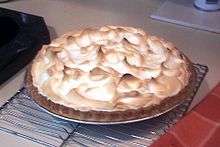
- A type of pastry that consists of an outer crust and a filling.
- The family had steak and kidney pie for dinner and cherry pie for dessert.
- Any of various other, non-pastry dishes that maintain the general concept of a shell with a filling.
- Shepherd's pie is made of mince covered with mashed potato.
- (Northeastern US) Pizza.
- (figuratively) The whole of a wealth or resource, to be divided in parts.
- 2010 December 4, Evan Thomas, “Why It’s Time to Worry”, in Newsweek:
- It is easier to get along when everyone, more or less, is getting ahead. But when the pie is shrinking, social groups are more likely to turn on each other.
-
- (letterpress typography) A disorderly mess of spilt type.
- (cricket) An especially badly bowled ball.
- (pejorative) a gluttonous person.
- A pie chart.
- 1986, Carolyn Sorensen, Henry J. Stock, Department of Education Computer Graphics Guide, page 8:
- Pies are best for comparing the components of only one or two totals.
-
- (slang) The vulva.
- 1981, William Kotzwinkle, Jack in the Box:
- "Yeah, take it off!" "SHOW US YOUR PIE!" The brunette opened the catch on her G-string and let the sequinned cloth slip down, teasing them with it.
- 2010, W. A. Moltinghorne, Magnolia Park, page 238:
- Yeah, some guys like to eat the old hairy pie. Women, too, or so I've heard.
-
Derived terms
|
|
Translations
|
|
|
|
|
- The translations below need to be checked and inserted above into the appropriate translation tables, removing any numbers. Numbers do not necessarily match those in definitions. See instructions at Wiktionary:Entry layout#Translations.
See also
Verb
pie (third-person singular simple present pies, present participle pieing, simple past and past participle pied)
- (transitive) To hit in the face with a pie, either for comic effect or as a means of protest (see also pieing).
- I'd like to see someone pie the chairman of the board.
- (transitive) To go around (a corner) in a guarded manner.
- (transitive) (of printing types) To reduce to confusion; to jumble.
- 1943, Esther Forbes Hoskins, Johnny Tremain:
- The door of the [printing] shop was shattered. He went in. The presses were broken. The type pied.
-
Translations
Etymology 2
Borrowed from Old French pie, from Latin pīca, feminine of pīcus (“woodpecker”), from Proto-Indo-European *(s)peyk- (“woodpecker; magpie”). Cognate with speight.
Noun
pie (plural pies)
- (obsolete) Magpie.
Derived terms
Etymology 3
Borrowed from Hindi पाई (pāī, “quarter”), from Sanskrit पादिका (pādikā).
Noun
pie (plural pie or pies)
- (historical) The smallest unit of currency in South Asia, equivalent to 1/192 of a rupee or 1/12 of an anna.
- 1888, Rudyard Kipling, “The Strange Ride of Morrowbie Jukes”, in The Phantom ’Rickshaw and Other Tales, Folio Society, published 2005, page 117:
- I gave him all the money in my possession, Rs.9.8.5. – nine rupees, eight annas, and five pie – for I always keep small change as bakshish when I am in camp.
-
Translations
Anagrams
Asturian
Etymology
From Latin pes, pedem.
Noun
pie m (plural pies)
Related terms
Esperanto
Adverb
pie
French
Etymology
From Old French pie, from Latin pica, feminine of picus (“woodpecker”).
Pronunciation
- IPA(key): /pi/
audio (file)
Noun
pie f (plural pies)
Derived terms
Further reading
- “pie” in le Trésor de la langue française informatisé (The Digitized Treasury of the French Language).
Anagrams
Italian
Adjective
pie f pl
- feminine plural of pio
Anagrams
Latin
Adjective
pie
- vocative masculine singular of pius
Adverb
piē (comparative pius, superlative pissimē)
References
- pie in Charlton T. Lewis and Charles Short (1879) A Latin Dictionary, Oxford: Clarendon Press
- pie in Charlton T. Lewis (1891) An Elementary Latin Dictionary, New York: Harper & Brothers
- pie in Gaffiot, Félix (1934) Dictionnaire Illustré Latin-Français, Hachette
- Carl Meissner; Henry William Auden (1894) Latin Phrase-Book, London: Macmillan and Co.
- (ambiguous) to show an affectionate regard for a person's memory: memoriam alicuius pie inviolateque servare
- (ambiguous) to be an earnest worshipper of the gods: deos sancte, pie venerari
- (ambiguous) to show an affectionate regard for a person's memory: memoriam alicuius pie inviolateque servare
Latvian
Preposition
pie (with genitive)
- at
- es biju pie tēva ― I was at my father's
- on
- māja pie jūras ― a house on the sea
- to
- braukšu pie tevis ― I will go to your place
Mandarin
Romanization
pie
Usage notes
- English transcriptions of Mandarin speech often fail to distinguish between the critical tonal differences employed in the Mandarin language, using words such as this one without the appropriate indication of tone.
Norman
Etymology
From Old French pie, from Latin pica, feminine of picus (“woodpecker”).
Pronunciation
Audio (Jersey) (file)
Noun
pie f (plural pies)
Synonyms
Coordinate terms
- The terms below need to be checked and allocated to the definitions (senses) of the headword above. Each term should appear in the sense for which it is appropriate. Use the templates
{{syn|nrf|...}}or{{ant|nrf|...}}to add them to the appropriate sense(s).
- (sex): piêté
Old French
Etymology
Noun
pie f (oblique plural pies, nominative singular pie, nominative plural pies)
Descendants
Portuguese
Verb
pie
- first-person singular (eu) present subjunctive of piar
- third-person singular (ele and ela, also used with você and others) present subjunctive of piar
- third-person singular (você) affirmative imperative of piar
- third-person singular (você) negative imperative of piar
Spanish
Etymology
From Latin pes, pedem, from Proto-Indo-European *pṓds. Compare Catalan peu, Esperanto piedo, French pied, Ido pedo, Interlingua pede, Italian piede, Latin pes, Latvian pēda, Lithuanian pėdės, Portuguese pé, Sardinian pei.
Pronunciation
- IPA(key): /pje/
Noun
pie m (plural pies)
Synonyms
Derived terms
|
|
|
Related terms
Verb
pie