犮
| ||||||||
Translingual
| 犮 | |
| 犮 | |
| 犮 | |
| 犮 |
Alternative forms
- In traditional Chinese and Korean scripts, the bottom right component is written 乂 instead of 又 (as found in the Kangxi dictionary).
- In simplified Chinese and Vietnamese scripts, the bottom right component is written 又 (友 with a dot on the top right corner).
- In Japanese, the character itself is written like the traditional Chinese form but may be simplified to 友 when used as a component for frequently used characters such as 抜 and 髪 (dot above 友 is missing).
Han character
犮 (radical 94 犬+1, 4 strokes, cangjie input 戈大水 (IKE) or 戈大大 (IKK), four-corner 43040, composition ⿺友丶(G) or ⿻犬丿(HTJK))
Derived characters
References
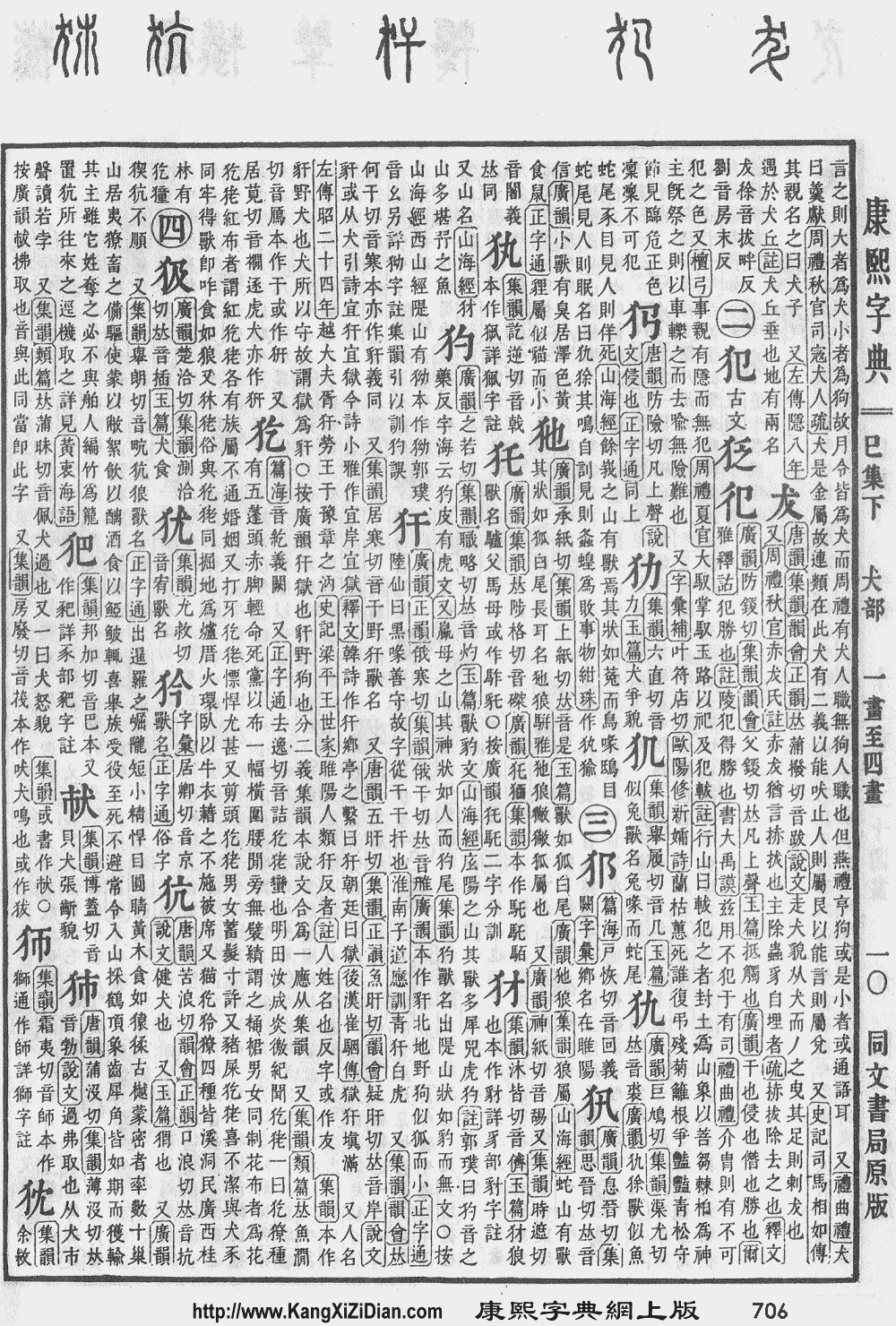
- KangXi: page 706, character 1
- Dai Kanwa Jiten: character 20236
- Dae Jaweon: page 1118, character 16
- Hanyu Da Zidian: volume 2, page 1331, character 2
- Unihan data for U+72AE
Chinese
| simp. and trad. |
犮 | |
|---|---|---|
| alt. forms | 叐 𡗜 𤝜 | |
Glyph origin
| Characters in the same phonetic series (犮) (Zhengzhang, 2003) | |
|---|---|
| Old Chinese | |
| 軷 | *boːds, *boːd |
| 韍 | *bruds, *pud |
| 祓 | *pods, *pʰud |
| 蛂 | *blɯːd |
| 拔 | *bruːd, *boːd, *bod |
| 菝 | *bruːd, *boːd |
| 袚 | *poːd |
| 茇 | *poːd |
| 盋 | *poːd |
| 帗 | *poːd, *pud |
| 跋 | *boːd |
| 魃 | *boːd |
| 䣮 | *boːd |
| 馛 | *boːd |
| 炦 | *boːd |
| 颰 | *boːd, *pod |
| 妭 | *boːd |
| 犮 | *boːd |
| 胈 | *boːd |
| 鈸 | *boːd |
| 苃 | *boːd |
| 坺 | *boːd, *bod |
| 髮 | *pod |
| 冹 | *pod, *pud |
| 瞂 | *bod |
| 紱 | *pud |
| 黻 | *pud |
| 翇 | *pud |
Pronunciation
Definitions
犮
- the appearance or shape of a dog running
- Alternative form of 跋 (“to step on”).
- Alternative form of 拔 (“to pull off”).
Japanese
Kanji
犮
Readings
Korean
Hanja
犮 • (bal) (hangeul 발, revised bal, McCune–Reischauer pal)
This article is issued from
Wiktionary.
The text is licensed under Creative Commons - Attribution - Sharealike.
Additional terms may apply for the media files.