御札
Chinese
| defend; imperial; to drive | short note | ||
|---|---|---|---|
| simp. and trad. (御札) |
御 | 札 | |
Pronunciation
Noun
御札
- (literary, archaic) imperial instruction; imperial order
Japanese
| Kanji in this term | |
|---|---|
| 御 | 札 |
| お Grade: S |
ふだ Grade: 4 |
| kun’yomi | |
Etymology 1
From 御 (o, “honorific prefix”) + 札 (fuda, “tag, note”).
Pronunciation
Noun
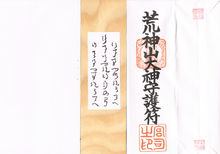
Ofuda, issued by a Shinto shrine.
Related terms
- 護符 (gofu): a protective charm issued by a Shinto shrine
- 神札 (shinsatsu): a protective charm issued by a Shinto shrine
- 御守, お守り (omamori): a protective charm issued by a Shinto shrine
- 破魔矢 (hamaya): a decorative arrow used as a ward against evil
- 縁起物 (engimono): a good luck charm
Further reading

Etymology 2
From 御 (o, “honorific prefix”) + 札 (satsu, “note, bank note”). Yutōyomi, mixing the kun'yomi o with the on'yomi satsu.
Noun
御札 (hiragana おさつ, rōmaji osatsu)
Etymology 3
From 御 (gyo, “honorific prefix”) + 札 (satsu, “note”). On'yomi.
Noun
御札 (hiragana ぎょさつ, rōmaji gyosatsu)
This article is issued from
Wiktionary.
The text is licensed under Creative Commons - Attribution - Sharealike.
Additional terms may apply for the media files.