lance
English
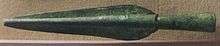
Lance shape of an Egyptian bronze spear from Banha, 2nd millennium BC
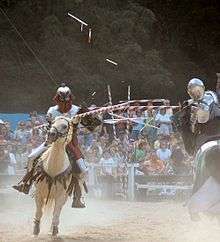
Jousters with broken lances.
Etymology
Borrowed from Old French lance, from Latin lancea.
Pronunciation
- (Received Pronunciation) enPR: läns, IPA(key): /lɑːns/
- (US) enPR: lăns, IPA(key): /læns/
Audio (US) (file) - Rhymes: -ɑːns
- Rhymes: -æns
Noun
lance (plural lances)
- A weapon of war, consisting of a long shaft or handle and a steel blade or head; a spear carried by horsemen.
- 1590, William Shakespeare, Henry VI, Part III, Act II, Scene III, line 15.
- 1909, Charles Henry Ashdown, European Arms & Armor, page 65.
- The head of the lance was commonly of the leaf form, and sometimes approached that of the lozenge; it was very seldom barbed, although this variety, together with the others, appears upon the Bayeux Tapestry.
- A wooden spear, sometimes hollow, used in jousting or tilting, designed to shatter on impact with the opposing knight’s armour.
- (fishing) A spear or harpoon used by whalers and fishermen.
- (military) A soldier armed with a lance; a lancer.
- (military) An instrument which conveys the charge of a piece of ordnance and forces it home.
- (founding) A small iron rod which suspends the core of the mold in casting a shell.
- (pyrotechnics) One of the small paper cases filled with combustible composition, which mark the outlines of a figure.
- (medicine) A lancet.
Derived terms
- free lance
- lance bucket (cavalry)
- lance corporal
- lance fish (zoology)
- lance knight
- lance sergeant
- lancer
- lance snake (zoology)
- stink-fire lance (military)
Related terms
Translations
weapon of war
|
|
wooden weapon used in jousting or tilting
spear or harpoon used by whalers
(military) soldier armed with a lance
(military) instrument which conveys the charge of a piece of ordinance
(founding) a small iron rod which suspends the core of the mold in casting a shell
(pyrotechnics) one of the small paper cases filled with combustible composition, which mark the outlines of a figure
- The translations below need to be checked and inserted above into the appropriate translation tables, removing any numbers. Numbers do not necessarily match those in definitions. See instructions at Wiktionary:Entry layout#Translations.
Verb
lance (third-person singular simple present lances, present participle lancing, simple past and past participle lanced)
- To pierce with a lance, or with any similar weapon.
- Seized the due victim, and with fury lanced Her back. Dryden.
- To open with a lancet; to pierce
- to lance a vein or an abscess
- To throw in the manner of a lance; to lanch.
Quotations
- For quotations of use of this term, see Citations:lance.
Translations
to pierce with a lance
|
|
to pierce or open an abscess
|
See also
Anagrams
French
Etymology
From Old French lance, from Latin lancea.
Pronunciation
- IPA(key): /lɑ̃s/
Noun
lance f (plural lances)
Derived terms
Verb
lance
- first-person singular present indicative of lancer
- third-person singular present indicative of lancer
- first-person singular present subjunctive of lancer
- third-person singular present subjunctive of lancer
- second-person singular imperative of lancer
Derived terms
- lance-roquette
- relance (form of verb relancer)
Related terms
Further reading
- “lance” in le Trésor de la langue française informatisé (The Digitized Treasury of the French Language).
Friulian
Etymology
Noun
lance f (plural lancis)
Related terms
Italian
Noun
lance f pl
- plural of lancia
Latin
Noun
lance
- ablative singular of lanx
Middle French
Etymology
From Old French lance.
Noun
lance f (plural lances)
Descendants
- French: lance
Old French
Etymology
Noun
lance f (oblique plural lances, nominative singular lance, nominative plural lances)
- lance (weapon)
Descendants
Portuguese
Etymology
From the verb lançar.
Noun
lance m (plural lances)
- throw (act of throwing something)
- bid (offer at an auction)
- (sports) a series of actions carried out during a game
- (informal) thing (only used for non-physical things)
- flight (series of stairs between landings)
Synonyms
- (throw): arremesso, jogada, lançamento
- (bid): lanço
- (series of actions during a game): jogada
Verb
lance
- first-person singular (eu) present subjunctive of lançar
- É importante que eu lance isso.
- It’s important that I throw this.
- É importante que eu lance isso.
- third-person singular (ele and ela, also used with você and others) present subjunctive of lançar
- É importante que ele lance isso.
- It’s important that he throws this.
- É importante que ele lance isso.
- third-person singular (você) affirmative imperative of lançar
- Você aí, lance isso sozinho.
- You there, throw this by yourself.
- Você aí, lance isso sozinho.
- third-person singular (você) negative imperative of lançar
- Você aí, não lance isso sozinho.
- You there, don’t throw this by yourself.
- Você aí, não lance isso sozinho.
Romanian
Etymology
Noun
lance f (plural lănci)
Synonyms
Spanish
Etymology
From the verb lanzar.
Noun
lance m (plural lances)
Synonyms
Verb
lance
This article is issued from
Wiktionary.
The text is licensed under Creative Commons - Attribution - Sharealike.
Additional terms may apply for the media files.