mold
English
Alternative forms
- mould (British spelling)
Pronunciation
Etymology 1
Via Middle English and Old French, from Latin modulus. Doublet of module.
Noun
mold (countable and uncountable, plural molds)
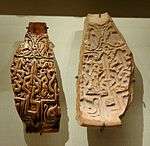
- A hollow form or matrix for shaping a fluid or plastic substance.
- A frame or model around or on which something is formed or shaped.
- Something that is made in or shaped on a mold.
- The shape or pattern of a mold.
- General shape or form.
- the oval mold of her face
- 1871, Alexander Pope (1688-1744), The Works of Alexander Pope: New Ed. Including Several Hundred Unpublished Letters, and Other New Materials, Collected in Part by John Wilson Croker. With Introd. and Notes by Whitwell Elwin, Volume 1, J.Murray, p.206
- Crowned with an architrave of antique mould.
- 1915, Emerson Hough, The Purchase Price, chapterI:
- This new-comer was a man who in any company would have seemed striking. […] Indeed, all his features were in large mold, like the man himself, as though he had come from a day when skin garments made the proper garb of men.
- Distinctive character or type.
- a leader in the mold of her predecessors
- A fixed or restrictive pattern or form.
- His method of scientific investigation broke the mold and led to a new discovery.
- (architecture) A group of moldings.
- the arch mold of a porch or doorway; the pier mold of a Gothic pier, meaning the whole profile, section, or combination of parts
- (anatomy) A fontanelle.
Derived terms
- break the mold
- (archaeology): post mold
- (paleontology): fossil mold
Translations
|
|
- The translations below need to be checked and inserted above into the appropriate translation tables, removing any numbers. Numbers do not necessarily match those in definitions. See instructions at Wiktionary:Entry layout#Translations.
Verb
mold (third-person singular simple present molds, present participle molding, simple past and past participle molded)
- (transitive) To shape in or on a mold.
- (transitive) To form into a particular shape; to give shape to.
- Job 10:8-9, Old Testament, New International Version:
- Your hands shaped me and made me....Remember that you molded me like clay.
- Job 10:8-9, Old Testament, New International Version:
- (transitive) To guide or determine the growth or development of; influence
- 1963. Haile Selassie (translated)
- It is you who must mold the minds of your students that they may be wise, farsighted, intelligent, profound in their thinking, devoted to their country and government and fruitful in their work. It is you who must sense as the example.
- 1963. Haile Selassie (translated)
- (transitive) To fit closely by following the contours of.
- (transitive) To make a mold of or from (molten metal, for example) before casting.
- (transitive) To ornament with moldings.
- (intransitive) To be shaped in or as if in a mold.
- These shoes gradually molded to my feet.
Translations
|
Etymology 2
From Middle English mowlde, noun use and alteration of mowled, past participle of moulen, mawlen (“to grow moldy”), from Old Norse mygla (compare dialectal Danish mugle), from Proto-Germanic *muglōną, diminutive and denominative of *mukiz 'soft substance' (compare Old Norse myki, mykr (“cow dung”)), from Proto-Indo-European *meuk- 'slick, soft'. More at muck and meek.
Noun
mold (countable and uncountable, plural molds)
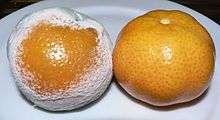
- A natural substance in the form of a woolly or furry growth of tiny fungi that appears when organic material lies for a long time exposed to (usually warm and moist) air.
Derived terms
Translations
|
|
See also
Verb
mold (third-person singular simple present molds, present participle molding, simple past and past participle molded)
- (transitive) To cause to become moldy; to cause mold to grow upon.
- (intransitive) To become moldy; to be covered or filled, in whole or in part, with a mold.
Etymology 3
From Old English molde, from Proto-Germanic *muldō ‘dirt, soil’ (compare Old Frisian molde, Middle Dutch moude, Dutch moude, obsolete German Molte, Norwegian mold), from Proto-Indo-European *ml̥-tā (compare Old Irish moll ‘bran’, Lithuanian mìltai ‘flour’), from *mel- (compare English meal). More at meal.
Noun
mold (plural molds)
- Loose friable soil, rich in humus and fit for planting.
- (Britain, dialectal, chiefly plural) Earth, ground.
Alternative forms
Derived terms
Translations
Verb
mold (third-person singular simple present molds, present participle molding, simple past and past participle molded)
- To cover with mold or soil.
Anagrams
Faroese
Etymology
From Old Norse mold, from Proto-Germanic *muldō ‘dirt, soil’, from Proto-Indo-European *ml̥-tā, from *mel-.
Pronunciation
- IPA(key): [mɔlt]
Noun
mold f (genitive singular moldar, uncountable)
- (agriculture) earth, humus soil, humus layer
Declension
| Declension of mold (singular only) | ||
|---|---|---|
| f2s | singular | |
| indefinite | definite | |
| nominative | mold | moldin |
| accusative | mold | moldina |
| dative | mold | moldini |
| genitive | moldar | moldarinnar |
Icelandic
Etymology
From Old Norse mold, from Proto-Germanic *muldō (“dirt, soil”).
Pronunciation
- IPA(key): /mɔlt/
- Rhymes: -ɔlt
Noun
mold f (genitive singular moldar, nominative plural moldir)
Declension
Old Norse
Etymology
From Proto-Germanic *muldō (“dirt, soil”). Cognate with Old English molde (English mold), Old High German molta, Gothic 𐌼𐌿𐌻𐌳𐌰 (mulda).
Pronunciation
- (12th century Icelandic) IPA(key): /mold/
Noun
mold f (genitive moldar, plural moldir)
- earth, dirt, soil
- Vǫluspá, stanza 3, lines 7–8:
- mjǫtvið mœran
- fyr mold neðan.
- the great tree
- beneath the ground.
- Vǫluspá, stanza 3, lines 7–8:
Declension
Descendants
References
- mold in Geir T. Zoëga (1910) A Concise Dictionary of Old Icelandic, Oxford: Clarendon Press