God
English
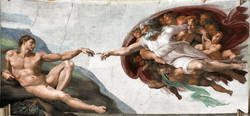
Etymology
From Middle English God. See god.
Pronunciation
Noun
God (plural Gods)
- An impersonal and universal spiritual presence or force.
- creator of the universe (as in deism).
- The (personification of the) laws of nature.
Translations
|
|
|
Proper noun
God (usually uncountable, plural Gods)
- The single deity of various monotheistic religions.
- Dawn believes in God, but Willow believes in multiple gods and goddesses.
- The single male deity of various bitheistic or duotheistic religions.
- 2001, Timothy Freke and Peter Gandy, Jesus and the Lost Goddess, page 133:
- The ancients represented this fundamental duality mythologically as God and Goddess. When Mystery looks at itself, God looks at Goddess.
- 2005, Nikki Bado-Fralick, Coming to the Edge of the Circle, page 45:
- This reduces the successful invocation of God to a function of the presence of male genitalia. Put another way, women have the wrong equipment to invoke God.
- Goddess and God flow throughout all of nature, through each and every man and woman, becoming fully present in the world.
- 2006, Ronald L. Clark, The Grace of Being, page 22:
- God and Goddess watched as the finite universe continued to develop into a stable platform to sustain finite life and were pleased.
- 2001, Timothy Freke and Peter Gandy, Jesus and the Lost Goddess, page 133:
Usage notes
God is often referred to by masculine pronouns, not necessarily implying that the speaker believes God to be male. God is also sometimes referred to by pronouns that begin with a capital letter, as a sign of respect, in many languages written in Latin script. In English, these include He, Him, His and Himself. The use of standard, uncapitalized pronouns is at least equally frequent and is the norm among English Bible translations (including the King James Version).[1] Many Jews follow a prohibition in their tradition against using this term and other equivalents in writing (see G-d).
When describing the Abrahamic deity, the word "God" is capitalized almost without exception, even when preceded by various qualifiers.[2] The term is frequently, but not always, capitalized in more vague, deistic references to a single deity.
English references to God in an Islamic context may use the word "God" or the Arabic "Allah." Though the latter is simply the word for "God" in Arabic, it is often treated as a personal name in English, and is used in English only with reference to Islam.
Synonyms
- The terms below need to be checked and allocated to the definitions (senses) of the headword above. Each term should appear in the sense for which it is appropriate. Use the templates
{{syn|en|...}}or{{ant|en|...}}to add them to the appropriate sense(s).
Derived terms
Translations
|
|
|
|
- The translations below need to be checked and inserted above into the appropriate translation tables, removing any numbers. Numbers do not necessarily match those in definitions. See instructions at Wiktionary:Entry layout#Translations.
|
|
Interjection
God
- An expression of frustration.
- God, is this because of the "I don't love you anymore" T-shirt I bought? It always goes back to that, doesn't it?
-
See also
References
Anagrams
Afrikaans
Etymology
Pronunciation
- IPA(key): /xɔt/
Proper noun
God
Dutch
Etymology
See god.
Pronunciation
- Rhymes: -ɔt
- IPA(key): /ɣɔt/
-
audio (Belgium) (file) -
audio (Netherlands) (file)
Proper noun
God m
Derived terms
See also
Middle English
Etymology
From Old English God, see Old English god.
Proper noun
God (uncountable)
- God (the deity of Abrahamic religions)
References
- God in The Century Dictionary, The Century Co., New York, 1911
- “God, n.(1)” in MED Online, Ann Arbor, Mich.: University of Michigan, 2007, retrieved 2015-03-23.
Saterland Frisian
Etymology
From Old Frisian god, from Proto-Germanic *gudą. More at god.
Noun
God m
Derived terms
- goddelk
Tok Pisin
Etymology
Pronunciation
- IPA(key): /ɡod/
Proper noun
God
- God (Abrahamic monotheistic deity)
- 1989, Buk Baibel long Tok Pisin, Bible Society of Papua New Guinea, Genesis 1:2 (translation here):
- Tudak i karamapim bikpela wara na spirit bilong God i go i kam antap long en.
- 1989, Buk Baibel long Tok Pisin, Bible Society of Papua New Guinea, Genesis 1:2 (translation here):
West Frisian
Etymology
See god.
Proper noun
God