aper
English
Etymology
Noun
aper (plural apers)
- Someone who apes something
- 1908, Rupert Sargent Holland, Builders of United Italy, page 175:
- Valerio ridiculed the proposal to his friends and called Cavour an aper of English customs.
-
Synonyms
Translations
someone who apes something — see imitator
Anagrams
Latin
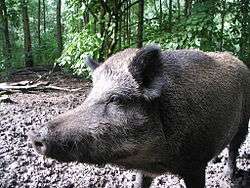
aper (a wild boar)
Etymology
From Proto-Italic *apros, from Proto-Indo-European *h₁ep-r-. Cognate with Proto-Germanic *eburaz (whence German Eber), Proto-Slavic *veprь (whence Serbo-Croatian vepar).
Pronunciation
- (Classical) IPA(key): /ˈa.per/, [ˈa.pɛr]
Noun
aper m (genitive aprī); second declension
Inflection
Second declension, nominative singular in -er.
| Case | Singular | Plural |
|---|---|---|
| nominative | aper | aprī |
| genitive | aprī | aprōrum |
| dative | aprō | aprīs |
| accusative | aprum | aprōs |
| ablative | aprō | aprīs |
| vocative | aper1 | aprī |
1May also be apre.
Derived terms
- aprārius
- aprīnus
- aprūgnus
Related terms
Descendants
- Sardinian: apru
References
- aper in Charlton T. Lewis and Charles Short (1879) A Latin Dictionary, Oxford: Clarendon Press
- aper in Charlton T. Lewis (1891) An Elementary Latin Dictionary, New York: Harper & Brothers
- aper in Gaffiot, Félix (1934) Dictionnaire Illustré Latin-Français, Hachette
- aper in Harry Thurston Peck, editor (1898) Harper's Dictionary of Classical Antiquities, New York: Harper & Brothers
- aper in William Smith, editor (1848) A Dictionary of Greek Biography and Mythology, London: John Murray
Norwegian Bokmål
Noun
aper m, f
- indefinite plural of ape
Verb
aper
- present tense of ape
Norwegian Nynorsk
Alternative forms
Noun
aper m, f
- indefinite feminine plural of ape
This article is issued from
Wiktionary.
The text is licensed under Creative Commons - Attribution - Sharealike.
Additional terms may apply for the media files.