天神
Chinese
| day; sky; heaven | God; unusual; mysterious; soul; spirit; divine essence; lively; spiritual being | ||
|---|---|---|---|
| simp. and trad. (天神) |
天 | 神 | |
Pronunciation
Noun
天神
Japanese
| Kanji in this term | |
|---|---|
| 天 | 神 |
| てん Grade: 1 |
じん Grade: 3 |
| on’yomi | |
Etymology 1
From Sinitic 天神. Date of borrowing unknown. Compare modern Mandarin 天神 (“god, godhead, divinity”).
Pronunciation
Usage notes
Less commonly read using the kan'on reading tenshin: [tẽ̞ɲ̟ɕĩɴ][2][3]
Noun
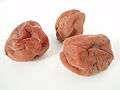
天神: an umeboshi

天神: the hairstyle
天神 (hiragana てんじん, rōmaji Tenjin)
- (mythology, Shinto): the Japanese gods of the heavens
- a noble wearing ordinary robes (robes not dyed to match the wearer's rank)
- an umeboshi (from the way that Sugawara no Michizane (see Proper noun below) was very fond of ume)
- an umeboshi pit
- short for 天神髷 (tenjin mage) or 天神結び (tenjin musubi), a certain kind of bow-shaped topknot or bun hairstyle worn by women, popular in the late 1800s
Synonyms
- (gods): 天つ神 (あまつかみ, ama tsu kami)
- (umeboshi): 梅干し (うめぼし, umeboshi)
- (hairstyle): 天神髷 (てんじんまげ, tenjin mage)
- (hairstyle): 天神結び (てんじんむすび, tenjin musubi)
Derived terms
Further reading
-

-
-
-
Proper noun
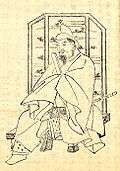
天神: Sugawara no Michizane
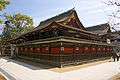
天神: Tenjin-san, the Tenman-gū shrine to Sugawara no Michizane in Kitano

天神: Tenjin Station in downtown Fukuoka
天神 (hiragana てんじん, rōmaji Tenjin)
- the Shinto kami of scholarship, the deification of Sugawara no Michizane (845-903 CE), a scholar, poet, and politician
- a shrine dedicated to Sugawara no Michizane
- one of the traditional Noh masks, depicting one of the 鬼神 (onigami; kijin, “fierce gods”) as the vengeful spirit of Sugawara no Michizane, the lead role in the 雷電 (Raiden) piece
- an area in downtown Fukuoka
Synonyms
- (shrine): 天満宮 (てんまんぐう, Tenman-gū)
Derived terms
Derived terms
- 天神ぞ (てんじんぞ, Tenjin zo): (archaic) for sure, for certain, absolutely, definitely
- 天神講 (てんじんこう, Tenjin Kō): a matsuri celebrating Sugawara no Michizane, held on the date of his death, 25 February (or on the 25th of every month)
- 天神祭 (てんじんまつり, Tenjin Matsuri): a matsuri celebrating Sugawara no Michizane, held on the date of his death, 25 February (or on the 25th of every month)
- 天神橋 (てんじんばし, Tenjin-bashi): a bridge over the Yodo River in Ōsaka
- 天神髭 (てんじんひげ, Tenjin hige): a beard of the style shown in depictions of Sugawara no Michizane
- 天神山 (てんじんやま, Tenjin Yama): the name of various mountains and other places around Japan
- 天神山古墳 (てんじんやまこふん, Tenjin Yama Kofun): a late-fourth-century kofun tomb in Gunma prefecture
Further reading
-
-
-
-
-
-
Etymology 2
Phrase consisting of 天 (ama, “the heavens”) + つ (tsu, Old Japanese possessive particle) + 神 (kami, “god, gods”).[2][3]
More commonly written with the tsu explicitly spelled out in hiragana, as 天つ神.
Pronunciation
Alternative forms
- 天つ神, 天津神
Noun
天神 (hiragana あまつかみ, rōmaji ama tsu kami)
- (mythology, Shinto): the Japanese gods of the heavens
Coordinate terms
Further reading
-
-
References
This article is issued from
Wiktionary.
The text is licensed under Creative Commons - Attribution - Sharealike.
Additional terms may apply for the media files.