See also:
U+947F, 鑿
CJK UNIFIED IDEOGRAPH-947F

[U+947E]
CJK Unified Ideographs
[U+9480]

Translingual

Han character

(radical 167, +19, 27 strokes, cangjie input 廿水金 (TEC), four-corner 37109, composition𣫞)

References

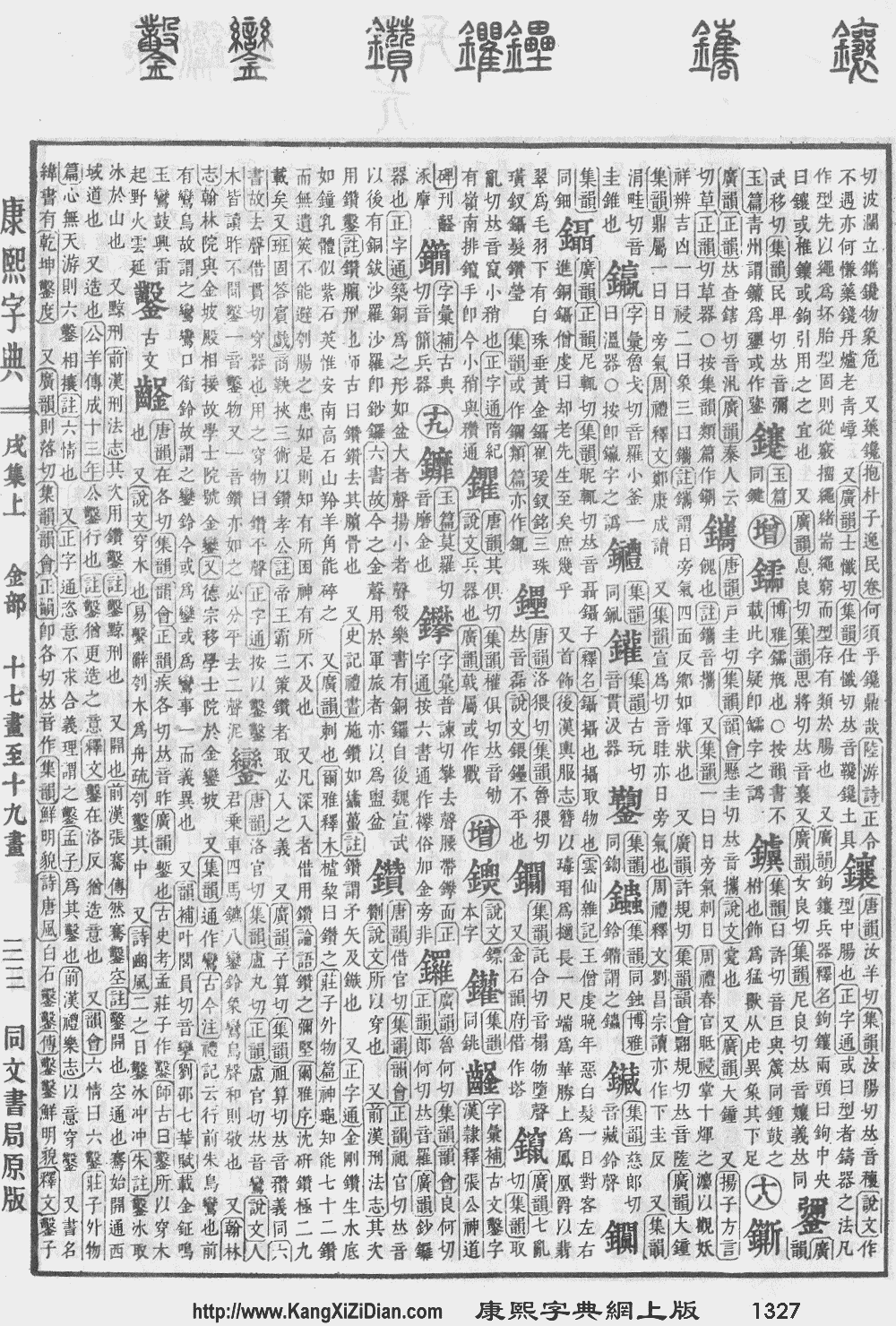
  • KangXi: page 1327, character 29
  • Dai Kanwa Jiten: character 41088
  • Dae Jaweon: page 1829, character 4
  • Hanyu Da Zidian: volume 6, page 4277, character 7
  • Unihan data for U+947F

Chinese

trad.
simp.

Glyph origin

Characters in the same phonetic series () (Zhengzhang, 2003) 
Old Chinese
*ʔsoːwɢ, *zoːwɢ, *zoːwɢ, *zoːwɢ
*ʔsoːwɢ

Phono-semantic compound (形聲, OC *ʔsoːwɢ, *zoːwɢ, *zoːwɢ, *zoːwɢ) : semantic  (metal) + phonetic 𥽿.

Pronunciation 1


Note: cho̍k - literary, chha̍k - vernacular.

Rime
Character
Reading # 3/3
Initial () (15)
Final () (103)
Tone (調) Checked (Ø)
Openness (開合) Open
Division () I
Fanqie
Reconstructions
Zhengzhang
Shangfang
/d͡zɑk̚/
Pan
Wuyun
/d͡zɑk̚/
Shao
Rongfen
/d͡zɑk̚/
Edwin
Pulleyblank
/d͡zak̚/
Li
Rong
/d͡zɑk̚/
Wang
Li
/d͡zɑk̚/
Bernard
Karlgren
/d͡zʱɑk̚/
Expected
Mandarin
Reflex
zuó
BaxterSagart system 1.1 (2014)
Character
Reading # 1/2 2/2
Modern
Beijing
(Pinyin)
záo záo
Middle
Chinese
‹ dzak › ‹ dzowk ›
Old
Chinese
/*[dz]ˤawk/ /*[dz]ˤawk/
English chisel chisel

Notes for Old Chinese notations in the Baxter–Sagart system:

* Parentheses "()" indicate uncertain presence;
* Square brackets "[]" indicate uncertain identity, e.g. *[t] as coda may in fact be *-t or *-p;
* Angle brackets "<>" indicate infix;
* Hyphen "-" indicates morpheme boundary;

* Period "." indicates syllable boundary.

Definitions

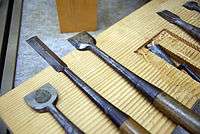
  1. chisel
  2. tool to tattoo (as a punishment)
  3. to tattoo criminals on the face or forehead
  4. to bore, to pierce
  5. to dig
  6. to break ground
  7. to interpret (in a strained manner)​
  8. to change
  9. orifice, aperture
  10. feeling, emotion
  11. to beat

Compounds

  • 天真未鑿天真未凿
  • 妄生穿鑿妄生穿凿
  • 斧鑿斧凿
  • 斧鑿痕斧凿痕
  • 架謊鑿空架谎凿空
  • 栗鑿栗凿
  • 穿鑿穿凿
  • 穿鑿附會穿凿附会
  • 腦鑿子脑凿子
  • 鋼鑿钢凿
  • 鑿井凿井 (záojǐng)
  • 鑿坏凿坏
  • 鑿壁偷光凿壁偷光
  • 鑿壁懸梁凿壁悬梁
  • 鑿子凿子 (záozi)
  • 鑿山破石凿山破石
  • 鑿渾沌凿浑沌
  • 鑿空凿空
  • 鑿空指鹿凿空指鹿
  • 鑿竅凿窍
  • 鑿船蟲凿船虫
  • 鑿飲耕食凿饮耕食
  • 開鑿开凿
  • 顏闔鑿培颜阖凿培

Pronunciation 2


Definitions

  1. hole, mortise
  2. tunnel

Compounds

  • 圓鑿方枘圆凿方枘
  • 圜鑿方枘圜凿方枘
  • 方枘圜鑿方枘圜凿
  • 方鑿圓枘方凿圆枘
  • 枘圓鑿方枘圆凿方
  • 枘鑿枘凿
  • 鑿圓枘方凿圆枘方
  • 鑿枘凿枘
  • 鑿枘不入凿枘不入

Pronunciation 3


Rime
Character
Reading # 2/3
Initial () (13)
Final () (103)
Tone (調) Checked (Ø)
Openness (開合) Open
Division () I
Fanqie
Reconstructions
Zhengzhang
Shangfang
/t͡sɑk̚/
Pan
Wuyun
/t͡sɑk̚/
Shao
Rongfen
/t͡sɑk̚/
Edwin
Pulleyblank
/t͡sak̚/
Li
Rong
/t͡sɑk̚/
Wang
Li
/t͡sɑk̚/
Bernard
Karlgren
/t͡sɑk̚/
Expected
Mandarin
Reflex
zuo

Definitions

  1. real
  2. to polish (rice)
  3. polished rice
  4. Only used in 鑿鑿凿凿.

Compounds

  • 人言鑿鑿人言凿凿
  • 炳炳鑿鑿炳炳凿凿
  • 鑿鑿凿凿
  • 鑿鑿有據凿凿有据

Pronunciation 4


Rime
Character
Reading # 1/3
Initial () (15)
Final () (3)
Tone (調) Checked (Ø)
Openness (開合) Open
Division () I
Fanqie
Reconstructions
Zhengzhang
Shangfang
/d͡zuk̚/
Pan
Wuyun
/d͡zuk̚/
Shao
Rongfen
/d͡zuk̚/
Edwin
Pulleyblank
/d͡zəwk̚/
Li
Rong
/d͡zuk̚/
Wang
Li
/d͡zuk̚/
Bernard
Karlgren
/d͡zʱuk̚/
Expected
Mandarin
Reflex
Zhengzhang system (2003)
Character
Reading # 4/4
No. 18074
Phonetic
component
Rime
group
Rime
subdivision
0
Corresponding
MC rime
Old
Chinese
/*zoːwɢ/

Definitions

  1. to carve
  2. Alternative form of (, “arrow”).

Japanese

Kanji

(uncommon “Hyōgai” kanji)

Readings

Etymology

Kanji in this term
のみ
Hyōgaiji
kun’yomi

Noun

(hiragana のみ, rōmaji nomi)

  1. chisel

Korean

Hanja

(chak, jo) (hangeul 착, , revised chak, jo, McCuneReischauer ch'ak, cho, Yale chak, co)

  1. This term needs a translation to English. Please help out and add a translation, then remove the text {{rfdef}}.

Vietnamese

Han character

(tạc, toạc)

  1. This term needs a translation to English. Please help out and add a translation, then remove the text {{rfdef}}.
This article is issued from Wiktionary. The text is licensed under Creative Commons - Attribution - Sharealike. Additional terms may apply for the media files.