sling
English
Etymology 1
Probably from Old Norse slyngja, slyngva (“to hurl”), from Proto-Germanic *slingwaną (“to worm, twist”) or compare Old English slingan (“to wind, twist”), from the same source. Compare German schlingen (“to swing, wind, twist”), Danish and Norwegian slynge), from Proto-Indo-European *slenk (“to turn, twist”) (compare Welsh llyngyr (“worms, maggots”), Lithuanian sliñkti (“to crawl like a snake”), Latvian slìkt (“to sink”)).
Pronunciation
- IPA(key): /ˈslɪŋ/
- Rhymes: -ɪŋ
Verb
sling (third-person singular simple present slings, present participle slinging, simple past slung or slang, past participle slung)
- To throw with a circular or arcing motion.
- (Can we find and add a quotation of Addison to this entry?)
- To throw with a sling.
- Bible, Judges xx. 16
- Everyone could sling stones at an hairbreadth, and not miss.
- Bible, Judges xx. 16
- (nautical) To pass a rope around (a cask, gun, etc.) preparatory to attaching a hoisting or lowering tackle.
- (slang) To sell drugs.
- 2008, Breaking Bad, Season 1, Episode 6:
- You may know a lot about chemistry man but you don't know jack about slinging dope.
- 2008, Breaking Bad, Season 1, Episode 6:
Derived terms
Translations
to throw
Noun
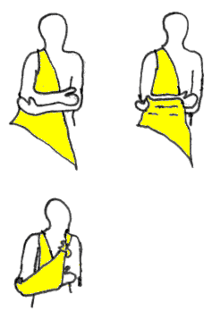
A diagram of how to put on a sling (sense 2)
sling (plural slings)
- (weapon) An instrument for throwing stones or other missiles, consisting of a short strap with two strings fastened to its ends, or with a string fastened to one end and a light stick to the other.
- 1786, Francis Grose, A Treatise on Ancient Armour and Weapons, page 43:
- The Sling is also a weapon of great antiquity, formerly in high estimation among the ancients.
-
- A kind of hanging bandage put around the neck, in which a wounded arm or hand is supported.
- A loop of cloth, worn around the neck, for supporting a baby or other such load.
- A loop of rope, or a rope or chain with hooks, for suspending a barrel, bale, or other heavy object, in hoisting or lowering.
- A strap attached to a firearm, for suspending it from the shoulder.
- (nautical, chiefly in the plural) A band of rope or iron for securing a yard to a mast.
- The act or motion of hurling as with a sling; a throw; figuratively, a stroke.
- Milton
- At one sling / Of thy victorious arm, well-pleasing Son.
- 1600, William Shakespeare, Hamlet, Act III, Scene I, line 55:
- To be, or not to be, that is the question: Whether 'tis nobler in the mind to suffer The slings and arrows of outrageous fortune, Or to take arms against a sea of troubles, And by opposing, end them.
- Milton
- (climbing) A loop of rope or fabric tape used for various purposes: e.g. as part of a runner, or providing extra protection when abseiling or belaying.
- A drink composed of a spirit (usually gin) and water sweetened.
- gin sling
- a Singapore sling
Derived terms
Translations
instrument for throwing
|
|
bandage
a loop of cloth or a strap around the neck to carry a load
|
rope or chain arrangement
strap attached to a firearm
rope or iron securing a yard to a mast
|
the act of hurling as with a sling
- The translations below need to be checked and inserted above into the appropriate translation tables, removing any numbers. Numbers do not necessarily match those in definitions. See instructions at Wiktionary:Entry layout#Translations.
Translations to be checked
Etymology 2
From a shortening of spiderling.
Noun
sling (plural slings)
- A young or infant spider, such as one raised in captivity.
Further reading

Anagrams
This article is issued from
Wiktionary.
The text is licensed under Creative Commons - Attribution - Sharealike.
Additional terms may apply for the media files.