Etymology 1
From Middle English marchen, from Middle French marcher (“to march, walk”), from Old French marchier (“to stride, to march, to trample”), from Frankish *markōn (“to mark, mark out, to press with the foot”), from Proto-Germanic *markō (“area, region, edge, rim, border”), akin to Persian مرز (marz), from Proto-Indo-European *mereg- (“edge, boundary”). Akin to Old English mearc, ġemearc (“mark, boundary”).
Noun
march (plural marches)
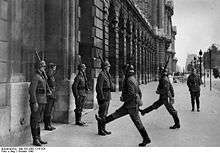
German Wehrmacht soldiers performing the Stechschritt (Goose-step), October 1940.
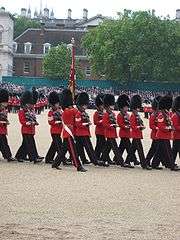
British soldiers of the Queen’s guard marching
- A formal, rhythmic way of walking, used especially by soldiers, bands and in ceremonies.
- A political rally or parade
- Synonyms: protest, parade, rally
- Any song in the genre of music written for marching (see Wikipedia's article on this type of music)
- Steady forward movement or progression.
the march of time
- Synonyms: process, advancement, progression
- (euchre) The feat of taking all the tricks of a hand.
Derived terms
Terms derived from march (noun)
Translations
political rally or parade
song in the genre of music written for marching
steady forward movement or progression
- The translations below need to be checked and inserted above into the appropriate translation tables, removing any numbers. Numbers do not necessarily match those in definitions. See instructions at Wiktionary:Entry layout#Translations.
Translations to be checked
- Breton: (please verify) kan-bale m, (please verify) kanoù-bale pl
- Bulgarian: (please verify) марш m (marš), (please verify) маршируване n (marširuvane)
- Neapolitan: (please verify) ammarcia f
|
|
- Old English: (please verify) faru (1)
- Sanskrit: (please verify) पदयात्रा (padayātrā)
|
Verb
march (third-person singular simple present marches, present participle marching, simple past and past participle marched)
- (intransitive) To walk with long, regular strides, as a soldier does.
- (transitive) To cause someone to walk somewhere.
-
1967, Sleigh, Barbara, Jessamy, 1993 edition, Sevenoaks, Kent: Bloomsbury, →ISBN, page 84:- The old man heaved himself from the chair, seized Jessamy by her pinafore frill and marched her to the house.
- To go to war; to make military advances.
Derived terms
Terms derived from march (verb)
Translations
walk with long, regular strides
go to war; make military advances
- The translations below need to be checked and inserted above into the appropriate translation tables, removing any numbers. Numbers do not necessarily match those in definitions. See instructions at Wiktionary:Entry layout#Translations.
Translations to be checked
- Breton: (1) (please verify) bale, (2) (please verify) bale war
- Bulgarian: (please verify) марширувам (marširuvam)
- Catalan: (please verify) marxar
- Hebrew: (please verify) צעד (tsa'ád)
|
|
- Lithuanian: (1,2) (please verify) žygiuoti, (1) (please verify) maršuoti
- Romanian: (please verify) marșa
- Tagalog: (please verify) martsa
|