camp
English
Etymology 1
From Middle English camp (“battlefield, open space”), from Old English camp (“battle, contest, battlefield, open space”), from Proto-Germanic *kampaz, *kampą (“open field where military exercises are held, level plain”), from Latin campus (“open field, level plain”), from Proto-Indo-European *kamp- (“to bend; crooked”). Reinforced circa 1520 by Middle French can, camp (“place where an army lodges temporarily”), from Old Northern French camp, from the same Latin (whence also French champ from Old French). Cognate with Old High German champf (“battle, struggle”) (German Kampf), Old Norse kapp (“battle”), Old High German hamf (“paralysed, maimed, mutilated”).
The verb is from Middle English campen, from Old English campian, compian (“to fight, war against”), from Proto-Germanic *kampōną (“to fight, do battle”), from *kampaz (“field, battlefield, battle”), see above. Cognate with Dutch kampen, German kämpfen (“to struggle”), Danish kæmpe, Swedish kämpa.
Pronunciation
- IPA(key): /kæmp/
-
Audio (US) (file) - Rhymes: -æmp
Noun
camp (plural camps)
- (archaic) Conflict; battle.
- An outdoor place acting as temporary accommodation in tents or other temporary structures.
- An organised event, often taking place in tents or temporary accommodation.
- A base of a military group, not necessarily temporary.
- A single hut or shelter.
- a hunter's camp
- The company or body of persons encamped.
- Macaulay
- The camp broke up with the confusion of a flight.
- Macaulay
- A group of people with the same strong ideals or political leanings.
- (uncommon) Campus
- (informal) A summer camp.
- (agriculture) A mound of earth in which potatoes and other vegetables are stored for protection against frost; called also burrow and pie.
- (Britain, obsolete) An ancient game of football, played in some parts of England.
- (Can we find and add a quotation of Halliwell to this entry?)
Derived terms
|
|
|
Related terms
Translations
|
|
|
- The translations below need to be checked and inserted above into the appropriate translation tables, removing any numbers. Numbers do not necessarily match those in definitions. See instructions at Wiktionary:Entry layout#Translations.
Verb
camp (third-person singular simple present camps, present participle camping, simple past and past participle camped)
- (intransitive, now chiefly dialectal) To fight; contend in battle or in any kind of contest; to strive with others in doing anything; compete.
- (intransitive, now chiefly dialectal) To wrangle; argue.
- To live in a tent or similar temporary accommodation.
- We're planning to camp in the field until Sunday.
- To set up a camp.
- (transitive) To afford rest or lodging for.
- Shakespeare
- Had our great palace the capacity / To camp this host, we all would sup together.
- Shakespeare
- (video games) To stay in an advantageous location in a video game, such as next to a power-up's spawning point or in order to guard an area.
- The easiest way to win on this map is to camp the double damage.
- Go and camp the flag for the win.
Derived terms
Translations
|
|
- The translations below need to be checked and inserted above into the appropriate translation tables, removing any numbers. Numbers do not necessarily match those in definitions. See instructions at Wiktionary:Entry layout#Translations.
|
Etymology 2
Unknown. Suggested origins include the 17th century French word camper (“to put oneself in a pose”),[1] an assumed dialectal English word *camp or *kemp (“rough, uncouth”) and a derivation from camp (n.)[2] Believed to be from Polari, otherwise obscure.[3]
Noun
camp (uncountable)
- An affected, exaggerated or intentionally tasteless style.
Translations
Adjective
camp (comparative camper, superlative campest)
- Theatrical; making exaggerated gestures.
- (of a man) Ostentatiously effeminate.
- 2014, Sarah Lotz, The Three, Hachette UK →ISBN
- And to be honest, in the illustration Mr Tumnus does look as camp as fuck with his little scarf tied jauntily around his neck. I suppose it isn't outside the realms of possibility that he'd just been off cottaging with some centaurs in the forest. God.
- 2007, David Rothwell, Dictionary of Homonyms, Wordsworth Editions →ISBN, page 88
- More recently the word has become colloquial English for either implying that someone is a homosexual ('he's very camp'), or for describing rather outre behaviour...
- 2014, Sarah Lotz, The Three, Hachette UK →ISBN
- Intentionally tasteless or vulgar, self-parodying.
- 2002, Georges-Claude Guilbert, Madonna as Postmodern Myth: How One Star's Self-Construction Rewrites Sex, Gender, Hollywood and the American Dream, McFarland →ISBN, page 123
- In Saturday Night Live, Madonna also unsurprisingly played Princess Diana, Marilyn Monroe, and a Joan Collins clone, all in a very camp way. As John Dean writes: “U.S. rock has a ruling camp queen with Madonna.”...
- 2002, Georges-Claude Guilbert, Madonna as Postmodern Myth: How One Star's Self-Construction Rewrites Sex, Gender, Hollywood and the American Dream, McFarland →ISBN, page 123
Translations
Derived terms
References
- ↑ Douglas Harper, "camp (adj.)" in: Etymonline.com - Online Etymology Dictionary, 2001ff
- ↑ Micheal Quinion, "Camp" in: World Wide Words, 2003
- ↑ listed in the Oxford English Dictionary, second edition (1989)
Anagrams
Catalan
Etymology
From Old Occitan camp (compare Occitan camp), from Latin campus (compare French champ, Spanish campo), from Proto-Indo-European *kh₂emp- (“to bend, curve”).
Noun
camp m (plural camps)
- field (open area of land)
- camp (temporary outdoor accommodation)
- field of study, discipline
- (physics) field
Synonyms
- (open area): terreny
- (camp): campament
- (discipline): disciplina
Derived terms
Related terms
French
Etymology 1
Probably from a Norman or Picard word equivalent to French champ (itself inherited from Old French champ and Latin), from Old Northern French camp, from Latin campus, or alternatively from Occitan camp, Old Occitan camp, possibly Italian campo.
Pronunciation
- IPA(key): /kɑ̃/
Noun
camp m (plural camps)
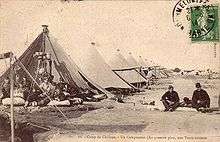
- camp (An outdoor place acting as temporary accommodation in tents or other temporary structures.)
- Il a dressé son camp de l'autre côté de la rivière.
- (please add an English translation of this usage example)
-
- camp (Semi-temporary accommodation)
- Un camp de concentration.
- (please add an English translation of this usage example)
-
- camp (A base of a military group, not necessarily temporary)
- Les camps ennemis.
- (please add an English translation of this usage example)
-
- camp (A group of people with the same ideals or political leanings, strongly supported.)
- Ce pays est partagé en deux camps.
- (please add an English translation of this usage example)
-
- camp, summer camp.
- Un camp de vacances.
- (please add an English translation of this usage example)
-
Derived terms
- camp volant
- foutre le camp, ficher le camp
Related terms
Etymology 2
Pronunciation
- IPA(key): /kɑ̃p/, /kamp/
Adjective
camp (invariable)
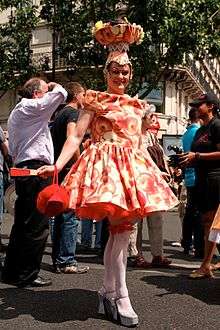
- camp (Intentionally tasteless or vulgar, self-parodying, affected, exaggerated)
- Une folle camp ne peut jamais en faire trop.
Noun
camp m (uncountable)
- campness; An affected, exaggerated or intentionally tasteless style.
- La tactique des Sœurs dans la lutte contre le sida repose sur une stratégie politique : une utilisation du camp, une réappropriation revendiquée de l’efféminement, de la visibilité homosexuelle et de la follitude qui visent à désarmer les injonctions morales pesant sur la sexualité – sociales, religieuses, liées au sexe, au genre, aux pratiques sexuelles…
Synonyms
- follitude
Further reading
- “camp” in le Trésor de la langue française informatisé (The Digitized Treasury of the French Language).
Norman
Alternative forms
Etymology
From Old Northern French camp (compare Old French champ), from Latin campus, from Proto-Indo-European *kamp- (“to bend; crooked”). Compare French champ.
Noun
camp m (plural camps)
Old English
Etymology
Noun
camp ?
Noun
camp n
- an enclosed piece of land
Old French
Etymology
Found in Old Northern French, Picard and Norman dialects, etc. From Latin campus.
Noun
camp m (oblique plural cans, nominative singular cans, nominative plural camp)