tabor
English
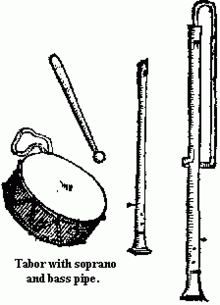
illustration by Praetorius
Pronunciation
- Rhymes: -eɪbə(r)
Etymology 1
From Old French tabour.
Noun
tabor (plural tabors)
- A small drum.
- In traditional music, a small drum played with a single stick, leaving the player's other hand free to play a melody on a three-holed pipe.
Derived terms
Translations
Verb
tabor (third-person singular simple present tabors, present participle taboring, simple past and past participle tabored)
- (transitive) To make (a sound) with a tabor.
- To strike lightly and frequently.
Etymology 2
From various Slavic languages, from a Turkic language. Compare Ottoman Turkish طابور (tabur).
Noun
tabor (plural tabors)
- A military train of men and wagons; an encampment of such resources.
- 2011, Norman Davies, Vanished Kingdoms, Penguin 2012, p. 269:
- A Polish-Lithuanian tabor besieged by twenty or thirty thousand Tartars must have closely resembled the overland wagon trains of American pioneers attacked by the Sioux or the Cherokee.
- 2011, Norman Davies, Vanished Kingdoms, Penguin 2012, p. 269:
Anagrams
Old French
Noun
tabor m (oblique plural tabors, nominative singular tabors, nominative plural tabor)
- tambour (drum)
Polish
Etymology
From a Turkic language. Compare Ottoman Turkish طابور (tabur).
Pronunciation
- IPA(key): /ˈta.bɔr/
Noun
tabor m inan
- (singular only) vehicle fleet
- (singular only) rolling stock
- (historical) nomadic group of Gypsies
- (historical) wagon fort
Declension
Derived terms
Serbo-Croatian
Etymology
From Hungarian tábor, from Ottoman Turkish طابور (tabur).
Noun
tȃbor m (Cyrillic spelling та̑бор)
Declension
Declension of tabor
| singular | plural | |
|---|---|---|
| nominative | tabor | tabori |
| genitive | tabora | tabora |
| dative | taboru | taborima |
| accusative | tabor | tabore |
| vocative | tabore | tabori |
| locative | taboru | taborima |
| instrumental | taborom | taborima |
This article is issued from
Wiktionary.
The text is licensed under Creative Commons - Attribution - Sharealike.
Additional terms may apply for the media files.