campus
English
Etymology
Borrowed from Latin campus (“field”).
First used in its current sense in reference to Princeton University in the 1770s.
Pronunciation
Noun
campus (plural campuses)
- The grounds or property of a school, college, university, business, church, or hospital, often understood to include buildings and other structures.
- 2013 August 24, Schumpeter, “Mr Geek goes to Washington”, in The Economist, volume 408, number 8850:
- From their corporate campuses on the west coast, America’s technology entrepreneurs used to ignore faraway Washington, DC—or mention the place only to chastise it for holding back innovation with excessive regulation. They have, at times, invested in the low politics of self-interested lobbying […]. Yet unlike Wall Street […] tech tycoons have remained largely aloof from the broader affairs of the nation’s capital.
- The campus is sixty hectares in size.
-
- An institution of higher education and its ambiance.
- During the late 1960s, many an American campus was in a state of turmoil.
Usage notes
- The Latinate plural form campi is sometimes used, particularly with respect to colleges or universities; however, it is sometimes frowned upon. By contrast, the common plural form campuses is universally accepted.
Derived terms
Related terms
Translations
|
|
- The translations below need to be checked and inserted above into the appropriate translation tables, removing any numbers. Numbers do not necessarily match those in definitions. See instructions at Wiktionary:Entry layout#Translations.
|
Verb
campus (third-person singular simple present campuses, present participle campusing, simple past and past participle campused)
- To confine to campus as a punishment.
Asturian
Etymology
Borrowed from Latin campus. Compare the inherited doublet campu.
Noun
campus m (plural campus)
- campus (grounds or property of a school, etc)
Catalan
Etymology
Noun
campus m (plural campus)
Dutch
Etymology
Pronunciation
Audio (file) - Hyphenation: cam‧pus
Noun
campus m (plural campussen, diminutive campusje n)
French
Etymology
Borrowed from Latin campus. Compare the inherited doublet champ.
Noun
campus m (plural campus)
- campus (of university)
Further reading
- “campus” in le Trésor de la langue française informatisé (The Digitized Treasury of the French Language).
Latin
Etymology
From Proto-Indo-European *kh₂emp- (“to bend, curve”).
Pronunciation
- (Classical) IPA(key): /ˈkam.pus/, [ˈkam.pʊs]
Noun
campus m (genitive campī); second declension
- Open flat level ground: a plain, a natural field.
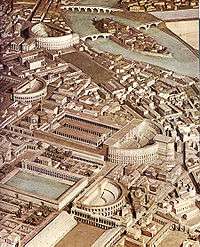
- Campus Martius ― The Field of Mars
- (literary) Any flat or level surface.
- Plautus, Trin., 4, 1, 15:
- ...campi natantes...
- Plautus, Trin., 4, 1, 15:
- The comitia centuriata, which met on the Campus Martius.
- A field of action: scope.
- A field of debate: a topic.
- An opportunity.
- The produce of a field.
Inflection
Second declension.
| Case | Singular | Plural |
|---|---|---|
| nominative | campus | campī |
| genitive | campī | campōrum |
| dative | campō | campīs |
| accusative | campum | campōs |
| ablative | campō | campīs |
| vocative | campe | campī |
Derived terms
Descendants
- Aragonese: campo
- Aromanian: cãmpu
- Asturian: campu, campo, quempu
- → Basque: kanpo
- Catalan: camp
- Corsican: campu
- Dalmatian: cuomp
- → Danish: kamp
- → Dutch: camp, kamp
- Emilian: canp
- → English: camp, campus
- Esperanto: kampo
- Extremaduran: campu
- Fala: campu
- Franco-Provençal: champ
- French: camp, champ
- Friulian: cjamp, čhamp
- Galician: campo
- → German: Kampf, Kamp, Camp, Campus
- → Greek: κάμπος (kámpos)
- Guinea-Bissau Creole: kampu
- Italian: campo
- Ladin: ciamp
- Ligurian: campo
- Leonese: campu
- Lombard: camp, champ, chèmp, ciamp
- Megleno-Romanian: cǫmp
- → Middle English: camp
- Mirandese: campo
- Mozarabic: [script needed] (cámpo), [script needed] (cámba)
- Norman: camp (Guernsey)
- → Norwegian: kamp
- Occitan: camp
- → Old English: camp
- Old French: camp, champ
- → Old High German: champf, kampf
- Old Portuguese: campo
- Old Spanish: campo
- Piedmontese: camp
- Portuguese: campo
- Romagnol: câmp
- Romanian: câmp
- Romansch: champ, camp, tgomp
- Sardinian: campu
- Sicilian: campu
- Spanish: campo
- → Swedish: kamp
- → Tetum: kampu
- Venetian: canpo, camp, canp
- Walloon: tchamp
References
- campus in Charlton T. Lewis and Charles Short (1879) A Latin Dictionary, Oxford: Clarendon Press
- campus in Charlton T. Lewis (1891) An Elementary Latin Dictionary, New York: Harper & Brothers
- campus in Charles du Fresne du Cange’s Glossarium Mediæ et Infimæ Latinitatis (augmented edition, 1883–1887)
- campus in Gaffiot, Félix (1934) Dictionnaire Illustré Latin-Français, Hachette
- Lewis, Charleton & al. "campus" in A Latin Dictionary.
Portuguese
Alternative forms
Etymology
Borrowed from Latin campus. Compare the inherited doublet campo.
Noun
campus m (plural campi or campus (nonstandard))
- campus
- Além das unidades localizadas nos campi Pampulha e Saúde, a UFMG possui ainda outras no centro de Belo Horizonte e bairros periféricos.
Besides units located in the Pampulha and Health campuses, UFMG has others in downtown Belo Horizonte and surrounding neighborhoods.
- Além das unidades localizadas nos campi Pampulha e Saúde, a UFMG possui ainda outras no centro de Belo Horizonte e bairros periféricos.
Romanian
Etymology
Borrowed from French campus, English campus, from Latin campus. Doublet of the inherited câmp.
Noun
campus n (plural campusuri)
Spanish
Etymology
Borrowed from Latin campus. Compare the inherited doublet campo.
Noun
campus m (plural campus)