蜀黍
Chinese
| Sichuan | broomcorn millet; glutinous millet | ||
|---|---|---|---|
| simp. and trad. (蜀黍) |
蜀 | 黍 | |
Pronunciation
Noun
蜀黍
Synonyms
Japanese
Etymology 1
| Kanji in this term | |
|---|---|
| 蜀 | 黍 |
| Hyōgaiji | Hyōgaiji |
| Irregular | |
Compound of 唐 (morokoshi, “China in general; (by extension) foreign”) + 黍 (kibi, “millet”).
The spelling is from Chinese.[1] See shokusho below.
Pronunciation
Alternative forms
Noun
蜀黍 (hiragana もろこしきび, rōmaji morokoshi kibi)
Usage notes
The longer term morokoshi kibi has been largely replaced by the shorter form morokoshi below.
Synonyms
Etymology 2
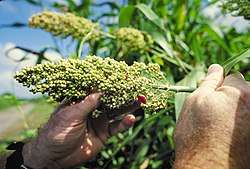
蜀黍 (morokoshi kibi, morokoshi, shokusho): sorghum.
| Kanji in this term | |
|---|---|
| 蜀 | 黍 |
| Hyōgaiji | Hyōgaiji |
| Irregular | |
Abbreviation of morokoshi kibi above, with the abbreviated reading then re-applied to the entire kanji compound.[1]
Pronunciation
Alternative forms
Noun
蜀黍 (hiragana もろこし, rōmaji morokoshi)
- sorghum
- maize, corn (especially corn on the cob)
Synonyms
Usage notes
The term 玉蜀黍 (tōmorokoshi) is more common for the maize sense.
Etymology 3
| Kanji in this term | |
|---|---|
| 蜀 | 黍 |
| しょく Hyōgaiji |
しょ Hyōgaiji |
| on’yomi | |
From Middle Chinese compound 蜀黍 (dzyowk syoX, literally “Shu (old place name) + millet”). The ancient state of Shu is roughly analogous to modern Sichuan province.
This reading appears to be rare, and may be obsolete.
Pronunciation
Noun
蜀黍 (hiragana しょくしょ, rōmaji shokusho)
- (rare, possibly obsolete) sorghum
References
This article is issued from
Wiktionary.
The text is licensed under Creative Commons - Attribution - Sharealike.
Additional terms may apply for the media files.