corn
English
Pronunciation
- (Received Pronunciation) IPA(key): /kɔːn/
- (US, Canada) IPA(key): /kɔɹn/
Audio (US) (file) - Rhymes: -ɔː(ɹ)n
Etymology 1
From Middle English corn, from Old English corn, from Proto-Germanic *kurną, from Proto-Indo-European *ǵr̥h₂nóm (“grain; worn-down”), from *ǵerh₂- (“grow old, mature”). Cognate with Dutch koren, Low German Koorn, German Korn, Norwegian and Swedish korn; see also Russian зерно́ (zernó), Czech zrno, Latin grānum, Lithuanian žirnis and English grain.
Noun
corn (usually uncountable, plural corns)
- (Britain, uncountable) The main cereal plant grown for its grain in a given region, such as oats in parts of Scotland and Ireland, and wheat or barley in England and Wales.
- 1847, John Mason Neale, Stories from heathen mythology and Greek history, page 115:
- Among the divinities that dwelt on Mount Olympus, none was more friendly to the husbandman than Demeter, goddess of corn.
- 1867, Karl Marx (Samuel Moore & Edward Aveling, translators), Das Kapital:
- However much the individual manufacturer might give the rein to his old lust for gain, the spokesmen and political leaders of the manufacturing class ordered a change of front and of speech towards the workpeople. They had entered upon the contest for the repeal of the Corn Laws, and needed the workers to help them to victory. They promised therefore, not only a double-sized loaf of bread, but the enactment of the Ten Hours' Bill in the Free-trade millennium.
- 1909, Johann David Wyss (Susannah Mary Paull, translator), The Swiss Family Robinson, page 462:
- I found that we had nearly a hundred bushels of corn, including wheat, maize, and barley, to add to our store.
-
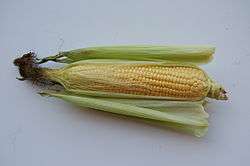
- (US, Canada, Australia, uncountable) Maize, a grain crop of the species Zea mays.
- A grain or seed, especially of a cereal crop.
- He paid her the nominal fee of two corns of barley.
- A small, hard particle.
- Bishop Hall:
- corn of sand
- Beaumont and Fletcher:
- a corn of powder
- Bishop Hall:
Derived terms
Translations
|
|
See also
Verb
corn (third-person singular simple present corns, present participle corning, simple past and past participle corned)
- (US, Canada) to granulate; to form a substance into grains
- to corn gunpowder
- (US, Canada) to preserve using coarse salt, e.g. corned beef
- (US, Canada) to provide with corn (typically maize; or, in Scotland, oats) for feed
- Corn the horses.
- (transitive) to render intoxicated
- ale strong enough to corn one
Translations
Etymology 2
Borrowed from Old French corn (modern French cor).
Noun
corn (plural corns)
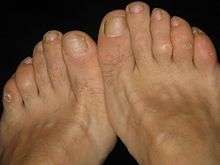
- A type of callus, usually on the feet or hands.
- Shakespeare
- Welcome, gentlemen! Ladies that have their toes / Unplagued with corns, will have a bout with you.
- Synonym: clavus
- Shakespeare
Hyponyms
Translations
|
|
Etymology 3
This use was first used in 1932, as corny, something appealing to country folk.
Noun
corn (uncountable)
- (US, Canada) Something (e.g. acting, humour, music, or writing) which is deemed old-fashioned or intended to induce emotion.[1]
- 1975, Tschirlie, Backpacker magazine,
- He had a sharp wit, true enough, but also a good, healthy mountaineer's love of pure corn, the slapstick stuff, the in-jokes that get funnier with every repetition and never amuse anybody who wasn't there.
- 1986, Linda Martin and Kerry Segrave, Women in Comedy,
- There were lots of jokes on the show and they were pure corn, but the audience didn't mind.
- 2007, Bob L. Cox, Fiddlin' Charlie Bowman: an East Tennessee old-time music pioneer and his musical family,
- The bulk of this humor was pure corn, but as hillbilly material it was meant to be that way.
- 1975, Tschirlie, Backpacker magazine,
Derived terms
Etymology 4
From the resemblance to white corn kernels.
Noun
corn (uncountable)
- (uncountable) A type of granular snow formed by repeated melting and re-freezing, often in mountain spring conditions.
- Synonym: corn snow
References
- ↑ “Corn (emotion)”, in Cambridge Advanced Learner's Dictionary, Cambridge University Press, (Please provide a date or year)
Anagrams
Catalan
Etymology
From Latin cornū, ultimately from Proto-Indo-European *ḱerh₂- (“horn”).
Noun
corn m (plural corns)
Derived terms
- corn anglès
- cornar
Irish
Etymology
From Old Irish corn (“drinking horn, goblet; trumpet, horn; curl”), from Latin cornū.
Pronunciation
- IPA(key): /koːɾˠn̪ˠ/
Noun
corn m (genitive singular coirn, nominative plural coirn)
Declension
Derived terms
|
|
|
Verb
corn (present analytic cornann, future analytic cornfaidh, verbal noun cornadh, past participle corntha)
Conjugation
| singular | plural | relative | autonomous | ||||||
|---|---|---|---|---|---|---|---|---|---|
| first | second | third | first | second | third | ||||
| indicative | present | cornaim | cornann tú; cornair† |
cornann sé, sí | cornaimid | cornann sibh | cornann siad; cornaid† |
a chornann; a chornas / a gcornann*; a gcornas* |
corntar |
| past | chorn mé; chornas | chorn tú; chornais | chorn sé, sí | chornamar; chorn muid | chorn sibh; chornabhair | chorn siad; chornadar | a chorn / ar chorn* |
cornadh | |
| past habitual | chornainn | chorntá | chornadh sé, sí | chornaimis; chornadh muid | chornadh sibh | chornaidís; chornadh siad | a chornadh / ar chornadh* |
chorntaí | |
| future | cornfaidh mé; cornfad |
cornfaidh tú; cornfair† |
cornfaidh sé, sí | cornfaimid; cornfaidh muid |
cornfaidh sibh | cornfaidh siad; cornfaid† |
a chornfaidh; a chornfas / a gcornfaidh*; a gcornfas* |
cornfar | |
| conditional | chornfainn | chornfá | chornfadh sé, sí | chornfaimis; chornfadh muid | chornfadh sibh | chornfaidís; chornfadh siad | a chornfadh / ar chornfadh* |
chornfaí | |
| subjunctive | present | go gcorna mé; go gcornad† |
go gcorna tú; go gcornair† |
go gcorna sé, sí | go gcornaimid; go gcorna muid |
go gcorna sibh | go gcorna siad; go gcornaid† |
— | go gcorntar |
| past | dá gcornainn | dá gcorntá | dá gcornadh sé, sí | dá gcornaimis; dá gcornadh muid |
dá gcornadh sibh | dá gcornaidís; dá gcornadh siad |
— | dá gcorntaí | |
| imperative | cornaim | corn | cornadh sé, sí | cornaimis | cornaigí; cornaidh† |
cornaidís | — | corntar | |
| verbal noun | cornadh | ||||||||
| past participle | corntha | ||||||||
* Indirect relative
† Archaic or dialect form
Alternative forms
- cornaigh, cornáil
Mutation
| Irish mutation | ||
|---|---|---|
| Radical | Lenition | Eclipsis |
| corn | chorn | gcorn |
| Note: Some of these forms may be hypothetical. Not every possible mutated form of every word actually occurs. | ||
Further reading
- "corn" in Foclóir Gaeilge-Béarla, An Gúm, 1977, by Niall Ó Dónaill.
- Entries containing “corn” in English-Irish Dictionary, An Gúm, 1959, by Tomás de Bhaldraithe.
- Entries containing “corn” in New English-Irish Dictionary by Foras na Gaeilge.
Old English
Etymology
From Proto-Germanic *kurną, from Proto-Indo-European *ǵr̥h₂nóm (“grain”). Cognate with Old Frisian korn, Old Saxon korn (Low German Koorn), Dutch koren, Old High German korn, Old Norse korn, Gothic 𐌺𐌰𐌿𐍂𐌽 (kaurn).
Pronunciation
- IPA(key): /korn/
Noun
corn n
- corn, a grain or seed
- Anglo-Saxon Chronicle
- Hīe wǣron benumene æġðer ġe ðæs ċēapes ġe ðæs cornes.
- They were deprived both of cattle and of corn.
- Anglo-Saxon Chronicle
- a cornlike pimple, a corn on the foot
Declension
Descendants
Old French
Alternative forms
Etymology
Noun
corn m (oblique plural corns, nominative singular corns, nominative plural corn)
Descendants
- French: cor
Romanian
Pronunciation
- IPA(key): [korn]
Etymology 1
From Latin cornū, ultimately from Proto-Indo-European *ḱerh₂- (“horn”).
Noun
corn n (plural coarne)
Declension
Derived terms
- încorna
- cornos
Related terms
Etymology 2
Noun
corn m (plural corni)
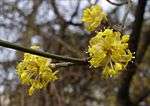
- cornel, European cornel, Cornus mas
- rafter (of a house)
Declension
See also
Scots
Etymology
From Old English corn.
Noun
corn (plural corns)
Verb
corn (third-person singular present corns, present participle cornin, past cornt, past participle cornt)
- to feed (a horse) with oats or grain
Welsh
Etymology
Pronunciation
- IPA(key): /kɔrn/
Noun
corn m (plural cyrn)
Mutation
| Welsh mutation | |||
|---|---|---|---|
| radical | soft | nasal | aspirate |
| corn | gorn | nghorn | chorn |
| Note: Some of these forms may be hypothetical. Not every possible mutated form of every word actually occurs. | |||