泣
| ||||||||
Translingual
Han character
泣 (radical 85, 水+5, 8 strokes, cangjie input 水卜廿 (EYT), four-corner 30118, composition ⿰氵立)
References
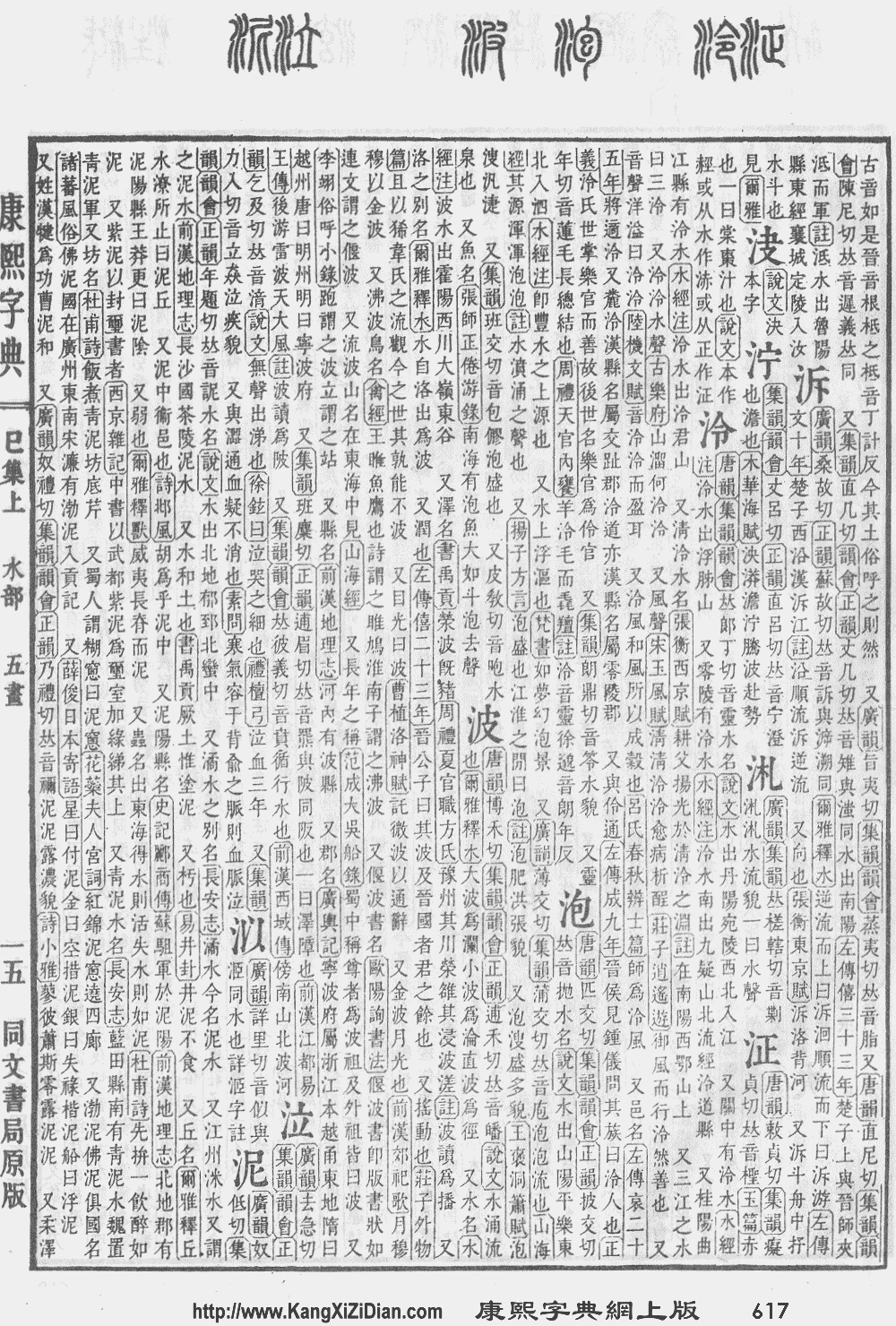
- KangXi: page 617, character 9
- Dai Kanwa Jiten: character 17309
- Dae Jaweon: page 1012, character 7
- Hanyu Da Zidian: volume 3, page 1593, character 2
- Unihan data for U+6CE3
Chinese
| simp. and trad. |
泣 | |
|---|---|---|
Glyph origin
| Historical forms of the character 泣 | |
|---|---|
| Shuowen Jiezi (compiled in Han) | Liushutong (compiled in Ming) |
| Small seal script | Transcribed ancient scripts |
 |
 |
| Characters in the same phonetic series (立) (Zhengzhang, 2003) | |
|---|---|
| Old Chinese | |
| 涖 | *rɯːbs, *rɯbs |
| 莅 | *rɯbs, *rɯbs |
| 蒞 | *rɯbs |
| 位 | *ɢʷrɯbs |
| 拉 | *ruːb |
| 菈 | *ruːb |
| 颯 | *sluːb |
| 立 | *rɯb |
| 粒 | *rɯb |
| 笠 | *ɡ·rɯb |
| 砬 | *rɯb |
| 岦 | *rɯb |
| 苙 | *ɡ·rɯb, *ɡrɯb |
| 鴗 | *rɯb |
| 雴 | *r̥ʰɯb |
| 泣 | *kʰrɯb |
Etymology
- “to weep; to sob”
- From Proto-Sino-Tibetan *krap (“to weep”). Cognate with Tibetan ཁྲབ་ཁྲབ (khrab khrab, “weeper”).
Pronunciation 1
Definitions
泣
Compounds
Pronunciation 2
Definitions
泣
Pronunciation 3
Definitions
泣
Japanese
Kanji
泣
Readings
- Goon: こう (kō)←こふ (kofu, historical)
- Kan’on: きゅう (kyū, Jōyō)←きふ (kifu, historical)
- Kun: なく (naku, 泣く, Jōyō); なき (naki, 泣き)
Korean
Hanja
泣 • (eup) (hangeul 읍)
- This term needs a translation to English. Please help out and add a translation, then remove the text
{{rfdef}}.
Vietnamese
Han character
泣 (khắp, khấp, lớp, rắp, rập, khóc)
- This term needs a translation to English. Please help out and add a translation, then remove the text
{{rfdef}}.
This article is issued from
Wiktionary.
The text is licensed under Creative Commons - Attribution - Sharealike.
Additional terms may apply for the media files.