正山小種
Chinese
Pronunciation
Noun
正山小種
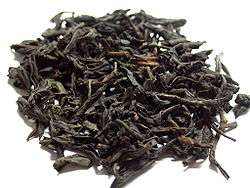
- lapsang souchong (tea plant)
Synonyms
See also
-

Japanese
Etymology 1
| Kanji in this term | |||
|---|---|---|---|
| 正 | 山 | 小 | 種 |
| Grade: 1 | Grade: 1 | Grade: 1 | Grade: 4 |
| Irregular | |||
Borrowed from Cantonese 立山小種 (laap6 saan1 siu2 zung2, literally “sub-variety from Lapu Mountain”).
The spelling was apparently changed prior to borrowing into Japanese, replacing the 立 (laap6) character with the 正 (zeng3) character while keeping the pronunciation unchanged.
The reading is an approximation of modern Cantonese, and is thus neither on'yomi nor kun'yomi.
Alternative forms
Pronunciation
- IPA(key): [ɾa̠pɯ̟ᵝsã̠ɰ̃ sɨᵝːt͡ɕõ̞ɴ]
Noun
正山小種 (katakana ラプサン・スーチョン, rōmaji rapusan sūchon)
Usage notes
This reading appears to be the most common.
Etymology 2
| Kanji in this term | |||
|---|---|---|---|
| 正 | 山 | 小 | 種 |
| せい Grade: 1 |
さん Grade: 1 |
しょう Grade: 1 |
しゅ Grade: 4 |
| on’yomi | |||
The spelling is borrowed from Chinese 正山小種. The reading is the expected on'yomi for these characters.
Pronunciation
Noun
正山小種 (hiragana せいさんしょうしゅ, rōmaji seisan shōshu)
Usage notes
This reading appears to be substantially less common than rapusan sūchon above. However, it is also the most obvious reading from a Japanese perspective, using the standard Japanese pronunciation of the characters.