七夕
Chinese
| seven | dusk; evening | ||
|---|---|---|---|
| simp. and trad. (七夕) |
七 | 夕 | |
Pronunciation
Proper noun
七夕
- (~節) Qixi Festival, the Chinese Valentine's Day, which falls on the seventh day of the seventh lunar month
Derived terms
|
|
Descendants
Japanese
Etymology 1
| Kanji in this term | |
|---|---|
| 七 | 夕 |
| Grade: 1 | Grade: 1 |
| Irregular | |
Origins somewhat obscure.
The latter bata portion is generally accepted to be from 機 (hata, “a loom”). The hata changes to bata due to rendaku (連濁).
The former tana portion may be from 棚 (tana, “a shelf, or a board placed lengthwise in a bridge”), in reference to an ancient ritual whereby a maiden would weave a special cloth on a hata in order to secure a bountiful harvest, as an offering for a god coming across a body of water via a tana. A related theory states that tana is instead an alteration of 種 (tane, “seed”). Yet another theory states that tana is an alteration of 手 (ta, “hand”, unbound Old Japanese form) + な (na, Old Japanese possessive particle superseded by no).[1]
The common spelling of 七夕 is an example of jukujikun, since the festival is held on the seventh night of the seventh month of the lunar calendar, now generally observed on 7 July.
Pronunciation
Alternative forms
- 棚機, 棚幡, 織女
Noun
七夕 (hiragana たなばた, rōmaji tanabata)
Proper noun
七夕 (hiragana たなばた, rōmaji Tanabata)
Synonyms
- 七夕祭り (Tanabata matsuri)
- 星祭り (Hoshi matsuri)
- 七日盆 (Nanuka Bon)
See also
- List of festivals in Japan on Wiktionary
- List of festivals in Japan on Wikipedia
Etymology 2
| Kanji in this term | |
|---|---|
| 七 | 夕 |
| しち Grade: 1 |
せき Grade: 1 |
| on’yomi | |
From Middle Chinese compound 七夕 (MC t͡sʰiɪt̚ ziᴇk̚, “lit. seventh evening”). Compare modern Mandarin 七夕.
Pronunciation
Proper noun
七夕 (hiragana しちせき, rōmaji Shichiseki)
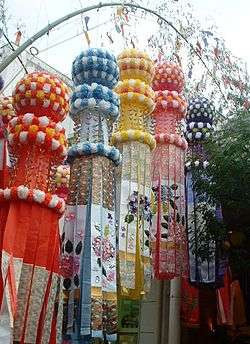
- the Tanabata Japanese star festival, observed on 7 July
- the Chinese Qīxī Festival, also sometimes referred to as the Double Seventh Festival
References
Korean
| Hanja in this term | |
|---|---|
| 七 | 夕 |
Noun
七夕 • (chilseok) (hangeul 칠석)
- Hanja form? of 칠석 (“Qixi”).
Vietnamese
| Hán tự in this word | |
|---|---|
| 七 | 夕 |
Noun
七夕