loom
English
Pronunciation
Etymology 1
From Middle English lome, from Old English lōma, ġelōma (“tool, utensil, implement, article of furniture, household effect”) (also as andlōma, andġelōma, andlāma (“utensil, instrument, implement, tool, vessel”), of uncertain origin. Cognate with Middle Dutch allame (“tool”). Perhaps originally meaning "a thing of frequent use", in which case, akin to Old English ġelōme (“often, frequently, continually, repeatedly”), from Proto-Germanic *ga- + Proto-Germanic *lōmiz, *lōmijaz (“lame, halt”), from Proto-Indo-European *lem- (“to break, soften”). Compare Old High German giluomo, kilōmo (“often, frequently”), Old English lama (“lame”). See lame.
Noun
loom (plural looms)
- A utensil; tool; a weapon; (usually in compound) an article in general.
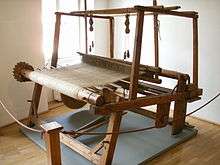
- A frame or machine of wood or other material, in which a weaver forms cloth out of thread; a machine for interweaving yarn or threads into a fabric, as in knitting or lace making.
- Rambler
- Hector, when he sees Andromache overwhelmed with terror, sends her for consolation to the loom and the distaff.
- Rambler
- The part of an oar which is between the grip or handle and the blade, the shaft.
Derived terms
- hand loom
- power loom
- backstrap loom
Translations
|
|
Etymology 2
Noun
loom (plural looms)
- (dated) loon (bird of order Gaviiformes)
Translations
Etymology 3
From Old Norse ljóma (“to shine”)[1].
Verb
loom (third-person singular simple present looms, present participle looming, simple past and past participle loomed)
- to impend; to threaten or hang over.
- The clouds loomed over the mountains.
- To rise and to be eminent; to be elevated or ennobled, in a moral sense.
- J. M. Mason
- On no occasion does he [Paul] loom so high, and shine so gloriously, as in the context.
- J. M. Mason
Translations
References
Anagrams
Dutch
Pronunciation
- IPA(key): /loːm/
Audio (file) - Rhymes: -oːm
Adjective
loom (comparative lomer, superlative loomst)
Inflection
| Inflection of loom | ||||
|---|---|---|---|---|
| uninflected | loom | |||
| inflected | lome | |||
| comparative | lomer | |||
| positive | comparative | superlative | ||
| predicative/adverbial | loom | lomer | het loomst het loomste | |
| indefinite | m./f. sing. | lome | lomere | loomste |
| n. sing. | loom | lomer | loomste | |
| plural | lome | lomere | loomste | |
| definite | lome | lomere | loomste | |
| partitive | looms | lomers | — | |
Adverb
loom
Estonian
Etymology
Derived from looma (“to create”)
Pronunciation
- IPA(key): /ˈloːm/
- Hyphenation: loom
- Rhymes: -oːm
Noun
loom (genitive looma, partitive looma)
Declension
| singular | plural | |
|---|---|---|
| nominative | loom | loomad |
| genitive | looma | loomade |
| partitive | looma | loomi / loomasid |
| illative | looma / loomasse | loomadesse / loomisse |
| inessive | loomas | loomades / loomis |
| elative | loomast | loomadest / loomist |
| allative | loomale | loomadele / loomile |
| adessive | loomal | loomadel / loomil |
| ablative | loomalt | loomadelt / loomilt |
| translative | loomaks | loomadeks / loomiks |
| terminative | loomani | loomadeni |
| essive | loomana | loomadena |
| abessive | loomata | loomadeta |
| comitative | loomaga | loomadega |
Derived terms
- loomaaed
- metsloom