pear
English
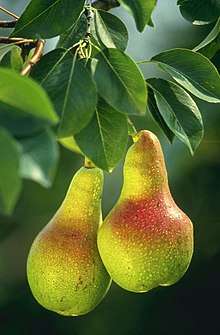
Photo of two pears
Etymology
From Middle English pere, from Old English pere, common North and West Germanic, from Vulgar Latin *pira, originally the plural of Latin pirum but reconstrued as a feminine singular. Cognate with Saterland Frisian Peere (“pear”), Dutch peer (“pear”), Danish pære (“pear”), Swedish päron (“pear”), Icelandic pera (“pear”).
Pronunciation
Audio (UK) (file)
- (Received Pronunciation) IPA(key): /pɛə/
- (General American) enPR: pâr, IPA(key): /pɛɚ/
Audio (US) (file) - Rhymes: -ɛə(r)
- Homophones: pair, pare
Noun
pear (plural pears)
- An edible fruit produced by the pear tree, similar to an apple but elongated towards the stem.
- (also pear tree) A type of fruit tree (Pyrus communis).
- The wood of the pear tree (pearwood, pear wood).
- Choke pear (a torture device).
Derived terms
Terms derived from pear
|
|
|
Translations
fruit
|
|
tree
|
|
wood of the pear tree
|
See also
Anagrams
Galician
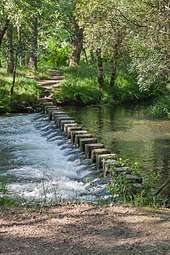
Peares or poldras across the river Ulla
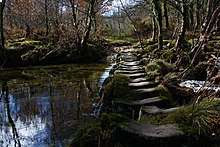
Peares or poldras across the river Verdugo
Alternative forms
Etymology
From Vulgar Latin *pilare, from Latin pīla (“pillar”).
Pronunciation
- IPA(key): /peˈaɾ/
Noun
pear m (plural peares)
- pillar
- Synonym: columna
- window sill
- Synonym: peitoril
- one of several stone pillars placed by way of a bridge
- Synonym: poldra
Related terms
- Os Peares
References
- “pear” in Dicionario de Dicionarios do galego medieval, SLI - ILGA 2006-2012.
- “piar” in Xavier Varela Barreiro & Xavier Gómez Guinovart: Corpus Xelmírez - Corpus lingüístico da Galicia medieval. SLI / Grupo TALG / ILG, 2006-2016.
- “pear” in Dicionario de Dicionarios da lingua galega, SLI - ILGA 2006-2013.
- “pear” in Santamarina, Antón (coord.): Tesouro informatizado da lingua galega. Santiago de Compostela: Instituto da Lingua Galega.
- “piar” in Álvarez, Rosario (coord.): Tesouro do léxico patrimonial galego e portugués, Santiago de Compostela: Instituto da Lingua Galega.
West Frisian
Etymology
From Old Frisian pār, from Latin pār. More at pair.
Noun
pear n
This article is issued from
Wiktionary.
The text is licensed under Creative Commons - Attribution - Sharealike.
Additional terms may apply for the media files.