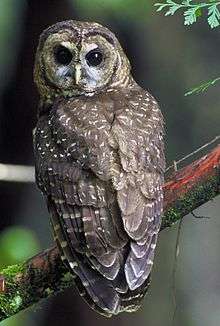
- Acehnese: jampôk
- Adyghe: кукумау (k°k°māw)
- Ainu: チカㇷ゚ (cikap)
- Albanian: kukuvajkë (sq) f, buf (sq) m
- Amharic: ጉጉት (gugut)
- Arabic: بُومَة f (būma)
- Egyptian Arabic: بومة f (buma)
- North Levantine Arabic: بومة f (boumé)
- Armenian: բու (hy) (bu)
- Assamese: ফেঁচা (phẽsa)
- Asturian: curuxa f
- Aymara: juku (ay)
- Azerbaijani: bayquş (az)
- Banjarese: kukulai
- Bashkir: ябалаҡ (yabalaq)
- Basque: mozo, hontz (eu), gauhontz, hontza
- Bau Bidayuh: buwo
- Belarusian: сава́ f (savá)
- Bengali: পেঁচা (bn) (pẽca), উলূক (uluk), পেচক (pecôk)
- Borôro: tagogo
- Breton: toud (br) m, kaouenn (br) f
- Bulgarian: кукумя́вка f (kukumjávka)
- Catalan: òliba (ca) f, mussol (ca) m
- Cebuano: ngiwngiw, mingok
- Central Bontoc: koop
- Chamicuro: ma'sheti
- Cherokee: ᎤᎫᎫ (ugugu)
- Cheyenne: vé'kėséhemėstaa'e
- Chinese:
- Cantonese: 貓頭鷹, 猫头鹰 (maau1 tau4 jing1), 鴞, 鸮 (hiu1) (formal), 鴟鴞, 鸱鸮 (ci1 hiu1) (formal)
- Hakka: 貓頭鳥, 猫头鸟 (meu-thèu-tiâu)
- Mandarin: 貓頭鷹 (zh), 猫头鹰 (zh) (māotóuyīng), 夜貓子 (zh), 夜猫子 (zh) (yèmāozi) (colloquial), 鴞 (zh), 鸮 (zh) (xiāo) (formal), 角鴟, 角鸱 (jiǎochī) (formal), 梟鳥 (zh), 梟鸟 (zh) (xiāoniǎo) (formal), 鵂鶹 (zh), 鸺鹠 (zh) (xiūliú) (formal), 鴟鵂 (zh), 鸱鸺 (zh) (chīxiū) (formal), 鴟鴞 (zh), 鸱鸮 (zh) (chīxiāo) (formal)
- Min Dong: 貓王鳥, 猫王鸟 (mà-uòng-cēu)
- Min Nan: 暗光鳥 (zh-min-nan), 暗光鸟 (zh-min-nan) (àm-kong-chiáu), 貓頭鳥 (zh-min-nan), 猫头鸟 (niau-thâu-chiáu), 貓頭鷹 (zh-min-nan), 猫头鹰 (niau-thâu-eng), 鴣黃, 鸪黄 (ko͘-n̂g, ko͘-ûiⁿ), 暗晏鳥, 暗晏鸟 (àm-òaⁿ-chiáu), 鴟鴞 (zh-min-nan), 鸱鸮 (chhi-hiau), 鷦鶹, 鹪鹠 (chiau-liû), 鵂鶹 (zh-min-nan), 鸺鹠 (hiu-liû), 公黃, 公黄 (kong-hûiⁿ), 姑嫂鳥, 姑嫂鸟 (ko͘-só-chiáu), 貓頭姑, 猫头姑 (niau-thâu-ko͘)
- Chukchi: тыӄыԓ (tyqyḷ)
- Chuvash: тӑмана (tămana)
- Comanche: mupitsʉ
- Cornish: cowan f
- Corsican: ciocciu m
- Crimean Tatar: kökökmiyav, muratquş
- Czech: sova (cs) f
- Dalmatian: civet m
- Danish: ugle (da) c
- Dutch: uil (nl) m
- Elfdalian: ugel f
- Esperanto: strigo (eo)
- Estonian: öökull, kakk
- Evenki: itiknija (itiknija)
- Faroese: ugla, (rare) ugli m, (rare) úla f
- Fijian: lulu
- Finnish: pöllö (fi)
- Franco-Provençal: please add this translation if you can
- French: hibou (fr) m, chouette (fr) f
- Friulian: çus
- Galician: moucho (gl) m
- Georgian: ბუ (bu)
- German: Eule (de) f, Uhu (de) m, Eulenvogel m (order Strigiformes)
- Old High German: ūwila f
- Gothic: 𐌿𐌲𐌲𐍅𐌹𐌻𐍉 f (uggwilō)
- Greek: κουκουβάγια (el) f (koukouvágia)
- Ancient: γλαῦξ f (glaûx)
- Greenlandic: uppik
- Guaraní: ñakurutû, urukure'a
- Haitian Creole: koukou
- Hausa: mujiya
- Hawaiian: pueo
- Hebrew: ינשוף (he) (yanshuf), תנשמת (he) (tinshemeth), לילית (he) (lilith), אוח (oakh)
- Hiligaynon: búkaw
- Hindi: उल्लू (hi) m (ullū)
- Hopi: hotsko
- Hungarian: bagoly (hu)
- Icelandic: ugla (is) f
- Ido: strigo (io)
- Igbo: please add this translation if you can
- Ilocano: kullaaw, puek
- Indonesian: burung hantu (id)
- Interlingua: uluco
- Interlingue: ul
- Irish: ulchabhán (ga) m, cailleach oíche f
- Italian: gufo (it) m (big), civetta (it) f (small)
- Ivatan: bantuluk
- Japanese: フクロウ (ja) (fukurō), 梟 (ja) (ふくろう, fukurō)
- Javanese: darès (jv)
- Kannada: ಗೂಬೆ (kn) (gūbe)
- Kazakh: жапалақ (japalaq)
- Khmer: ទីទុយ (km) (tiituy), មៀម (km) (miəm)
- Kimaragang: puwok
- Komi-Permyak: сюзь (sjuzʹ)
- Kongo: dikuti
- Korean: 올빼미 (ko) (olppaemi), 부엉이 (ko) (bueong-i)
- Kurdish: kund (ku), bu (ku), pû (ku), pepûk (ku)
- Kyrgyz: please add this translation if you can
- Ladin: ciuita
- Lao: ເຄົ້າ (khao)
- Latgalian: palāda, (some species) opūgs m
- Latin: ulula f, noctua f, strix (la) f, bubo m
- Latvian: pūce, apogs (some species), ūpis m (eagle-owl)
- Limburgish: uul (li) m
- Lingala: esulúngútu
- Lithuanian: pelėda (lt) f; also apuokas (lt) m (some species)
- Low German:
- Dutch Low Saxon: uul f
- German Low German: Uul (nds) f
|
|
- Lun Bawang: fuek
- Luxembourgish: Eil (lb) f, Échel (lb) f
- Macedonian: був (buv), ут m (ut), утка f (utka)
- Malagasy: vorombozaka (mg), vorondolo (mg)
- Malay: burung hantu, kokok beluk, burung suangi
- Malayalam: മൂങ്ങ (ml) (mūṅṅa)
- Maltese: kokka f
- Manx: hullad f
- Marathi: घुबड n (ghubaḍ)
- Mari:
- Western Mari: тымана (təmana)
- Maricopa: mmdii
- Mazanderani: کوربی (kurebi), پیت کتله (pitketele)
- Mi'kmaq: gu'gu'gwes anim
- Mirandese: queruja f
- Moksha: корож (korož)
- Mongolian: шар шувуу (šar šuvuu), ууль (mn) (uulʹ)
- Montagnais: uhu
- Nanai: oqsarä
- Navajo: néʼéshjaaʼ
- Nepali: लाटोकोसेरो (ne) (lāṭokosero)
- Norman: cahouain m
- Northern Sami: skuolfi, idjaloddi
- Northern Sotho: leribiši
- Norwegian:
- Bokmål: ugle m, f
- Nynorsk: ugle f
- O'odham: cukut
- Occitan: chòta f
- Ojibwe: gookooko'oo
- Old English: ūle f
- Old Norse: ugla
- Old Occitan: cavec m
- Oriya: ପେଚା (or) (pēcā)
- Ossetian: уыг (wyg), сидахъ (sidaq)
- Pangasinan: kolayot
- Pashto: کونګ (kong)
- Persian: جغد (fa) (joğd), بوف (fa) (buf)
- Polish: sowa (pl) f
- Portuguese: coruja (pt) f, estrige f
- Quechua: tuku, paqpaka, ch'usiqa, huku, juku
- Romanian: bufniță (ro) f
- Romansch: tschuetta f
- Russian: сова́ (ru) f (sová), фи́лин (ru) m (fílin), сыч (ru) m (syč)
- Rusyn: совы f (sovŷ)
- Sami: skuolfelottit
- Samoan: lulu
- Sanskrit: उलूक (sa) m (ulūka)
- Santali: ᱫᱩᱱᱫᱩ (dundu)
- Sardinian: tirulia, cuccumeu, cuccumiau
- Saterland Frisian: Uule f
- Scots: yuggle
- Scottish Gaelic: cailleach-oidhche f, comhachag f
- Serbo-Croatian:
- Cyrillic: сова f, јеја f, јејина f, буљина f
- Roman: sova (sh) f, jeja (sh) f, jejina (sh) f, buljina (sh) f
- Shona: zizi
- Sicilian: cuccu (scn) m (big, Bubo bubo), cucca (scn) f (small, Athene noctua)
- Silesian: uojle f
- Skolt Sami: hõˊppi
- Slovak: sova f, výr m
- Slovene: sova (sl) f
- Sorbian:
- Lower Sorbian: sowa f
- Upper Sorbian: sowa f
- Spanish: búho (es) m, lechuza (es) f, tecolote (es) m (Mexico, Guatemala, Honduras), mochuelo (es) m (Spain), autillo m (Spain), cárabo (es) m (Spain), cuco (es) m (Cuba), sijú cotunto m (Cuba), caburé (es) m (Argentina), chuncho (es) m (Argentina, Chile), anteojo (es) m (Peru), tucúquere (es) m (Peru, Bolivia, Argentina, Chile)
- Sundanese: bueuk (su)
- Swahili: bundi (sw)
- Swedish: uggla (sv) c, uv (sv) c
- Sylheti: ꠚꠦꠌꠣ (fesa)
- Syriac, Classical: ܒܘܡܐ c (būmā)
- Tagal Murut: puvok
- Tagalog: kuwago
- Tamil: ஆந்தை (ta) (āntai)
- Taos: kǫ̏wéna
- Telugu: గుడ్లగూబ (te) (guḍlagūba)
- Thai: นกฮูก (th) (nók hûuk)
- Tibetan: འུག་པ། ('ug pa)
- Turkish: baykuş (tr)
- Turkmen: baýguş (tk)
- Ukrainian: сова (uk) f (sova), сич m (syč)
- Urdu: الو m (ullū)
- Uyghur: مۈشۈك ياپىلاق (müshük yapilaq), ھۇۋقۇش (huwqush)
- Uzbek: boyqush (uz), boyo'g'li (uz), yapaloqqush (uz)
- Veps: hir'pulo
- Vietnamese: con cú, cú (vi)
- Vilamovian: aojł f
- Volapük: lül (vo)
- Walloon: please add this translation if you can
- Waray-Waray: bukaw
- Welsh: tylluan (cy) f, gwdihŵ (cy) f, gwdihŵaid f pl
- West Coast Bajau: puok
- West Frisian: ûle
- Wolof: looy mi
- Yakut: мэкчиргэ (mekçirge)
- Yiddish: סאָווע f (sove)
- Yoruba: òwìwí
- Zazaki: kund
- Zealandic: ulen m
- Zhuang: roeggyaeujmeuz
- Zulu: isikhova (zu) class 7/8
|