civet
See also: civět
English
Alternative forms
Etymology
From French civette, from Italian zibetto, from Arabic زَبَاد (zabād).
Pronunciation
- IPA(key): /ˈsɪ.vɪt/
Noun
civet (countable and uncountable, plural civets)
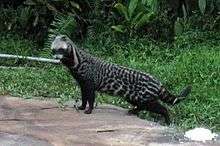
- (countable) A carnivorous catlike animal, Civettictis civetta, that produces a musky secretion. It is two to three feet long, with black bands and spots on the body and tail.
- (uncountable) The musky perfume produced by the animal.
- 1599, William Shakespeare, Much Ado About Nothing, Act 3 Scene 2
- LEONATO. Indeed he looks younger than he did, by the loss of a beard.
- DON PEDRO. Nay, a' rubs himself with civet: can you smell him out by that?
- CLAUDIO. That's as much as to say the sweet youth's in love.
- 1599, William Shakespeare, Much Ado About Nothing, Act 3 Scene 2
- Any animal in the family Viverridae or the similar family Nandiniidae
- (countable, US) Any of several species of spotted skunk, in the genus Spilogale.
Derived terms
Translations
cat-like animal
|
|
perfume
Anagrams
Dalmatian
Etymology
Compare Italian civetta, Romansch tschuetta, French chouette.
Noun
civet m
- owl
- burrowing owl
French
Etymology
Pronunciation
- IPA(key): /si.vɛ/
Noun
civet m (plural civets)
- (cuisine) ragout of hare, rabbit or wild mammal, with red wine and onions, bound with the animal’s blood.
Further reading
- “civet” in le Trésor de la langue française informatisé (The Digitized Treasury of the French Language).
This article is issued from
Wiktionary.
The text is licensed under Creative Commons - Attribution - Sharealike.
Additional terms may apply for the media files.