ola
English
Noun
ola (uncountable)
- Alternative form of olay
Anagrams
Chichewa
Etymology
Borrowed from Portuguese hora.
Pronunciation
- IPA(key): /ˈó.ɽa/
Noun
óla class 5 (plural maóla class 6)
Galician
Interjection
ola
Hawaiian
Etymology
From Proto-Polynesian *ola, from Proto-Oceanic [Term?], from Proto-Malayo-Polynesian *wada (“to exist”).
Noun
ola
Verb
ola
Irish
Etymology
From Old Irish olae, from Latin oleum, from Ancient Greek ἔλαιον (élaion, “olive oil”), from ἐλαία (elaía, “olive”).
Pronunciation
- IPA(key): /ˈɔlˠə/
Noun
ola f (genitive singular ola, nominative plural olaí)
Declension
Derived terms
|
|
|
Mutation
| Irish mutation | |||
|---|---|---|---|
| Radical | Eclipsis | with h-prothesis | with t-prothesis |
| ola | n-ola | hola | not applicable |
| Note: Some of these forms may be hypothetical. Not every possible mutated form of every word actually occurs. | |||
Further reading
- "ola" in Foclóir Gaeilge-Béarla, An Gúm, 1977, by Niall Ó Dónaill.
- “ola” in Dictionary of the Irish Language, Royal Irish Academy, 1913–76.
Latgalian
Noun
ola f
Latin
Pronunciation
- (Classical) IPA(key): /ˈoː.la/, [ˈoː.ɫa]
Noun
ōla f (genitive ōlae); first declension
- Alternative form of olla
Declension
First declension.
| Case | Singular | Plural |
|---|---|---|
| nominative | ōla | ōlae |
| genitive | ōlae | ōlārum |
| dative | ōlae | ōlīs |
| accusative | ōlam | ōlās |
| ablative | ōlā | ōlīs |
| vocative | ōla | ōlae |
Latvian
Etymology
From a previous Proto-Baltic neuter noun *wuolan, from Proto-Baltic *wuol-, from Proto-Indo-European *wēl-, *wōl-, the length grade of the stem *wel- (“to turn, to roll, to wind”), whence also velt “to roll, to trundle.” The original meaning was therefore “something that turns, rolls,” still visible in the dialectal verb olāt (“to roll, to trundle”), and in the standard Latvian term olis (“round pebble”), dialectally also ola. It is possible that Proto-Indo-European *h₂ōwyóm (“egg”), which would have become *wowan in Proto-Baltic, may have influenced the development of *wuolan into ola. A synonym term pauts was used alongside ola until the beginning of the 20th century, when ola became dominant and replaced it. Cognates include Lithuanian uolà (“cliff, rock”).[1]
Pronunciation
- IPA(key): [uōla]
Noun
ola f (4th declension)
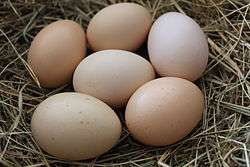
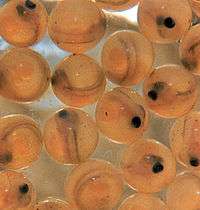
- egg (reproductive cell, wrapped in a shell, where the embryo of certain animal species develops)
- vistu olas ― chicken (lit. hen) eggs
- zivju olas ― fish eggs
- olas čaumala ― eggshell
- olas baltums, dzeltenums ― the white, the yolk of the egg
- dēt olas ― to lay eggs
- rāpuļu olas pēc savas uzbūves atgādina putnu olas ― reptile eggs, by their structure, are similar to bird eggs
- olas vidū ir liels, barības vielām bagāts dzeltenums, kuram apkārt ir olbaltuma slānis ― in the middle of the egg there is a big yolk rich in nutrients, surrounded by a protein layer
- zivis vairojas ar olām jeb ikriem ― the fish reproduce with eggs, also called “ikri”
- odu mātītes olas dēj uz ūdens virsmas ― female mosquitoes lay eggs on water surfaces
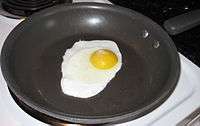
- egg (said reproductive cell, usually from birds, used as food)
- cieti, mīksti vārīta ola ― hard-, soft-boiled egg
- cieta, mīksta ola ― hard-, soft-boiled egg
- nolobīt olu ― to peel an egg
- jēla ola ― raw egg (also: unexperienced, naive person)
- cepta ola ― fried egg
- pildīta ola ― stuffed egg
- olu kultenis ― scrambled eggs
- izdzert olu ― to drink an egg (= to suck the liquid through a hole on the eggshell)
- Lieldienu ola ― Easter egg (painted egg, part of the celebration of Easter)
- mums, kā vistu neturēja, tā olu pašiem nebija ― since we didn't keep hens, we didn't have eggs
Declension
Synonyms
- (of "fish eggs"): ikrs
Derived terms
- olbaltums
- olnīca
Related terms
References
- ↑ Karulis, Konstantīns (1992), “ola”, in Latviešu Etimoloģijas Vārdnīca (in Latvian), Rīga: AVOTS, →ISBN
Lithuanian
Pronunciation
Noun
olà f (plural õlos) stress pattern 4 [1]
Declension
| singular (vienaskaita) | plural (daugiskaita) | |
|---|---|---|
| nominative (vardininkas) | olà | õlos |
| genitive (kilmininkas) | olõs | olų̃ |
| dative (naudininkas) | õlai | olóms |
| accusative (galininkas) | õlą | olàs |
| instrumental (įnagininkas) | olà | olomìs |
| locative (vietininkas) | olojè | olosè |
| vocative (šauksmininkas) | õla | õlos |
Synonyms
- urvas m
See also
- įdubimas m; skylė f
References
- 1 2 “ola” in Balčikonis, Juozas et al. (1954), Dabartinės lietuvių kalbos žodynas. Vilnius: Valstybinė politinės ir mokslinės literatūros leidykla.
- “ola” in Martsinkyavitshute, Victoria (1993), Hippocrene Concise Dictionary: Lithuanian-English/English-Lithuanian. New York: Hippocrene Books. →ISBN
Occitan
Etymology
Noun
ola f (plural olas)
Portuguese
Etymology
Pronunciation
- (Brazil) IPA(key): /ˈo.la/, /ˈo.lɐ/
Noun
ola f (plural olas)
- wave (a group activity in a crowd imitating a wave going through water, where people in successive parts of the crowd stand and stretch upward, then sit)
Samoan
Interjection
ola!
- An exclamation to mean wonderful.
References
- Pratt, G. (1862). A Samoan dictionary: English and Samoan, and Samoan and English; with a short grammar of the Samoan dialect. Samoa: London Missionary Society's Press. Page 12.
Scottish Gaelic
Noun
ola f (genitive singular ola, plural olaichean)
Derived terms
Spanish
Etymology
Unknown.
Pronunciation
- IPA(key): /ˈo.la/
- Homophone: hola
Noun
ola f (plural olas)
- wave (on the surface of a liquid)
- (figuratively) sudden appearance of a large amount of something.
- ola de calor ― heat wave
Synonyms
- (wave on the surface of a liquid; all technical senses, e.g. sound waves, light waves): onda
Derived terms
Tagalog
Noun
ola
Volapük
Pronoun
ola