dragon
English
Pronunciation
- enPR: drăg'ən, IPA(key): /ˈdɹæɡən/
Audio (US) (file) - Rhymes: -æɡən
Etymology 1
From Middle English dragoun, from Old French dragon, from Latin dracō, from Ancient Greek δράκων (drákōn, “a serpent of huge size, a python, a dragon”), probably from δρακεῖν (drakeîn), aorist active infinitive of δέρκομαι (dérkomai, “I see clearly”).
.jpg)
Noun
dragon (plural dragons)
- A legendary serpentine or reptilian creature.
- In Western mythology, a gigantic beast, typically reptilian with leathery bat-like wings, lion-like claws, scaly skin and a serpent-like body, often a monster with fiery breath.
- c. 1900, Edith Nesbit, The Last of the Dragons:
- But as every well-brought-up prince was expected to kill a dragon, and rescue a princess, the dragons grew fewer and fewer till it was often quite hard for a princess to find a dragon to be rescued from.
- c. 1900, Edith Nesbit, The Last of the Dragons:
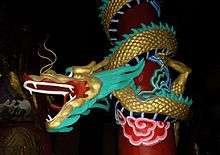
- In Eastern mythology, a large, snake-like monster with the eyes of a hare, the horns of a stag and the claws of a tiger, usually beneficent.
- 1913, Sax Rohmer, The Insidious Dr. Fu Manchu, chapter XIII:
- These tapestries were magnificently figured with golden dragons; and as the serpentine bodies gleamed and shimmered in the increasing radiance, each dragon, I thought, intertwined its glittering coils more closely with those of another.
- 1913, Sax Rohmer, The Insidious Dr. Fu Manchu, chapter XIII:
- In Western mythology, a gigantic beast, typically reptilian with leathery bat-like wings, lion-like claws, scaly skin and a serpent-like body, often a monster with fiery breath.
- A heraldic representation of such a beast used as a charge or as a supporter; as in the arms of Wales.
- An animal of various species that resemble a dragon in appearance:
- (obsolete) A very large snake; a python.
- Any of various agamid lizards of the genera Draco, Physignathus or Pogona.
- A Komodo dragon.
- (astronomy, with definite article, often capitalized) The constellation Draco.
- 1605, William Shakespeare, King Lear, Act I, Scene 2:
- My father compounded with my mother vnder the Dragons taile, and my nativity was vnder Vrsa Maior.
- 1605, William Shakespeare, King Lear, Act I, Scene 2:
- (pejorative) A fierce and unpleasant woman; a harridan.
- She’s a bit of a dragon.
- (with definite article, often capitalized) The (historical) Chinese empire or the People's Republic of China.
- Napoleon already warned of the awakening of the Dragon.
- (figuratively) Something very formidable or dangerous.
- A luminous exhalation from marshy ground, seeming to move through the air like a winged serpent.
- (military, historical) A short musket hooked to a swivel attached to a soldier's belt; so called from a representation of a dragon's head at the muzzle.
- (Can we find and add a quotation of Fairholt to this entry?)
- A variety of carrier pigeon.
Part or all of this entry has been imported from the 1913 edition of Webster’s Dictionary, which is now free of copyright and hence in the public domain. The imported definitions may be significantly out of date, and any more recent senses may be completely missing.
(See the entry for dragon in Webster’s Revised Unabridged Dictionary, G. & C. Merriam, 1913.)
Quotations
- For quotations of use of this term, see Citations:dragon.
Synonyms
Derived terms
|
|
Related terms
Translations
|
|
- The translations below need to be checked and inserted above into the appropriate translation tables, removing any numbers. Numbers do not necessarily match those in definitions. See instructions at Wiktionary:Entry layout#Translations.
See also
- basilisk
- serpent
- wyvern
- wurm
- Saint George
- Saint Patrick
Etymology 2
derived from drag queen
Noun
dragon (plural dragons)
- (slang) a transvestite man, or more broadly a male-to-female transgender person
- May 2017 Michael Connelly shares excerpt from The Late Show
- Ballard felt her phone vibrate in her hand and turned away from the nurse. She saw a return text from Mendez. She read his answer out loud to Jenkins. “‘Ramona Ramone, dragon. Real name Ramón Gutierrez. Had him in here a couple weeks back. Priors longer than his pre-op dick.’ Nice way of putting it.” “Considering his own dimensions,” Jenkins said. Drag queens, cross-dressers, and transgenders were all generally referred to as dragons in vice. No distinctions were made. It wasn’t nice but it was accepted.
- October 2017 Drag Star VIZIN is back with new single Blasting News
- My favorite part was probably the ‘de-dragging.’ Taking the Dragon off (that’s what I call her) is always my favorite. In all honesty, the entire experience was amazing and I wouldn’t change it for the world. Being felt up by Michael Silas wasn’t bad either...
- December 2017 Miss Lawrence as Miss Bruce, "Climax" Star episode 21
- Yes. Butt shots. Everybody can't afford lipo and fat transfers. Especially dragons. So if they want to pay me top dollar to pump their ass up that's what I'm gonna do, and you've benefited from it.
- May 2017 Michael Connelly shares excerpt from The Late Show
Anagrams
Danish
Pronunciation
- Rhymes: -oːˀn
Noun
dragon c (singular definite dragonen, plural indefinite dragoner)
- a dragoon (soldier of the mounted infantry)
References
- “dragon” in Den Danske Ordbog
Dutch
Pronunciation
- Hyphenation: dra‧gon
Etymology 1
From Middle French dragon, from Arabic طَرْخْوْن (ṭarḵwn), from Ancient Greek δρακόντιον (drakóntion), although not all etymologists agree it must have been borrowed via Arabic.
Noun
dragon m (uncountable)
- The edible Mediterranean herb Artemisia dracunculus (tarragon), used as a salad spice
- The plant Erysimum cheiranthoides
Synonyms
- (Erysium cheiranthoides):) steenraket
Etymology 2
Noun
dragon m (plural dragons, diminutive dragonnetje n)
- A (French) dragoon
Synonyms
French
Etymology
From Old French dragon, from Latin dracō, from Ancient Greek δράκων (drákōn)
Pronunciation
- IPA(key): /dʁa.ɡɔ̃/
Audio (file)
Noun
dragon m (plural dragons, feminine dragonne)
Derived terms
|
|
|
Further reading
- “dragon” in le Trésor de la langue française informatisé (The Digitized Treasury of the French Language).
Anagrams
Middle English
Alternative forms
Etymology
Borrowed from Old French dragon, from Latin dracō, from Ancient Greek δράκων (drákōn).
Noun
dragon
- A dragon.
- 1382, Wyclif's Bible, Daniel 14:26
- Therfor Daniel took pitch, and talow, and heeris, and sethide togidere; and he made gobetis, and yaf in to the mouth of the dragun; and the dragun was al to-brokun.
- 1380-1399 — Geoffrey Chaucer, The Canterbury Tales, The Parson's Tale
- For God seith thus by Moyses: they shul been wasted with hunger, and the briddes of helle shul devouren hem with bitter deeth, and the galle of the dragon shal been hire drynke, and the venym of the dragon hire morsels.
- 1382, Wyclif's Bible, Daniel 14:26
Norman
Etymology
From Old French dragon, from Latin dracō, from Ancient Greek δράκων (drákōn).
Pronunciation
Audio (Jersey) (file)
Noun
dragon m (plural dragons)
- (Jersey) dragon
- (Jersey, nautical) flying jib
Norwegian Bokmål
Noun
dragon m (definite singular dragonen, indefinite plural dragoner, definite plural dragonene)
- a dragoon (soldier of the mounted infantry)
References
- “dragon” in The Bokmål Dictionary.
Norwegian Nynorsk
Noun
dragon m (definite singular dragonen, indefinite plural dragonar, definite plural dragonane)
- a dragoon (soldier of the mounted infantry)
References
- “dragon” in The Nynorsk Dictionary.
Old French
Alternative forms
- dragun (Anglo-Norman)
Etymology
From Latin dracō, from Ancient Greek δράκων (drákōn).
Noun
dragon m (oblique plural dragons, nominative singular dragons, nominative plural dragon)
- dragon (mythical animal)
Old Spanish
Etymology
From Latin dracōnem, accusative of dracō, from Ancient Greek δράκων (drákōn).
Pronunciation
- IPA(key): [dɾaˈɡõn]
Noun
dragon m (plural dragones)
- dragon
- c. 1250: Alfonso X, Lapidario, f. 103r.
- Et eſto faz deſcédiédo ſobrella la uertud de fiǵa de oḿe cubierto duna ſauana. ¬ cauallero ſobre un dragó ¬ teniédo en ſu mano dieſtra una láça.
- And it does this when over it descends the virtue of the figure of a man covered with a sheet, and a knight riding a dragon with a spear in his right hand.
- Et eſto faz deſcédiédo ſobrella la uertud de fiǵa de oḿe cubierto duna ſauana. ¬ cauallero ſobre un dragó ¬ teniédo en ſu mano dieſtra una láça.
- Idem, f. 118v.
- Et es de la manera de las piedras ſeelladas. que los antigos gardauan. / Et presta pora echar los dragones. ¬ las ſirpientes. de los lugares.
- And it is akin to the sealed stones that the ancients kept. And it is good for expeling dragons and snakes from any place.
- Et es de la manera de las piedras ſeelladas. que los antigos gardauan. / Et presta pora echar los dragones. ¬ las ſirpientes. de los lugares.
- c. 1250: Alfonso X, Lapidario, f. 103r.
Descendants
- Spanish: dragón
Old Welsh
Noun
dragon m
- commander, war leader
Related terms
Romanian
Etymology
Pronunciation
- IPA(key): /draˈɡon/
Noun
dragon m (plural dragoni)
- a dragon (mythical creature)
- a flying lizard species (of the genera Draco, Physignathus or Pogona)
- (astronomy, often capitalized, with definite articulation) Draco (constellation)
- (military) a dragoon (horse soldier)
Declension
Synonyms
- (mythical creature): balaur
Related terms
References
- dragon in DEX online - Dicționare ale limbii române (Dictionaries of the Romanian language), 2004-2018
Swedish
Pronunciation
- IPA(key): /draˈɡuːn/
Audio (file)
Noun
dragon c
- a dragoon (soldier of the mounted infantry)
- the perennial herb tarragon
- leaves of that plant, used as seasoning
Declension
| Declension of dragon | ||||
|---|---|---|---|---|
| Singular | Plural | |||
| Indefinite | Definite | Indefinite | Definite | |
| Nominative | dragon | dragonen | dragoner | dragonerna |
| Genitive | dragons | dragonens | dragoners | dragonernas |
Related terms
- dragonregemente
- dragonättika
- dragonört
References
- dragon in Svenska Akademiens Ordlista över svenska språket (13th ed., online)