clay
English
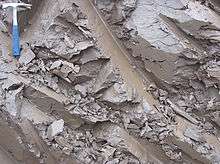
Clay in Estonia
Etymology
From Middle English clay, cley, from Old English clǣġ (“clay”), from Proto-Germanic *klajjaz (“clay”), from Proto-Indo-European *gley- (“to glue, paste, stick together”).[1] Cognate with Dutch klei (“clay”), Low German Klei (“clay”), German Klei, Danish klæg (“clay”); compare Ancient Greek γλία (glía), Latin glūten (“glue”) (whence ultimately English glue), Ukrainian ґлей (glej, “clay”). Related also to clag, clog.
Pronunciation
- enPR: klā, IPA(key): /kleɪ/
Audio (US) (file) - Rhymes: -eɪ
Noun
clay (usually uncountable, plural clays)
- A mineral substance made up of small crystals of silica and alumina, that is ductile when moist; the material of pre-fired ceramics.
- 1914, Louis Joseph Vance, Nobody, chapter I:
- Three chairs of the steamer type, all maimed, comprised the furniture of this roof-garden, with (by way of local colour) on one of the copings a row of four red clay flower-pots filled with sun-baked dust […].
- 1914, Louis Joseph Vance, Nobody, chapter I:
- An earth material with ductile qualities.
- (tennis) A tennis court surface.
- The French Open is played on clay.
- (biblical) The material of the human body.
- 1611, Old Testament, King James Version, Job 10:8-9:
- Thine hands have made me and fashioned me together round about...thou hast made me as the clay.
- 1611, Old Testament, King James Version, Isaiah 64:8:
- But now, O Lord, thou art our Father; we are the clay, and thou art our potter; and we are the work of thy hand.
- 1611, Old Testament, King James Version, Job 10:8-9:
- (geology) A particle less than 3.9 microns in diameter, following the Wentworth scale.
- (firearms, informal) A clay pigeon.
- We went shooting clays at the weekend.
- (Internet, informal) Land or territory of a country or other political region.
- Danzig is rightful German clay.
Antonyms
Hyponyms
Derived terms
Terms derived from clay
Translations
mineral substance
|
|
See also
Verb
clay (third-person singular simple present clays, present participle claying, simple past and past participle clayed)
- (transitive) To add clay to, to spread clay onto.
- (transitive, of sugar) To purify using clay.
- 1776, Adam Smith, An Inquiry into the Nature and Causes of the Wealth of Nations, Book IV, Chapter 7: Of Colonies, Part 2: Causes of Prosperity of New Colonies,
- They amounted, therefore, to a prohibition, at first of claying or refining sugar for any foreign market, and at present of claying or refining it for the market, which takes off, perhaps, more than nine-tenths of the whole produce.
- 1809, Jonathan Williams, On the Process of Claying Sugar, in Transactions of the American Philosophical Society, Volume 6.
- 1776, Adam Smith, An Inquiry into the Nature and Causes of the Wealth of Nations, Book IV, Chapter 7: Of Colonies, Part 2: Causes of Prosperity of New Colonies,
References
- ↑ Krueger 1982; Merriam-Webster 1974.
- Krueger, Dennis (December 1982). "Why On Earth Do They Call It Throwing?" Studio Potter volume 11, Number 1. (etymology)
- “clay” in Webster’s New Collegiate Dictionary: Based on Webster’s Third New International Dictionary, 8th edition, Springfield, Mass.: G[eorge] & C[harles] Merriam, 1973 (1974 printing), OCLC 299192187.
- Clay, New Webster Dictionary of English Language, 1980 edition.
Anagrams
This article is issued from
Wiktionary.
The text is licensed under Creative Commons - Attribution - Sharealike.
Additional terms may apply for the media files.