lar
English
Etymology
Pronunciation
- (Received Pronunciation) IPA(key): /lɑː/
- (US) IPA(key): /lɑɹ/, [lɑɹ], [lɑ˞]
Noun
- A household or ancestral god in ancient Rome
- 1974, Guy Davenport, Tatlin!:
- Would the great emperor’s lar, free of its soldierly body rheumatic from German mists and browned and grizzled by the Indus sun, haunt that pinedark road to Elefsis to taste again the essences on which it fed and gather with voluptuous fingers the ghosts of roses?
-
- The lar gibbon.
Usage notes
The first sense is most often used in English as the capitalized plurale tantum Lares. It is more often pluralized lares as in Latin than lars.
Derived terms
Anagrams
Albanian
Etymology
Noun
lar m (indefinite plural larë, definite singular lari, definite plural larët)
Synonyms
- dafinë
Derived terms
- larëz, larth, larushkë
References
- ↑ Vladimir Orel, Albanian Etymological Dictionary (Leiden: Brill, 1998), 213–4.
Galician
Etymology
Pronunciation
- IPA(key): /ˈlaɾ/
Noun
lar m (plural lares)
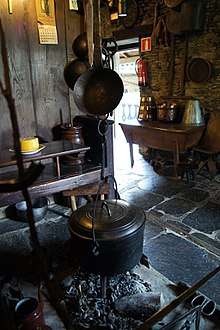
- home (place or building where one dwells)
- Miña casiña meu lar.
- My house, my home.
- fireside
- hearth
- 1485, Antonio López Ferreiro (ed.), Galicia Histórica. Colección diplomática. Santiago: Tipografía Galaica, page 286:
- iten vnna caldeyra de trager agoa, iten hua caldeyra de sobre do lar, iten dous caldeyros de mao
- item, a bucket for carrying water; item a cauldron for hanging over the hearth; item two hand cauldrons
- iten vnna caldeyra de trager agoa, iten hua caldeyra de sobre do lar, iten dous caldeyros de mao
- 1485, Antonio López Ferreiro (ed.), Galicia Histórica. Colección diplomática. Santiago: Tipografía Galaica, page 286:
- A household or ancestral god in ancient Rome
Synonyms
Derived terms
References
- “lar” in Dicionario de Dicionarios do galego medieval, SLI - ILGA 2006-2012.
- “lar” in Dicionario de Dicionarios da lingua galega, SLI - ILGA 2006-2013.
- “lar” in Santamarina, Antón (coord.): Tesouro informatizado da lingua galega. Santiago de Compostela: Instituto da Lingua Galega.
- “lar” in Álvarez, Rosario (coord.): Tesouro do léxico patrimonial galego e portugués, Santiago de Compostela: Instituto da Lingua Galega.
Latin
Alternative forms
Etymology
Probably from Etruscan 𐌋𐌀𐌓 (lar), 𐌋𐌀𐌓𐌔 (lars), or 𐌋𐌀𐌓𐌈 (larθ, “lord”), though it could possibly be from Proto-Indo-European *las- (“eager”), cognate with lascivus.
Pronunciation
- (Classical) IPA(key): /laːr/, [ɫaːr]
Noun
lār m (genitive laris); third declension
Declension
Third declension.
| Case | Singular | Plural |
|---|---|---|
| nominative | lār | larēs |
| genitive | laris | larum |
| dative | larī | laribus |
| accusative | larem | larēs |
| ablative | lare | laribus |
| vocative | lār | larēs |
Related terms
Descendants
References
- Lar in Charlton T. Lewis and Charles Short (1879) A Latin Dictionary, Oxford: Clarendon Press
- lar in Harry Thurston Peck, editor (1898) Harper's Dictionary of Classical Antiquities, New York: Harper & Brothers
- lar in William Smith, editor (1848) A Dictionary of Greek Biography and Mythology, London: John Murray
- De Vaan, Michiel (2008) Etymological Dictionary of Latin and the other Italic Languages (Leiden Indo-European Etymological Dictionary Series; 7), Leiden, Boston: Brill
Middle English
Noun
lar
- Alternative form of lore
Norwegian Bokmål
Verb
lar
- present tense of la
Norwegian Nynorsk
Verb
lar
- present tense of la
Old English
Etymology
From Proto-Germanic *laizō, from *laizijaną (“to teach”). Cognate with Old Saxon lēra, Dutch leer, Old High German lēra (German Lehre).
Pronunciation
- IPA(key): /lɑːr/
Noun
lār f (nominative plural lāre)
Declension
Derived terms
Related terms
Descendants
Portuguese
Etymology
From Latin larem (“guardian spirit”), from Etruscan 𐌋𐌀𐌓 (lar), 𐌋𐌀𐌓𐌔 (lars), or 𐌋𐌀𐌓𐌈 (larth, “lord”).
Pronunciation
Noun
lar m (plural lares)
- (affectionate) home (place or building where one dwells)
- Não há lugar como o nosso lar.
- There is no place like home.
Synonyms
Related terms
Spanish
Etymology
From Latin lār, lārem, in its current form most likely a learned borrowing[1]. A popular or inherited form also existed, referring to the irons in a hearth on which vats were hung to heat water or make stews. The word may ultimately be of Etruscan origin.
Noun
lar m (plural lares)
Synonyms
- hogar m
See also
- casa f