chicken
English
.jpg)
Pronunciation
- (Received Pronunciation, General American) IPA(key): /ˈt͡ʃɪkɪn/
Audio (RP) (file) Audio (RP) (file) Audio (GA) (file) - Rhymes: -ɪkɪn
- Hyphenation: chick‧en
- Rhymes: -ɪkən
Etymology 1
From Middle English chiken (also as chike > English chick), from Old English ċicen, ċycen (“chicken”), of uncertain origin. Possibly from Proto-Germanic *kiukīną (“chicken”), or alternatively from Proto-Germanic *kukkīną, equivalent to cock + -en (diminutive suffix). Compare North Frisian schückling (“chicken”), Saterland Frisian Sjuuken (“chicken”), Dutch kuiken (“chick, chicken”), Low German küken (“chicken”), German Küken (“chick”), dialectal German Küchlein (“chicken”) and Old Norse kjúklingr (“chicken”).
Noun
chicken (countable and uncountable, plural chickens)
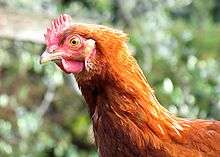
- (countable) A domestic fowl, Gallus gallus, especially when young.
- (uncountable) The meat from this bird eaten as food.
- (countable, slang) A coward.
- (countable, slang) A young or inexperienced person.
- 1752, Jonathan Swift, “Stella's Birth-day, 1720”, in The Works of D. Jonathan Swift. In Nine Volumes. The Seventh Edition, to which is Prefixed, the Doctor's Life, with Remarks on His Writings, from the Earl of Orrery and Others, not to be Found in any Former Edition of His Works, volume II (Containing His Poetical Writings), 7th edition, Dublin; Edinburgh: [P]rinted; and [...] reprinted, for G. Hamilton & J. Balfour, & L. Hunter at Edinburgh; and A. Stalker, at Glasgow; and sold by them and other booksellers, OCLC 642497542, page 99:
- Purſue your trade of ſcandal-picking, / Your hints, that Stella is no chicken: / Your innuendos, when you tell us, / That Stella loves to talk with fellows; […]
- 1886, A[rthur] Conan Doyle, “The Lauriston Garden Mystery”, in A Study in Scarlet (Beeton's Christmas Annual; 28th season), London; New York, N.Y.: Ward Lock & Co., November 1887, OCLC 15800088; republished as A Study in Scarlet. A Detective Story, new edition, London: Ward, Lock, Bowden, and Co., 1892, OCLC 23246292, page 43:
- "This case will make a stir, sir," he remarked. "It beats anything I have seen, and I am no chicken."
-
- (countable, Polari) A young, attractive, slim man, usually having little body hair; compare chickenhawk.
- The game of dare.
- A confrontational game in which the participants move toward each other at high speed (usually in automobiles); the player who turns first to avoid colliding into the other is the chicken (that is, the loser.)
- Don't play chicken with a freight train; you're guaranteed to lose.
- A confrontational game in which the participants move toward each other at high speed (usually in automobiles); the player who turns first to avoid colliding into the other is the chicken (that is, the loser.)
Synonyms
- (bird): biddy, chook (Australia, NZ)
- (coward): see Thesaurus:coward
- (young inexperienced person): spring chicken
- (young, attractive, slim man): twink
Hyponyms
Derived terms
Translations
|
|
|
|
|
|
See also
Adjective
chicken (comparative more chicken, superlative most chicken)
- (informal) Cowardly.
- Why do you refuse to fight? Huh, I guess you're just too chicken.
Derived terms
Etymology 2
Shortening of chicken out.
Verb
chicken (third-person singular simple present chickens, present participle chickening, simple past and past participle chickened)
- (intransitive) To avoid a situation one is afraid of.
- 1964, Max Shulman, Anyone Got a Match?, New York, N.Y.: Harper & Row, OCLC 176716, page 31:
- For the umpteenth time, I chickened.
- 1968, Aidan Chambers, The Chicken Run: A Play for Young People, Oxford: Heinemann Educational Publishers, →ISBN, Act II, scene v, page 81:
- ABE: What are you chucking it for, then? You're running, aren't you? Running, cos you chickened. / SLIM: All right, so I chickened.
- 2014, Anne M. Brown, “James Day”, in Belonging: The Story of How James Became a Brown, Acacia Ridge, Qld.: Australian eBook Publisher, →ISBN:
- To reach the lower branches of the blackwood one had to swing Tarzan-like across a narrow gully choked with gorse and blackberries. […] [T]he challenge of the rope swing was definitely more in James' line. […] Even if he slipped and failed, or worse, chickened, they would be unlikely to judge too harshly.
-
Etymology 3
From chick + -en (plural ending).
Noun
chicken
Further reading

Anagrams
Scots
Etymology
Noun
chicken (plural chickens)