vista
English
Etymology
Borrowed from Italian vista (“view, sight”), from visto, past participle of vedere (“to see”), from Latin vidēre, present active infinitive of videō (“I see”). Compare vision, video.
Pronunciation
- IPA(key): /ˈvɪstə/
Noun
vista (plural vistas)
- A distant view or prospect, especially one seen through some opening, avenue or a passage.
- 1999, Harish Kapadia, “Ascents in the Panch Chuli Group”, in Across Peaks & Passes in Kumaun Himalaya, New Delhi: Indus Publishing Company, →ISBN, page 136:
- We had our reward for our high camp and early start, for the sky was still clear, the view magnificent, with fresh vistas to the north of mountains in Tibet, of Gurla Mandhata, massive, majestic to the northeast, and further to the north, a distant pyramid, Kailash, most holy of all mountains in both Hindu and Buddhist mythology.
-
- A site offering such a view.
- (figuratively) A vision, a view presented to the mind in prospect or in retrospect by the imagination.
- a vista of pleasure to come
- dim vistas of the past
Derived terms
Related terms
Translations
References
- vista in The Century Dictionary, The Century Co., New York, 1911
- “vista”, in OED Online

Anagrams
Asturian
Etymology
From Vulgar Latin *visita, from Latin visa, feminine past participle of videō.
Noun
vista f (plural vistes)
- vision (sense or ability of sight)
- Synonym: visión
- view
- celerity
- This term needs a translation to English. Please help out and add a translation, then remove the text
{{rfdef}}.
Catalan
Etymology
From Vulgar Latin *visita, from Latin visa, feminine past participle of videō.
Noun
vista f (plural vistes)
Galician
Etymology
From Old Portuguese, from Vulgar Latin *visita, from Latin visa, feminine past participle of videō.
Noun
vista f (plural vistas)
Icelandic
Pronunciation
- IPA(key): /ˈvɪsta/
- Rhymes: -ɪsta
Verb
vista (weak verb, third-person singular past indicative vistaði, supine vistað)
- (transitive, intransitive, with accusative) to place, to find a place for
- (transitive, intransitive, with accusative, computing) to save a document, a file, pages etc.
- Vista sem…
- Save as…
- Ég vistaði myndirnar sem þú sendir mér.
- I saved the pictures you sent me.
- Ég kann ekki að vista myndir af Netinu.
- I don’t know how to save images from the Internet.
Usage notes
Conjugation
| infinitive (nafnháttur) |
að vista | ||||
|---|---|---|---|---|---|
| supine (sagnbót) |
vistað | ||||
| present participle (lýsingarháttur nútíðar) |
vistandi | ||||
| indicative (framsöguháttur) |
subjunctive (viðtengingarháttur) | ||||
| present (nútíð) |
ég vista | við vistum | present (nútíð) |
ég visti | við vistum |
| þú vistar | þið vistið | þú vistir | þið vistið | ||
| hann, hún, það vistar | þeir, þær, þau vista | hann, hún, það visti | þeir, þær, þau visti | ||
| past (þátíð) |
ég vistaði | við vistuðum | past (þátíð) |
ég vistaði | við vistuðum |
| þú vistaðir | þið vistuðuð | þú vistaðir | þið vistuðuð | ||
| hann, hún, það vistaði | þeir, þær, þau vistuðu | hann, hún, það vistaði | þeir, þær, þau vistuðu | ||
| imperative (boðháttur) |
vista (þú) | vistið (þið) | |||
| Forms with appended personal pronoun | |||||
| vistaðu | vistiði * | ||||
| * Spoken form, usually not written; in writing, the unappended plural form (optionally followed by the full pronoun) is preferred. | |||||
| infinitive (nafnháttur) |
að vistast | ||||
|---|---|---|---|---|---|
| supine (sagnbót) |
vistast | ||||
| present participle (lýsingarháttur nútíðar) |
vistandist ** ** the mediopassive present participle is extremely rare and normally not used; it is never used attributively or predicatively, only for explicatory subclauses | ||||
| indicative (framsöguháttur) |
subjunctive (viðtengingarháttur) | ||||
| present (nútíð) |
ég vistast | við vistumst | present (nútíð) |
ég vistist | við vistumst |
| þú vistast | þið vistist | þú vistist | þið vistist | ||
| hann, hún, það vistast | þeir, þær, þau vistast | hann, hún, það vistist | þeir, þær, þau vistist | ||
| past (þátíð) |
ég vistaðist | við vistuðumst | past (þátíð) |
ég vistaðist | við vistuðumst |
| þú vistaðist | þið vistuðust | þú vistaðist | þið vistuðust | ||
| hann, hún, það vistaðist | þeir, þær, þau vistuðust | hann, hún, það vistaðist | þeir, þær, þau vistuðust | ||
| imperative (boðháttur) |
vistast (þú) | vistist (þið) | |||
| Forms with appended personal pronoun | |||||
| vistastu | vististi * | ||||
| * Spoken form, usually not written; in writing, the unappended plural form (optionally followed by the full pronoun) is preferred. | |||||
| strong declension (sterk beyging) |
singular (eintala) | plural (fleirtala) | |||||
|---|---|---|---|---|---|---|---|
| masculine (karlkyn) |
feminine (kvenkyn) |
neuter (hvorugkyn) |
masculine (karlkyn) |
feminine (kvenkyn) |
neuter (hvorugkyn) | ||
| nominative (nefnifall) |
vistaður | vistuð | vistað | vistaðir | vistaðar | vistuð | |
| accusative (þolfall) |
vistaðan | vistaða | vistað | vistaða | vistaðar | vistuð | |
| dative (þágufall) |
vistuðum | vistaðri | vistuðu | vistuðum | vistuðum | vistuðum | |
| genitive (eignarfall) |
vistaðs | vistaðrar | vistaðs | vistaðra | vistaðra | vistaðra | |
| weak declension (veik beyging) |
singular (eintala) | plural (fleirtala) | |||||
| masculine (karlkyn) |
feminine (kvenkyn) |
neuter (hvorugkyn) |
masculine (karlkyn) |
feminine (kvenkyn) |
neuter (hvorugkyn) | ||
| nominative (nefnifall) |
vistaði | vistaða | vistaða | vistuðu | vistuðu | vistuðu | |
| accusative (þolfall) |
vistaða | vistuðu | vistaða | vistuðu | vistuðu | vistuðu | |
| dative (þágufall) |
vistaða | vistuðu | vistaða | vistuðu | vistuðu | vistuðu | |
| genitive (eignarfall) |
vistaða | vistuðu | vistaða | vistuðu | vistuðu | vistuðu | |
Italian
Etymology
From Vulgar Latin *visita, from Latin visa, feminine past participle of videō.
Pronunciation
Audio (IT) (file)
Participle
vista f sg
- feminine singular of visto
Adjective
vista f sg
- Feminine singular of adjective visto.
Noun
vista f (plural viste)
Hypernyms
Related terms
Verb
vista
Anagrams
Latvian
Etymology
There are two theories on the origin of this word. One derives it from Proto-Baltic *wiš- (with an extra element -tā), from Proto-Indo-European *wik-, the zero grade form of *weyḱ- (“house, settlement”). The original meaning would then have been “(relating to) the house, the settlement", from which "domestic (animal)” and finally “chicken.” The other theory relates it to Avestan 𐬬𐬍𐬱 (vīš, “bird”), possibly from a Proto-Indo-European stem *weys-. Cognates include Lithuanian vištà.[1]
Pronunciation
Audio (file)
Noun
vista f (4th declension)
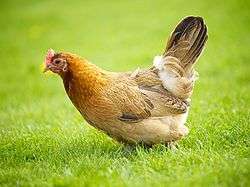
- hen (female chicken); chicken (Gallus gallus in general)
- mājas vista ― domestic chicken
- vista ar cāļiem ― hen with chicks
- vistas gaļa, olas ― chicken meat, eggs
- vistu kūts ― henhouse
- perētāja vista ― broody hen, sitter
- cekulainā vista ― crested hen
- vistas buljons ― chicken broth
Declension
Related terms
References
- ↑ Karulis, Konstantīns (1992), “vista”, in Latviešu Etimoloģijas Vārdnīca (in Latvian), Rīga: AVOTS, →ISBN
Portuguese
Etymology
Past participle of ver. From Old Portuguese, from Vulgar Latin *visita, from Latin visa, feminine past participle of videō.
Pronunciation
- (Portugal) IPA(key): /ˈviʃ.tɐ/
- Hyphenation: vis‧ta
Noun
vista f (plural vistas)
- (colloquial) eye; eyeball
- Synonym: olho (more common)
- sight
- Tenho uma vista normal.
- I have normal eyesight.
- view
- Mas que vista maravilhosa!
- What a marvelous view!
Derived terms
Adjective
vista f sg
- Feminine singular of adjective visto.
Verb
vista f sg
- feminine singular past participle of ver
Romansch
Alternative forms
- vesta (Sursilvan, Sutsilvan, Surmiran)
Etymology
From Vulgar Latin *visita, from Latin visa, feminine past participle of videō.
Noun
vista f (plural vistas)
- (Rumantsch Grischun, Surmiran, Puter, Vallader) view
- (Rumantsch Grischun, anatomy) cheek
- (Puter, Vallader, anatomy) face
- Synonym: fatscha
Synonyms
Spanish
Etymology
From the Vulgar Latin *visita, from Latin videō.
Pronunciation
- IPA(key): /ˈbista/
Adjective
vista f sg
- Feminine singular of adjective visto.
Noun
vista f (plural vistas)
Derived terms
|
|
Related terms
Verb
vista
Verb
vista f sg
- Feminine singular past participle of ver.
References
- “vista” in Diccionario de la lengua española, Vigésima tercera edición, Real Academia Española, 2014.