cam
English
Pronunciation
- IPA(key): [kæm]
- Rhymes: -æm
Etymology 1
Recorded since the 16th century, from Dutch kam (“cog of a wheel; originally, comb”) (cognate with English comb, and preserved in modern Dutch compounds such as kamrad, kamwiel (“cog wheel”))
Noun
cam (plural cams)
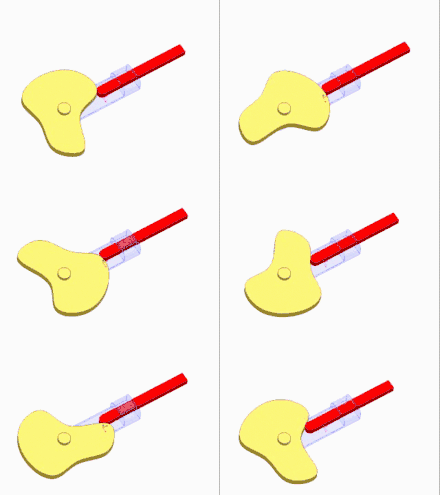
- A turning or sliding piece which imparts motion to a rod, lever or block brought into sliding or rolling contact with it.
- A curved wedge, movable about an axis, used for forcing or clamping two pieces together.
- (Britain, dialect) A ridge or mound of earth.
- (Can we find and add a quotation of Wright to this entry?)
- (rock climbing) A camming device, a spring-loaded device for effecting a temporary belay in a rock crevice.
Derived terms
Translations
|
See also
Further reading
Etymology 2
Clipping of camera, from the first part of Latin camera obscura (“dark chamber”), itself from Ancient Greek καμάρα (kamára, “vaulted chamber”), from Proto-Indo-European *kam- (“to arch”)
Noun
cam (plural cams)
- (informal) Camera.
Derived terms
Translations
Verb
cam (third-person singular simple present cams, present participle camming, simple past and past participle cammed)
- To go on webcam with someone.
Etymology 3
Adverb
cam (comparative more cam, superlative most cam)
- Alternative form of kam
Further reading
- cam in Webster’s Revised Unabridged Dictionary, G. & C. Merriam, 1913
Anagrams
Acholi
Noun
cam
French
Etymology
Pronunciation
- IPA(key): /kam/
Noun
cam f (plural cams)
- cam (device for filming)
Abbreviation
cam m (uncountable)
Alternative forms
- (contre-amiral): CAm
Anagrams
Irish
Etymology
From Old Irish camm, from Proto-Celtic *kambos.
Pronunciation
Adjective
cam (genitive singular masculine caim, genitive singular feminine caime, plural cama, comparative caime)
Declension
| Singular | Plural (m/f) | |||
|---|---|---|---|---|
| Positive | Masculine | Feminine | (strong noun) | (weak noun) |
| Nominative | cam | cham | cama; chama² | |
| Vocative | chaim | cama | ||
| Genitive | caime | cama | cam | |
| Dative | cam; cham¹ |
cham; chaim (archaic) |
cama; chama² | |
| Comparative | níos caime | |||
| Superlative | is caime | |||
¹ When the preceding noun is lenited and governed by the definite article.
² When the preceding noun ends in a slender consonant.
Mutation
| Irish mutation | ||
|---|---|---|
| Radical | Lenition | Eclipsis |
| cam | cham | gcam |
| Note: Some of these forms may be hypothetical. Not every possible mutated form of every word actually occurs. | ||
Kurdish
Etymology
Related to Persian جام (jam).
Noun
cam f
Manx
Etymology
From Old Irish camm, from Proto-Celtic *kambos.
Adjective
cam (plural cammey)
Verb
Mutation
| Manx mutation | ||
|---|---|---|
| Radical | Lenition | Eclipsis |
| cam | cham | gam |
| Note: Some of these forms may be hypothetical. Not every possible mutated form of every word actually occurs. | ||
Old Irish
Adjective
cam
- Alternative spelling of camm
Declension
| o/ā-stem | |||
|---|---|---|---|
| Singular | Masculine | Feminine | Neuter |
| Nominative | cam | cam | cam |
| Vocative | caim* cam** | ||
| Accusative | cam | caim | |
| Genitive | caim | caime | caim |
| Dative | cam | caim | cam |
| Plural | Masculine | Feminine/neuter | |
| Nominative | caim | cama | |
| Vocative | camu cama† | ||
| Accusative | camu cama† | ||
| Genitive | cam | ||
| Dative | camaib | ||
| Notes | *modifying a noun whose vocative is different from its nominative **modifying a noun whose vocative is identical to its nominative | ||
Mutation
| Old Irish mutation | ||
|---|---|---|
| Radical | Lenition | Nasalization |
| cam | cham | cam pronounced with /ɡ(ʲ)-/ |
| Note: Some of these forms may be hypothetical. Not every possible mutated form of every word actually occurs. | ||
Romanian
Etymology
From Latin quam, or more likely from camai, from Latin quam magis.
Adverb
cam
- approximately, a little
- rather
- Lacul ăsta e cam murdar.
- This lake is rather dirty.
Related terms
Scottish Gaelic
Etymology
From Old Irish camm, from Proto-Celtic *kambos.
Pronunciation
- IPA(key): /kaːm/, /kʰaum/
Adjective
cam
Declension
First declension; forms of the positive degree:
| Case | Masculine singular | Feminine singular | Plural |
|---|---|---|---|
| Nominative | cam | cham | cama |
| Vocative | chaim | chaim | cama |
| Genitive | chaim | chaim/caime | cam |
| Dative | cham | chaim | cama |
Comparative/superlative: caime
Turkish
Etymology
Pronunciation
- IPA(key): /dʒam/
Noun
cam (definite accusative camı, plural camlar)
Vietnamese
Etymology
Sino-Vietnamese word from 柑 (“orange”).
Pronunciation
- (Hà Nội) IPA(key): [kaːm˧˧]
- (Huế) IPA(key): [kaːm˧˧]
- (Hồ Chí Minh City) IPA(key): [kaːm˧˧]
Noun
(classifier cây, trái, quả) cam
Derived terms
- cam sành - a Vietnamese citrus fruit similar to an orange
- cây cam - orange tree
Adjective
cam
Derived terms
- nước cam - orange juice (literally: "orange water")
- sách màu cam - orange book (literally: "orange-coloured book")
Welsh
Etymology 1
From Proto-Celtic *kanksman, *kanxsman, from *kengeti.
Noun
cam m (plural camau)
- step, pace, footstep
- footfall (sound made by a footstep)
- footprint
- step (of a process), stage, phase
Derived terms
- cam a cham (“step by step”)
- camu (“to step”)
Etymology 2
From Proto-Celtic *kambos. Compare Old Irish camm.
Adjective
cam (feminine singular cam, plural ceimion, equative camed, comparative camach, superlative camaf)
Derived terms
- ar gam (“unjustly, wrongly”)
- camu (“to bend, to distort”)
Noun
cam m (plural camau)
Etymology 3
Noun
cam m (plural camau)
Mutation
| Welsh mutation | |||
|---|---|---|---|
| radical | soft | nasal | aspirate |
| cam | gam | ngham | cham |
| Note: Some of these forms may be hypothetical. Not every possible mutated form of every word actually occurs. | |||
Zhuang
Etymology
From Proto-Tai *c.raːmᴬ (“to ask”). Cognate with Thai ถาม (tǎam), Northern Thai ᨳᩣ᩠ᨾ, Lao ຖາມ (thām), Lü ᦏᦱᧄ (ṫhaam), Shan ထၢမ် (thǎam), Ahom 𑜌𑜪 (tham), 𑜌𑜉𑜫 (tham) or 𑜌𑜢𑜤𑜉𑜫 (thuem), Saek ถ่าม.
Pronunciation
- (Standard Zhuang) IPA(key): /ɕaːm˨˦/
- Tone numbers: cam1
- Hyphenation: cam
Verb
cam (old orthography cam)
- to ask (to request an answer)
- to inquire; to ask
- to ask for instructions