dye
See also: d'ye
English
Pronunciation
Etymology 1
From Middle English deie, from Old English dēag (“color, hue, dye”), from Proto-Germanic *daugō (“colour, shade”), from *dauganą, *dug- (“to conceal, be dark”), from Proto-Indo-European *dʰewh₂- (“to smoke, raise dust, camouflage”). Cognate with Old High German tougan (“dark, secretive”), tougal (“dark, hidden, covert”), Old English dēagol, dīegle (“dark, hidden, secret”), Old English dohs, dox (“dusky, dark”). See dusk.
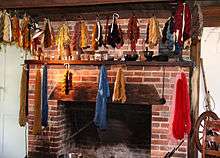
Yarn colored with dye. The yarn has been dyed.
Noun
dye (countable and uncountable, plural dyes)
Synonyms
Translations
a colourant, especially one that has an affinity to the substrate to which it is applied
|
|
See also
Verb
dye (third-person singular simple present dyes, present participle dyeing, simple past and past participle dyed)
- (transitive) to colour with dye
Synonyms
Derived terms
Translations
to colour with dye
|
|
Etymology 2
Noun
dye (plural dice)
- Alternative spelling of die
- 1748. David Hume. Enquiries concerning the human understanding and concerning the principles of moral. London: Oxford University Press, 1973. § 46.
- If a dye were marked with one figure or number of spots on four sides, and with another figure or number of spots on the two remaining sides, it would be more probable, that the former would turn up than the latter;
- 1748. David Hume. Enquiries concerning the human understanding and concerning the principles of moral. London: Oxford University Press, 1973. § 46.
Translations
die — see die
Anagrams
Haitian Creole
Etymology
Noun
dye
This article is issued from
Wiktionary.
The text is licensed under Creative Commons - Attribution - Sharealike.
Additional terms may apply for the media files.