塚
| ||||||||
| ||||||||
Translingual
| Japanese | 塚 |
|---|---|
| Simplified | 冢 |
| Traditional | 塚 |
Alternative forms
- There are two Unicode z-variants, at code points U+585A and U+FA10. The latter form (U+FA10) has the next to last stroke of 豖 connected to the top horizontal stroke (similar to 衣).
- The Japanese form of the character is written with 豕 instead of 豖 as its bottom right component. However both 塚 (Japanese) and 塚 (traditional Chinese) forms are encoded under the same codepoint.
Han character
塚 (radical 32 土+10 in Chinese, 土+9 in Japanese, in Chinese 13 strokes, in Japanese 12 strokes, cangjie input 土月一人 (GBMO), four-corner 47132, composition ⿰土冢(GHTK) or ⿰土⿱冖豕(J))
References
- KangXi: page 236, character 2
- Dai Kanwa Jiten: character 5345
- Dae Jaweon: page 473, character 18
- Hanyu Da Zidian: volume 1, page 476, character 7
- Unihan data for U+585A
- Unihan data for U+FA10
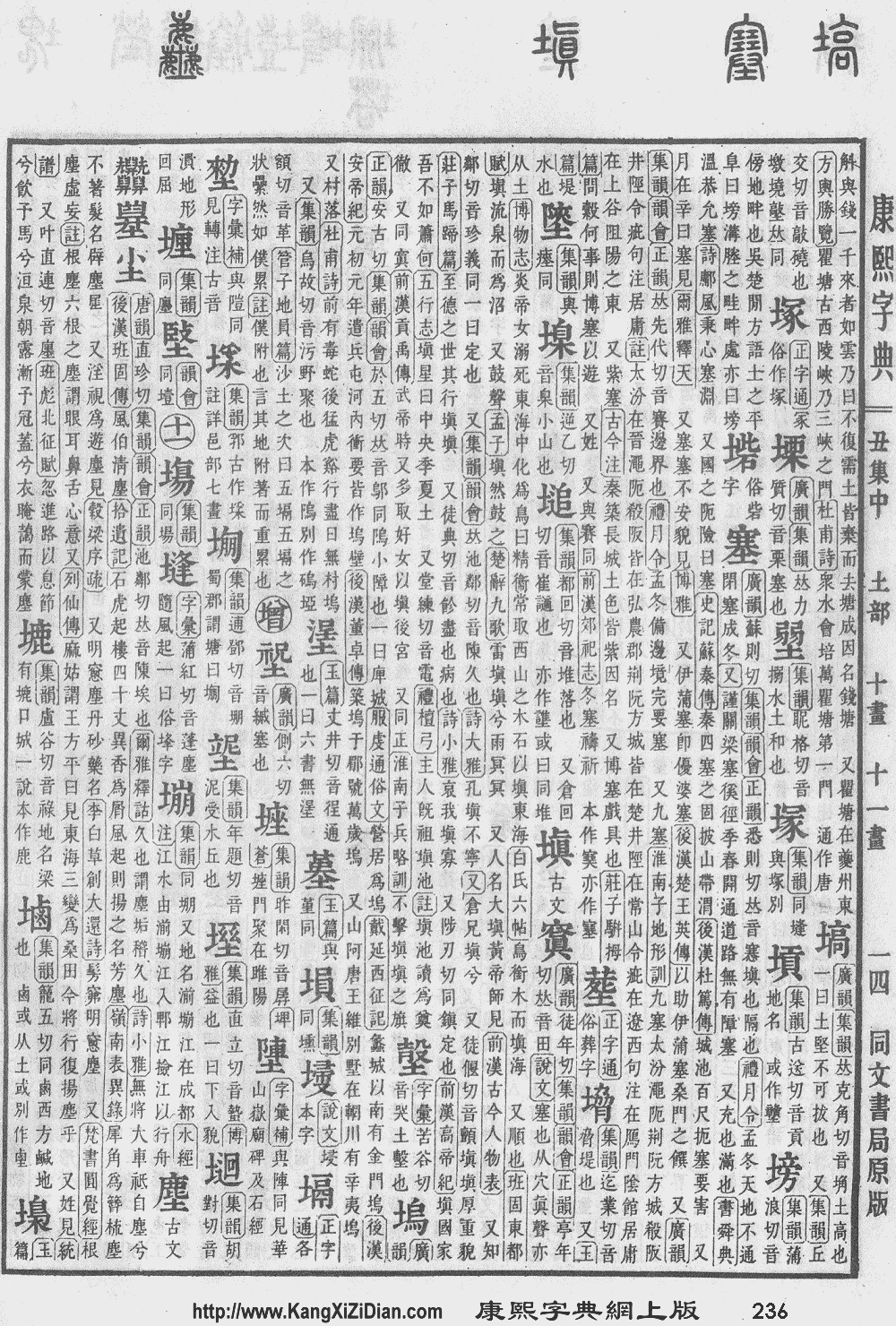
Usage notes
The Kangxi dictionary lists 塚 as the unorthodox form (俗字) of 冢. However, the usage of 塚 persists in Japan with one stroke removed. In traditional and simplified Chinese 冢 is the orthodox form (正字) of the character. As a variant character, 塚 is used in mainland China.
Chinese
Glyph origin
| Characters in the same phonetic series (豖) (Zhengzhang, 2003) | |
|---|---|
| Old Chinese | |
| 冢 | *toŋʔ |
| 塚 | *toŋʔ |
| 涿 | *rtoːɡ |
| 琢 | *rtoːɡ |
| 啄 | *rtoːɡ, *toːɡ |
| 諑 | *rtoːɡ |
| 剢 | *toːɡ |
| 瘃 | *toɡ |
| 豖 | *tʰoɡ |
Phono-semantic compound (形聲, OC *toŋʔ) : semantic 土 (“earth”) + phonetic 冢 (OC *toŋʔ) – an earthen mound, a tomb of earth.
Definitions
| For pronunciation and definitions of 塚 – see 冢 (“tomb, burial mound”). (This character, 塚, is a variant form of 冢.) |
Japanese
Kanji
Readings
Etymology
| Kanji in this term |
|---|
| 塚 |
| つか Grade: S |
| kun’yomi |
Cognate with Old Japanese verb 築く (tsuku, “to build up using earth and/or stone”).[1]
The /a/ ending may indicate that tsuka developed as the nominalization of the 未然形 (mizenkei, “irrealis form”) of the verb, suggesting an original meaning of "that which is being built up into an earthworks (but isn't finished yet)". The irrealis is also the root form for constructing the passive form of all Japanese verbs, so the original meaning might instead have been just the passive sense of "that which is built up into an earthworks".
Pronunciation
Alternative forms
Noun
Derived terms
Synonyms
References
Korean
Hanja
塚 • (chong) (hangeul 총, revised chong, McCune–Reischauer ch'ong)
Vietnamese
Han character
塚 (trủng)
- This term needs a translation to English. Please help out and add a translation, then remove the text
{{rfdef}}.