凞
| ||||||||
| ||||||||
Translingual
| 凞 | |
| 凞 | |
| 凞 | |
| 凞 |
Alternative forms
- In mainland China and Japan, the character is composed of 冫 and 熈 as the right and left components.
- In Taiwan and Hong Kong, only the upper left component consists of 冫 while the bottom consists entirely of 灬.
- In Korea, the middle component 丿 is missing and 巳 is replaced by 㔾.
- A CJK compatibility ideograph exists at
U+FA15which is similar to the Korean form except 㔾 is replaced by 巳.
Han character
凞 (radical 15 冫+14, 16 strokes, cangjie input 戈一中尸火 (IMLSF), four-corner 37331, composition ⿰冫熈(GJ) or ⿱⿰冫⿲丿臣巳灬(HT) or ⿱⿲冫臣㔾灬(K) or ⿱⿲冫臣巳灬(U+FA15))
Related characters
- 熙 (Preferred form in modern Chinese)
- 煕 (Orthodox form in Kangxi dictionary)
References
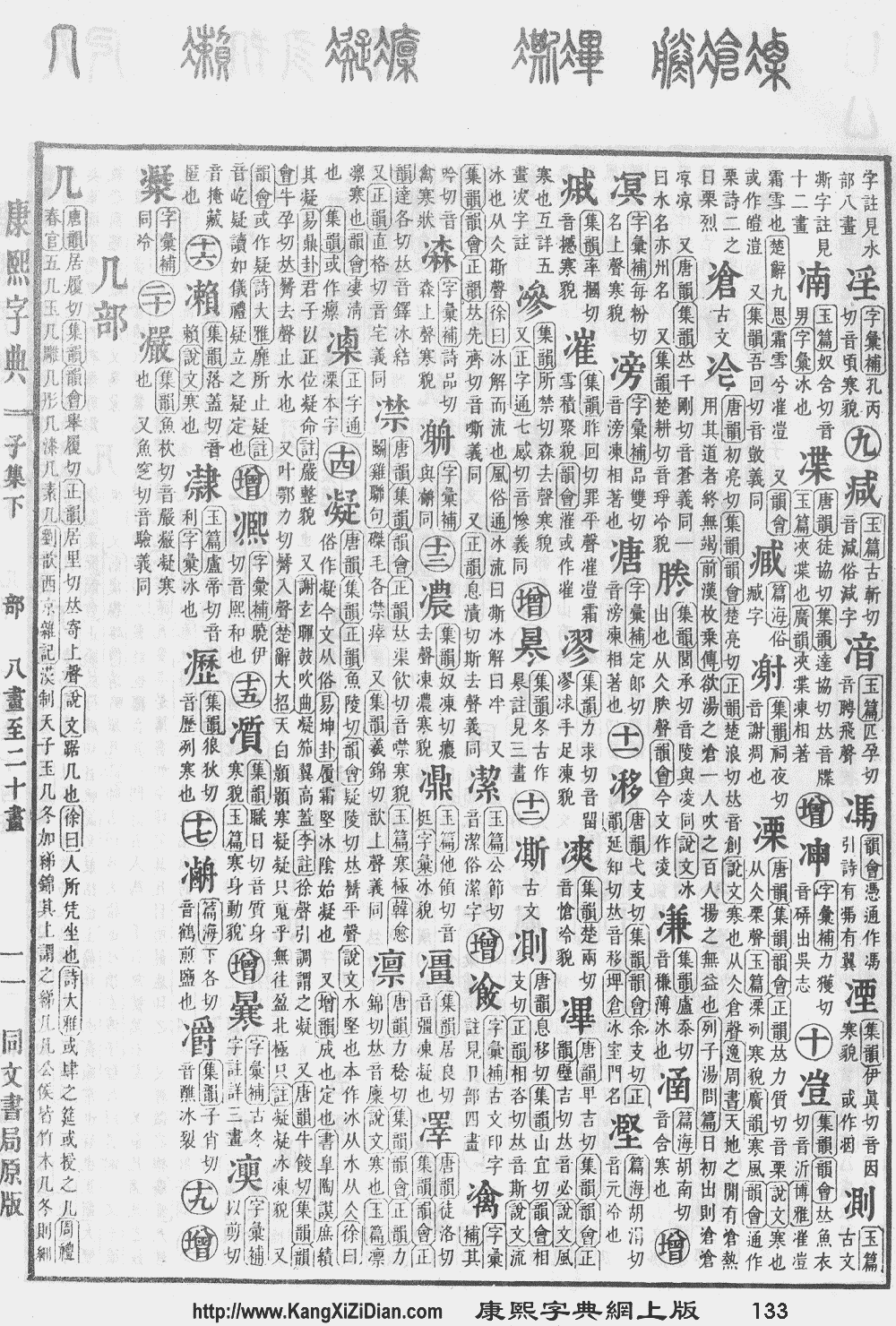
- KangXi: page 133, character 46
- Dai Kanwa Jiten: character 1721
- Dae Jaweon: page 298, character 28
- Hanyu Da Zidian: volume 1, page 301, character 16
- Unihan data for U+51DE
Chinese
| For pronunciation and definitions of 凞 – see 熙 (“bright; splendid; glorious”). (This character, 凞, is recorded in one or more historical dictionaries as a variant form of 熙.) |
Japanese
Kanji
凞
- This term needs a translation to English. Please help out and add a translation, then remove the text
{{rfdef}}.
Readings
Korean
Hanja
凞 • (hui) (hangeul 희, revised hui, McCune–Reischauer hŭi)
- This term needs a translation to English. Please help out and add a translation, then remove the text
{{rfdef}}.
This article is issued from
Wiktionary.
The text is licensed under Creative Commons - Attribution - Sharealike.
Additional terms may apply for the media files.