สาง
Thai
Pronunciation
| Orthographic/Phonemic | สาง s ā ŋ | |
| Romanization | Paiboon | sǎang |
| Royal Institute | sang | |
| (standard) IPA(key) | /saːŋ˩˩˦/ | |
Etymology 1
Uncertain.
Alternative forms
Alternative forms
|
Noun
สาง • (sǎang)
Derived terms
Derived terms
|
|
|
Etymology 2
Uncertain. Compare Old Khmer *rāṅ, rāṅ, rāṅṅ (“to grow light, to dawn; to rise up; auroral, dim”); Old Khmer slāṅ (“colourless; pale; pallid”); Modern Khmer ស្រាង (sraang, “auroral; dim; early”); Modern Khmer ស្លាំង (slang, “colourless; pale”), ស្រាំង (srang, “colourless; pale”).
Verb
สาง • (sǎang) (abstract noun การสาง)
Noun
สาง • (sǎang)
Derived terms
Derived terms
|
|
Etymology 3
Uncertain. Perhaps corruption of ช้าง (cháang).
Noun
สาง • (sǎang)
- (somewhat archaic) elephant.
Synonyms
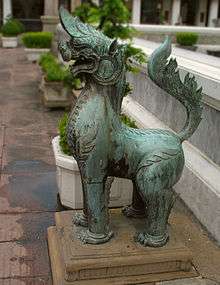
Etymology 4, definition 1: สาง at the Temple of the Reclining Buddha
Etymology 4
Uncertain.
Noun
สาง • (sǎang)
- (mythology) mythological creature, said to be like a tiger or lion.
- (mythology) supernatural tiger สมิง (sà-mǐng).
This article is issued from
Wiktionary.
The text is licensed under Creative Commons - Attribution - Sharealike.
Additional terms may apply for the media files.