vilks
Latvian
Etymology
From Proto-Balto-Slavic *wilkas, from Proto-Indo-European *wĺ̥kʷos, perhaps from a stem *wel, *welh₂ (“to tear up; to pluck; to plunder; to kill”), whence also vilkt (“to drag, to pull”) (q.v.). The word would originally have been a descriptive nickname ('the killer, the plunderer, the destroyer'), the original name having perhaps become a taboo word. Note that similarly formed nicknames for “wolf” still occur in modern Latvian: pelēcis (“gray one”), mežainis (“forest one”), mežavīrs (“forest man”), vecbrālis (“old brother”), etc. Cognates include Lithuanian vil̃kas, Old Prussian wilkis, Proto-Slavic *vьlkъ (Old Church Slavonic влькъ (vlĭkŭ), Russian волк (volk), Belarusian воўк (voŭk), Ukrainian вовк (vovk), dialetal вівк (vivk), Bulgarian вълк (vǎlk), Czech vlk, Slovak vlk, Polish wilk), Gothic 𐍅𐌿𐌻𐍆𐍃 (wulfs), Old English wulf, Old High German wolf, German Wolf, English wolf, Sanskrit वृक (vṛka), Ancient Greek λύκος (lúkos) (< *lukʷos < *wĺ̥kʷos), perhaps also Latin lupus.[1]
Pronunciation
- IPA(key): [vìlks]
| Audio | (file) |
Noun
vilks m (1st declension)
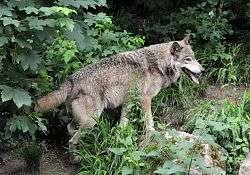
- wolf (esp. Canis lupus)
- pelēkais vilks ― gray wolf
- vilka midzenis ― wolf's lair
- vilku bars ― a pack of wolves
- vilks gaudo, kauc ― the wolf howls
- vilku kaucieni ― wolf howls
- medīt vilkus ― to hunt wolves
- izsalcis kā vilks ― hungry as a wolf
Declension
Derived terms
Verb
vilks
References
- ↑ Karulis, Konstantīns (1992), “vilks”, in Latviešu Etimoloģijas Vārdnīca (in Latvian), Rīga: AVOTS, →ISBN
Lithuanian
Pronunciation
- IPA(key): [vʲɪlks̪]
Verb
vil̃ks