vest
English
Etymology
From French veste (“a vest, jacket”), from Latin vestis (“a garment, gown, robe, vestment, clothing, vesture”), from Proto-Indo-European *wes-ti(h₂)-, from *wes- (“to be dressed”) (English wear).
Pronunciation
Audio (US) (file) - Rhymes: -ɛst
Noun
vest (plural vests)
- (now rare) A loose robe or outer garment worn historically by men in Arab or Middle Eastern countries.
- (now Canada, US) A sleeveless garment that buttons down the front, worn over a shirt, and often as part of a suit; a waistcoat.
- 1913, Joseph C. Lincoln, chapter 10, in Mr. Pratt's Patients:
- The Jones man was looking at her hard. Now he reached into the hatch of his vest and fetched out a couple of cigars, everlasting big ones, with gilt bands on them.
-
- (Britain) A sleeveless garment, often with a low-cut neck, usually worn under a shirt or blouse.
- A sleeveless top, typically with identifying colours or logos, worn by an athlete or member of a sports team.
- Any sleeveless outer garment, often for a purpose such as identification, safety, or storage.
- 2010, Thomas Mullen, The Many Deaths of the Firefly Brothers, Random House, →ISBN, page 162:
- He gripped some of the shreds and pulled off his vest and the shirt beneath it, his clothing disintegrating around him. What in the hell point was there in wearing a twenty-five-pound bulletproof vest if you could still get gunned to death?
- 2010, Thomas Mullen, The Many Deaths of the Firefly Brothers, Random House, →ISBN, page 162:
- A vestment.
- John Dryden (1631-1700)
- In state attended by her maiden train, / Who bore the vests that holy rites require.
- John Dryden (1631-1700)
- Clothing generally; array; garb.
- William Wordsworth (1770-1850)
- Not seldom clothed in radiant vest / Deceitfully goes forth the morn.
- William Wordsworth (1770-1850)
Synonyms
Hyponyms
- (sleeveless outergarment): safety vest, scrimmage vest, fishing vest
Derived terms
Related terms
Translations
|
|
|
|
- The translations below need to be checked and inserted above into the appropriate translation tables, removing any numbers. Numbers do not necessarily match those in definitions. See instructions at Wiktionary:Entry layout#Translations.
Verb
vest (third-person singular simple present vests, present participle vesting, simple past and past participle vested)
- To clothe with, or as with, a vestment, or garment; to dress; to robe; to cover, surround, or encompass closely.
- Milton
- Came vested all in white, pure as her mind.
- Dryden
- With ether vested, and a purple sky.
- Milton
- To clothe with authority, power, etc.; to put in possession; to invest; to furnish; to endow; followed by with and the thing conferred.
- to vest a court with power to try cases of life and death
- Prior
- Had I been vested with the monarch's power.
- To place or give into the possession or discretion of some person or authority; to commit to another; with in before the possessor.
- The power of life and death is vested in the king, or in the courts.
- John Locke
- Empire and dominion was vested in him.
- (obsolete) To invest; to put.
- to vest money in goods, land, or houses
- (law) To clothe with possession; also, to give a person an immediate fixed right of present or future enjoyment of.
- to vest a person with an estate
- an estate is vested in possession
- (Can we find and add a quotation of Bouvier to this entry?)
- (commonly used of financial arrangements) To become vested, to become permanent.
- My pension vests at the end of the month and then I can take it with me when I quit.
- 2005, Kaye A. Thomas, Consider Your Options, page 104
- If you doubt that you'll stick around at the company long enough for your options to vest, you should discount the value for that uncertainty as well.
- 2007, Ransey Guy Cole, Jr. (United States Court of Appeals, Sixth Circuit), Roger Miller Music, Inc. v. Sony ATV Publishing, LLC
- Sony interpreted 17 U.S.C. § 304 as requiring that the author be alive at the start of the copyright renewal term for the author’s prior assignments to vest.
Further reading
Anagrams
Danish
Pronunciation
- IPA(key): /vɛst/, [ʋɛsd̥]
Etymology 1
From Old Norse vestr, from Proto-Germanic *westrą.
Noun
vest c (singular definite vesten, not used in plural form)
- the west
Inflection
| common gender |
Singular | |
|---|---|---|
| indefinite | definite | |
| nominative | vest | vesten |
| genitive | vests | vestens |
Derived terms
Adverb
vest
Etymology 2
Noun
vest c (singular definite vesten, plural indefinite veste)
- A vest.
Inflection
References
- “vest” in Den Danske Ordbog
Dutch
Pronunciation
- Rhymes: -ɛst
audio (file)
Etymology 1
Noun
vest f (plural vesten, diminutive vestje n)
Synonyms
Etymology 2
Noun
vest n (plural vesten, diminutive vestje n)
Latvian
Verb
vest tr. or intr., 1st conj., pres. vedu, ved, ved, past vedu
- to lead
Conjugation
| INDICATIVE (īstenības izteiksme) | IMPERATIVE (pavēles izteiksme) | ||||
|---|---|---|---|---|---|
| Present (tagadne) |
Past (pagātne) |
Future (nākotne) | |||
| 1st pers. sg. | es | vedu | vedu | vedīšu | — |
| 2nd pers. sg. | tu | ved | vedi | vedīsi | ved |
| 3rd pers. sg. | viņš, viņa | ved | veda | vedīs | lai ved |
| 1st pers. pl. | mēs | vedam | vedām | vedīsim | vedīsim |
| 2nd pers. pl. | jūs | vedat | vedāt | vedīsiet, vedīsit |
vediet |
| 3rd pers. pl. | viņi, viņas | ved | veda | vedīs | lai ved |
| RENARRATIVE (atstāstījuma izteiksme) | PARTICIPLES (divdabji) | ||||
| Present | vedot | Present Active 1 (Adj.) | vedošs | ||
| Past | esot vedis | Present Active 2 (Adv.) | vezdams | ||
| Future | vedīšot | Present Active 3 (Adv.) | vedot | ||
| Imperative | lai vedot | Present Active 4 (Obj.) | vedam | ||
| CONDITIONAL (vēlējuma izteiksme) | Past Active | vedis | |||
| Present | vestu | Present Passive | vedams | ||
| Past | būtu vedis | Past Passive | vests | ||
| DEBITIVE (vajadzības izteiksme) | NOMINAL FORMS | ||||
| Indicative | (būt) jāved | Infinitive (nenoteiksme) | vest | ||
| Conjunctive 1 | esot jāved | Negative Infinitive | nevest | ||
| Conjunctive 2 | jāvedot | Verbal noun | vešana | ||
Norwegian Bokmål
Etymology 1
From Old Norse vestr, from Proto-Germanic *westrą.
Noun
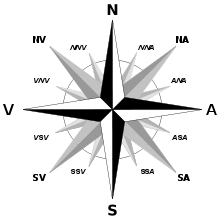
vest n (indeclinable) (abbreviation: V)
- west (compass point)
Antonyms
Derived terms
Etymology 2
From Latin vestis, via French and Italian.
Noun
vest m (definite singular vesten, indefinite plural vester, definite plural vestene)
Derived terms
Norwegian Nynorsk
Etymology 1
From Old Norse vestr, from Proto-Germanic *westrą.
Noun
vest n (indeclinable) (abbreviation: V)
- west (compass point)
Antonyms
Derived terms
Etymology 2
From Latin vestis, via French and Italian.
Noun
vest m (definite singular vesten, indefinite plural vestar, definite plural vestane)
Derived terms
Romanian
Etymology
Noun
vest n (uncountable)
Declension
| singular | ||
|---|---|---|
| n gender | indefinite articulation | definite articulation |
| nominative/accusative | (un) vest | vestul |
| genitive/dative | (unui) vest | vestului |
| vocative | vestule | |
Synonyms
See also
Romansch
Etymology
From a Germanic language.
Noun
vest m
Antonyms
Derived terms
Related terms
Serbo-Croatian
Alternative forms
- (Ijekavian) vijȇst
Etymology
From Proto-Slavic *věstь, from Proto-Indo-European *weyd- (“to see, know, perceive”).
Noun
vȇst f (Cyrillic spelling ве̑ст)
Declension
Slovene
Pronunciation
- IPA(key): /ˈʋéːst/
- Tonal orthography: vẹ̑st
Noun
vést f (genitive vestí, nominative plural vestí)