falcon
English
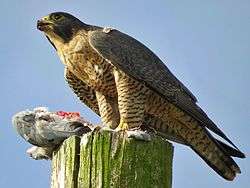
a falcon
Alternative forms
Etymology
From Middle English falcon, faulcon, from Old French falcun, from Late Latin falcō (“falcon”), of Germanic origin, probably via Old Frankish *falko (“falcon, hawk”), from Proto-Germanic *falkô (“falcon”), from Proto-Indo-European *pol̑- (“pale”), from *pel- (“fallow”).
Pronunciation
- enPR: fôlʹkən, fôʹkən, fălʹkən, IPA(key): /ˈfɔː(l)kən/, /ˈfɒlkən/, /ˈfælkən/
Audio (US) (file) - Rhymes: -ɔːkən
Noun
falcon (plural falcons)
- Any bird of the genus Falco, all of which are birds of prey.
- A female such bird, a male being a tiercel.
- A light cannon used from the 15th to the 17th century; a falconet.
Derived terms
Related terms
Translations
bird of the genus Falco
|
|


Verb
falcon (third-person singular simple present falcons, present participle falconing, simple past and past participle falconed)
- To hunt with a falcon or falcons.
- 2003, Brenda Joyce, House of Dreams, page 175:
- He rode astride while hawking; she falconed in the ladylike position of sidesaddle.
- 2003, Brenda Joyce, House of Dreams, page 175:
Anagrams
Ladin
Noun
falcon m
Old French
Noun
falcon m (oblique plural falcons, nominative singular falcons, nominative plural falcon)
- Alternative form of faucon (falcon)
Old Occitan
Etymology
Noun
falcon m (oblique plural falcons, nominative singular falcons, nominative plural falcon)
- falcon (bird)
Descendants
References
- von Wartburg, Walther (1928-2002), “falco”, in Französisches Etymologisches Wörterbuch (in German), volume 30, page 381
This article is issued from
Wiktionary.
The text is licensed under Creative Commons - Attribution - Sharealike.
Additional terms may apply for the media files.