scarf
English
Pronunciation
Etymology 1
Probably from Old Northern French escarpe (compare Old French escherpe (“pilgrim's purse suspended from the neck”)), possibly from Frankish *skirpja or of other Germanic origin (compare Old Norse skreppa (“small bag, wallet, satchel”)). Alternatively from Medieval Latin scirpa (“little woven bag of rushes”), from Latin scirpus (“rush, bullrush”).[1] The verb is derived from the noun.
Noun
scarf (plural scarves or scarfs)
- A long, often knitted, garment worn around the neck.
- 1963, Margery Allingham, chapter 2, in The China Governess:
- Now that she had rested and had fed from the luncheon tray Mrs. Broome had just removed, she had reverted to her normal gaiety. She looked cool in a grey tailored cotton dress with a terracotta scarf and shoes and her hair a black silk helmet.
-
- A headscarf.
- (dated) A neckcloth or cravat.
Derived terms
Descendants
- → Welsh: sgarff
Translations
|
|
Verb
scarf (third-person singular simple present scarfs, present participle scarfing, simple past and past participle scarfed)
- To throw on loosely; to put on like a scarf.
- 1599-1601, William Shakespeare, Hamlet, Act 5, Scene 2:
- My sea-gown scarfed about me.
- 1599-1601, William Shakespeare, Hamlet, Act 5, Scene 2:
- To dress with a scarf, or as with a scarf; to cover with a loose wrapping.
Etymology 2
Of uncertain origin. Possibly from Old Norse skarfr, derivative of skera (“to cut”).
Noun
scarf (plural scarfs)
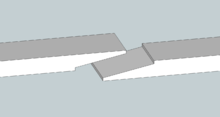
- A type of joint in woodworking.
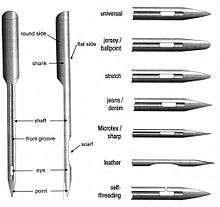
- A groove on one side of a sewing machine needle.
- A dip or notch or cut made in the trunk of a tree to direct its fall when felling.
Synonyms
Translations
|
Verb
scarf (third-person singular simple present scarfs, present participle scarfing, simple past and past participle scarfed)
- To shape by grinding.
- To form a scarf on the end or edge of, as for a joint in timber, forming a "V" groove for welding adjacent metal plates, metal rods, etc.
- To unite, as two pieces of timber or metal, by a scarf joint.
Etymology 3
Of imitative origin, or a variant of scoff. Alternatively from Old English sceorfan (“gnaw, bite”).
Verb
scarf (third-person singular simple present scarfs, present participle scarfing, simple past and past participle scarfed)
Usage notes
The more usual form in the UK is scoff.
Derived terms
Translations
|
|
Etymology 4
Noun
scarf
Part or all of this entry has been imported from the 1913 edition of Webster’s Dictionary, which is now free of copyright and hence in the public domain. The imported definitions may be significantly out of date, and any more recent senses may be completely missing.
(See the entry for scarf in Webster’s Revised Unabridged Dictionary, G. & C. Merriam, 1913.)
References
- scarf in Webster’s Revised Unabridged Dictionary, G. & C. Merriam, 1913
Anagrams
Old High German
Alternative forms
Etymology
From Proto-Germanic *skarpaz, whence also Old Saxon skarp, Old English scearp, Old Norse skarpr. Ultimately from Proto-Indo-European *(s)kerb-, from *(s)ker- (“to cut”).
Adjective
scarf