ice
English
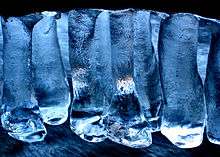
Ice.
Etymology
From Middle English is, from Old English īs, from Proto-Germanic *īsą (compare West Frisian iis, Dutch ijs, Low German Is, German Eis, Danish, Swedish and Norwegian is), from Proto-Indo-European *h₁eyH- (compare Lithuanian ýnis (“glazed frost”), Russian и́ней (ínej, “hoarfrost”), Ossetian их (ix), ех (ex, “ice”), Persian یخ (yax)),Kurdish qeş.
Pronunciation
Noun
ice (countable and uncountable, plural ices)
- (uncountable) Water in frozen (solid) form.
- 1882, Popular Science Monthly Volume 20, The Freezing of a Salt Lake
- It has always been difficult to explain how ice is formed on the surface of oceans while the temperature of maximum density is lower than that of cogelation, and the observations on this lake were instituted in the hope that they might throw light upon the subject.
- 2013 May 11, “The climate of Tibet: Pole-land”, in The Economist, volume 407, number 8835, page 80:
- Of all the transitions brought about on the Earth’s surface by temperature change, the melting of ice into water is the starkest. It is binary. And for the land beneath, the air above and the life around, it changes everything.
- 1882, Popular Science Monthly Volume 20, The Freezing of a Salt Lake
- (uncountable) Covering made of frozen water on a river or other water basin in cold season.
- (uncountable, physics, astronomy) Any frozen volatile chemical, such as ammonia or carbon dioxide.
- (uncountable, astronomy) Any volatile chemical, such as water, ammonia, or carbon dioxide, not necessarily in solid form.
- (countable) A frozen dessert made of fruit juice, water and sugar.
- (uncountable) Any substance having the appearance of ice.
- (uncountable, slang) One or more diamonds.
- (uncountable, slang, drugs) Crystal form of amphetamine-based drugs.
- (uncountable, ice hockey) The area where a game of ice hockey is played.
- 2006, CBC, Finland, Sweden 'the dream final', February 26 2002,
- The neighbouring countries have enjoyed many great battles on the ice. They last met for gold at the 1998 world championship, won by Sweden. Three years earlier, Finland bested Sweden for the only world title in its history.
- 2006, CBC, Finland, Sweden 'the dream final', February 26 2002,
Hyponyms
Hyponyms of ice
|
Derived terms
Derived terms
Translations
water in frozen form
|
|
frozen volatile chemical
frozen dessert
|
|
substance having the appearance of ice
diamond — see diamond
crystal methamphetamine
Verb
ice (third-person singular simple present ices, present participle icing, simple past and past participle iced)
- To cool with ice, as a beverage.
- To become ice, to freeze.
- (slang) To murder.
- To cover with icing (frosting made of sugar and milk or white of egg); to frost; as cakes, tarts, etc.
- (ice hockey) To put out a team for a match.
- Milton Keynes have yet to ice a team this season
- (ice hockey) To shoot the puck the length of the playing surface, causing a stoppage in play called icing.
- If the Bruins ice the puck, the faceoff will be in their own zone.
Derived terms
Translations
to cool with ice
|
to freeze
|
to murder
to cover with icing
ice hockey: to put a team on ice for a match
|
ice hockey: to shoot an icing
|
Further reading

Anagrams
Hausa
Etymology
Of uncertain origin, perhaps from a Saharan language; compare Dazaga idi.
Noun
icḕ m (possessed form icèn)
Latin
Verb
īce
- second-person singular present active imperative of īciō
Middle English
Noun
ice (uncountable)
- Alternative form of is (“ice”)
Portuguese
Verb
ice
- first-person singular (eu) present subjunctive of içar
- third-person singular (ele and ela, also used with você and others) present subjunctive of içar
- third-person singular (você) affirmative imperative of içar
- third-person singular (você) negative imperative of içar
Spanish
Pronunciation
Verb
ice
This article is issued from
Wiktionary.
The text is licensed under Creative Commons - Attribution - Sharealike.
Additional terms may apply for the media files.