leopard
English
Alternative forms
Etymology
From Middle English leopard, leopart, lepard, leperd, from Old French leopard (“leopard”), from Late Latin leopardus (“leopon, lipard”) from late Ancient Greek λεόπαρδος (leópardos, “leopon, lipard”), from λέων (léōn, “lion”) + πάρδος (párdos, “pard, male leopard”),[1] from earlier πάρδαλις (párdalis, “leopard”),[2] probably from an unattested Old Persian term ancestral to Middle Persian palang, Chorasmian plyk, Sogdian [script needed] (pwrδnk), Pashto پړانګ.[3]
Pronunciation
Noun
leopard (plural leopards)
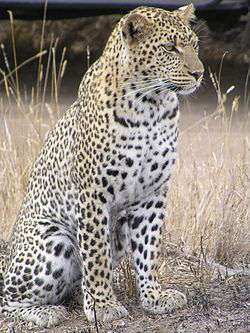
- Panthera pardus, a large wild cat with a spotted coat native to Africa and Asia, especially the male of the species (in contrast to leopardess).
- 1990, Dorothy L. Cheney, How Monkeys See the World: Inside the Mind of Another Species, 1992, page 284,
- During all such cases when we were present they responded by giving repeated alarm calls, even when the leopard was already feeding on a carcass. We wanted to determine whether vervets knew enough about the behavior of leopards to recognize that, even in the absence of a leopard, a carcass in a tree signaled the same potential danger as did a leopard itself.
- 1998, Oded Borowski, Every Living Thing: Daily Use of Animals in Ancient Israel, page 201,
- The leopard (Panthera pardus or Felis pardus cf tulliana) is a close relative of the lion, but biblical references mentioning it are very few, suggesting that it was not as common.
- 2005, Richard Ellis, Tiger Bone & Rhino Horn: The Destruction of Wildlife for Traditional Chinese Medicine, page 197,
- Leopard skins have always been desirable commodities because of their spectacular spotted patterns.
- 1990, Dorothy L. Cheney, How Monkeys See the World: Inside the Mind of Another Species, 1992, page 284,
- (inexact) The clouded leopard (Neofelis nebulosa), a similar-looking large wild cat native to Asia.
- 2005, Eric Dinerstein, Tigerland and Other Unintended Destinations, p. 81:
- There are plenty of beautiful cats among the thirty-nine species in the Felidae family, but the three leopards—clouded, common, and snow—may be the most visually stunning. Cloaked in the most beautiful fur of any cat, the reclusive clouded leopard is the Greta Garbo of the lot; it lives a solitary life in the remote jungles of Asia, from Nepal to Borneo.
- 2005, Eric Dinerstein, Tigerland and Other Unintended Destinations, p. 81:
- (inexact) The snow leopard (Uncia uncia), a similar-looking large wild cat native to Asia.
- (heraldry) A lion passant guardant.
- 1968, Charles MacKinnon of Dunakin, The Observer's Book of Heraldry, pages 68-69:
- Sometimes there is confusion over the heraldic leopard, the question being—When is a leopard not a leopard? There is a theory that the lion and leopard were the same thing, and that they were named entirely depending on their attitude—thus if the animal was passant guardant it was a leopard, but when rampant it was a lion. Nowadays a leopard is the genuine spotted article and quite unmistakeable. Some people still speak, wrongly, of the leopards of England, but it does no great harm as it is an ancient expression and everybody knows what it means.
-
Synonyms
- (Panthera pardus): common leopard, pard, pardal
- (Neofelis nebulosa): See clouded leopard
- (Uncia uncia): See snow leopard
Hypernyms
Hyponyms
- (female): leopardess
- (young): cub, leopard cub
Derived terms
- a leopard cannot change its spots
- clouded leopard
- common leopard
- leopardess
- leopard cat
- leopard complex
- leopard cub
- leopard frog
- leopard gecko
- leopardling
- leopard moth
- leopard seal
- leopard shark
- leopard tortoise
- leopard's head
- leopardsbane
- leopon
- lipard
- Louisiana Catahoula leopard dog
- snow leopard
Related terms
Translations
|
|
See also
- (hybrid formed by a leopard and a lioness): leopon
- (hybrid formed by a lion and a leopardess): lipard
References
- ↑ “leopard”, in OED Online

- ↑ “pard, n.”, in OED Online
- ↑ “†pardal, n.”, in OED Online
Anagrams
Crimean Tatar
Etymology
Noun
leopard
Declension
| nominative | leopard |
|---|---|
| genitive | leopardnıñ |
| dative | leopardğa |
| accusative | leopardnı |
| locative | leopardda |
| ablative | leoparddan |
References
- Mirjejev, V. A.; Usejinov, S. M. (2002) Ukrajinsʹko-krymsʹkotatarsʹkyj slovnyk [Ukrainian – Crimean Tatar Dictionary], Simferopol: Dolya, →ISBN
Czech
Noun
leopard m
Synonyms
Derived terms
Further reading
- leopard in Příruční slovník jazyka českého, 1935–1957
- leopard in Slovník spisovného jazyka českého, 1960–1971, 1989
Norwegian Bokmål
Noun
leopard m (definite singular leoparden, indefinite plural leoparder, definite plural leopardene)
- a leopard (big cat, Panthera pardus)
Derived terms
See also
Norwegian Nynorsk
Noun
leopard m (definite singular leoparden, indefinite plural leopardar, definite plural leopardane)
- a leopard (as above)
Derived terms
See also
Romanian
Etymology
Pronunciation
- IPA(key): /ˌle.oˈpard/
- Hyphenation: le‧o‧pard
Noun
leopard m (plural leoparzi)
Declension
| singular | plural | |||
|---|---|---|---|---|
| indefinite articulation | definite articulation | indefinite articulation | definite articulation | |
| nominative/accusative | (un) leopard | leopardul | (niște) leoparzi | leoparzii |
| genitive/dative | (unui) leopard | leopardului | (unor) leoparzi | leoparzilor |
| vocative | leopardule | leoparzilor | ||
Further reading
- leopard in DEX online - Dicționare ale limbii române (Dictionaries of the Romanian language), 2004-2018
Serbo-Croatian
Pronunciation
- IPA(key): /lêopaːrd/
- Hyphenation: le‧o‧pard
Noun
lȅopārd m (Cyrillic spelling ле̏опа̄рд)
Declension
Swedish
Noun
leopard c (pl leoparder, def sing leoparden, def pl leoparderna)
Descendants
- Finnish: leopardi