iceberg
English
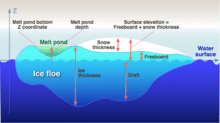
Iceberg diagram
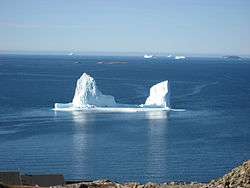
An iceberg
Etymology
Borrowed from Dutch ijsberg, compound of ijs (“ice”) + berg (“mountain”). First used to describe a glacier as seen at a distance from a ship then used as a term to describe the floating chunks of ice broken off from such glaciers. Compare German Eisberg, Danish isbjerg, Norwegian/Swedish isberg, Welsh eisberg.
Pronunciation
- (Received Pronunciation) IPA(key): /ˈaɪsbɜːɡ/
- (US) IPA(key): /ˈaɪsbɝɡ/
Noun
iceberg (plural icebergs)
- A huge mass of ocean-floating ice which has broken off a glacier or ice shelf
- The Titanic hit an iceberg and sank.
- (US, slang) An aloof person.
- (figuratively, after an adjective) An impending disastrous event whose adverse effects are only beginning to show, in reference to one-tenth of the volume of an iceberg being visible above water.
Derived terms
Terms derived from iceberg
|
|
Related terms
Translations
huge mass of floating ice
|
|
See also
References


- “iceberg” in Douglas Harper, Online Etymology Dictionary, 2001–2018.
French
Etymology
Pronunciation
- IPA(key): /ajs.bɛʁɡ/, /is.bɛʁɡ/
- Rhymes: -ɛʁɡ
- Homophone: icebergs
Noun
iceberg m (plural icebergs)
Further reading
- “iceberg” in le Trésor de la langue française informatisé (The Digitized Treasury of the French Language).
Galician
Noun
iceberg m (plural [please provide])
Italian
Noun
iceberg m (invariable)
Derived terms
- punta dell'iceberg - tip of the iceberg
See also
- ghiaccio - ice
Portuguese
Alternative forms
- icebergue (uncommon)
Noun
iceberg m (plural icebergs)
Spanish
Etymology
Pronunciation
- (Castilian) IPA(key): /ˈiθe̞βe̞ɾ(x)/, /iθe̞ˈβe̞ɾ(x)/
- (Latin America) IPA(key): /ˈajsβe̞ɾɡ/
Noun
iceberg m (plural icebergs)
Synonyms
Derived terms
This article is issued from
Wiktionary.
The text is licensed under Creative Commons - Attribution - Sharealike.
Additional terms may apply for the media files.