frost
English
Etymology
From Middle English frost, from Old English frost (“frost”), from Proto-Germanic *frustaz (“frost”), from Proto-Indo-European *prews- (“to freeze; frost”). Cognate with West Frisian froast (“frost”), Dutch vorst (“frost”), German Frost (“frost”), Swedish frost (“frost”), Icelandic frost (“frost”), Latin pruīna (“hoarfrost, frost, rime, snow”). Related to freeze.
Pronunciation
- (Received Pronunciation) IPA(key): /fɹɒst/
- (General American) IPA(key): /fɹɔst/
- (cot–caught merger, Canada) IPA(key): /fɹɑst/
Audio (US) (file) - Rhymes: -ɒst, -ɔːst
Noun
frost (countable and uncountable, plural frosts)
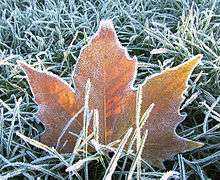
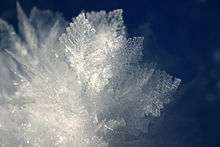
- A cover of minute ice crystals on objects that are exposed to the air. Frost is formed by the same process as dew, except that the temperature of the frosted object is below freezing.
- 1748. David Hume. Enquiries concerning the human understanding and concerning the principles of moral. London: Oxford University Press, 1973. § 47.
- It is more probable, in almost every country of Europe, that there will be frost sometime in January, than that the weather will continue open throughout that whole month;
- 1748. David Hume. Enquiries concerning the human understanding and concerning the principles of moral. London: Oxford University Press, 1973. § 47.
- The cold weather that causes these ice crystals to form.
- (figuratively) Coldness or insensibility; severity or rigidity of character.
- Sir Walter Scott
- It was one of those moments of intense feeling when the frost of the Scottish people melts like a snow-wreath.
- Sir Walter Scott
- (obsolete) The act of freezing; the congelation of water or other liquid.
Derived terms
Translations
|
|
|
|
- The translations below need to be checked and inserted above into the appropriate translation tables, removing any numbers. Numbers do not necessarily match those in definitions. See instructions at Wiktionary:Entry layout#Translations.
Verb
frost (third-person singular simple present frosts, present participle frosting, simple past and past participle frosted)
- To get covered with frost.
- To coat something (e.g. a cake) with icing to resemble frost.
- To anger or annoy.
- I think the boss's decision frosted him, a bit.
Derived terms
Translations
Anagrams
Danish
Etymology
Pronunciation
- IPA(key): /frɔst/, [fʁ̥ʌsd̥]
Noun
frost c (singular definite frosten, not used in plural form)
Declension
| common gender |
Singular | |
|---|---|---|
| indefinite | definite | |
| nominative | frost | frosten |
| genitive | frosts | frostens |
References
- “frost” in Den Danske Ordbog
Icelandic
Etymology
Pronunciation
- IPA(key): /frɔst/
- Rhymes: -ɔst
Noun
frost n (genitive singular frosts, nominative plural frost)
Declension
See also
Norwegian Bokmål
Etymology
Noun
frost m (definite singular frosten)
Derived terms
References
- “frost” in The Bokmål Dictionary.
Norwegian Nynorsk
Etymology
Noun
frost m (definite singular frosten)
Derived terms
References
- “frost” in The Nynorsk Dictionary.
Old English
Alternative forms
Etymology
From Proto-Germanic *frustą, *frustaz, akin to Old High German frost, Old Norse frost.
Noun
frost m
Descendants
- English: frost
Old High German
Etymology
From Proto-Germanic *frustą, *frustaz, akin to Old English frost, Old Norse frost.
Noun
frost m
Descendants
- German: Frost
Old Norse
Etymology
From Proto-Germanic *frustą, *frustaz, akin to Old English frost, Old High German frost.
Noun
frost n
Descendants
References
- frost in Geir T. Zoëga (1910) A Concise Dictionary of Old Icelandic, Oxford: Clarendon Press
Swedish
Etymology
From Old Norse frost, from Proto-Germanic *frustą, *frustaz.
Pronunciation
audio (file)
Noun
frost c
Declension
| Declension of frost | ||||
|---|---|---|---|---|
| Uncountable | ||||
| Indefinite | Definite | |||
| Nominative | frost | frosten | — | — |
| Genitive | frosts | frostens | — | — |