fur
English
Etymology 1
From Middle English furre, forre, from Anglo-Norman forre, fuerre (“a case; sheath”), from Frankish *fōdar, from Proto-Germanic *fōdrą (“sheath”) (compare Old English fōdor (“sheaf”), Dutch voering (“lining”), German Futter (“lining”), Gothic 𐍆𐍉𐌳𐍂 (fōdr, “sheath”)), from Proto-Indo-European *peh₂-, *poh₂- (“to protect”) (compare Lithuanian piemuō (“protection”), Ancient Greek πῶυ (pôu, “flock”), πῶμα (pôma, “lid”), ποιμήν (poimḗn, “shepherd”), Old Armenian հաւրան (hawran, “herd, flock”), Kurdish pawan (“to watch over”), Sanskrit पाति (pāti, “he watches, protects”).
The verb is from Middle English furren, from Anglo-Norman furrer, forrer, fourrer (“to line; stuff; fill”), from the noun.
Pronunciation
- (UK) IPA(key): /fɜː(ɹ)/
- (Received Pronunciation) IPA(key): [fɜ̝ː]
- (US) enPR: fûr, IPA(key): /fɝ/
Audio (US) (file) - Rhymes: -ɜː(r)
- Homophone: fir
Noun
fur (countable and uncountable, plural furs)
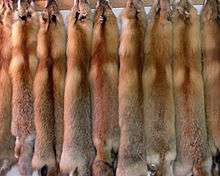
- The hairy coat of various mammal species, especially when fine, soft and thick.
- The hairy skin of an animal processed into clothing for humans.
- Lady M. W. Montagu
- wrapped up in my furs
- Lady M. W. Montagu
- A pelt used to make, trim or line clothing apparel.
- A coating, lining resembling fur in function and/or appearance.
- A thick pile of fabric.
- The soft, downy covering on the skin of a peach.
- The deposit formed on the interior of boilers and other vessels by hard water.
- The layer of epithelial debris on a tongue.
- (heraldry) One of several patterns or diapers used as tinctures.
- A furry; a member of the furry subculture.
- 2006, Shari Caudron, Who Are You People?
- "You want to know what brings furries together?" she asks. "Furs are here because they don't fit in anywhere else. For real furs, this is the only place they feel comfortable."
- 2006, Shari Caudron, Who Are You People?
- (vulgar, slang) Pubic hair.
- (vulgar, slang) Sexual attractiveness.
Derived terms
Translations
|
|
|
- The translations below need to be checked and inserted above into the appropriate translation tables, removing any numbers. Numbers do not necessarily match those in definitions. See instructions at Wiktionary:Entry layout#Translations.
Verb
fur (third-person singular simple present furs, present participle furring, simple past and past participle furred)
- (transitive) To cover with fur.
Derived terms
Translations
Etymology 2
Conjunction
fur
- Eye dialect spelling of for, representing African American Vernacular English.
Preposition
fur
- Eye dialect spelling of for, representing African American Vernacular English.
Anagrams
Aromanian
Etymology 1
From Vulgar Latin fūrō, from Latin fūror. Compare Romanian fura, fur.
Alternative forms
Verb
fur (third-person singular present indicative furã, past participle furatã)
- I steal.
Related terms
See also
Etymology 2
Alternative forms
Noun
fur m (plural furi)
Synonyms
- furcudar, haramiu, chisãgi, caceac
Catalan
Noun
fur m (plural furs)
Dalmatian
Verb
fur
- Alternative form of facro
Conjugation
| infinitive | fur | ||||||
|---|---|---|---|---|---|---|---|
| gerund | fundo | ||||||
| past participle | fut | ||||||
| singular | plural | ||||||
| 1st person | 2nd person | 3rd person | 1st person | 2nd person | 3rd person | ||
| indicative | ju | te | jal/jala | nu | vu | jali/jale | |
| present | faz | fai | facaja | faime | faite | facaja | |
| imperfect | fazua | fazui | fazua | fazume | fazute | fazua | |
| perfect | jai fut | je fut | ju fut | jaime fut | jaite fut | ju fut | |
| pluperfect | avas fut | avas fut | avaja fut | avaime fut | avaite fut | avas fut | |
| future | fura | furai | fura | furme | furte | fura | |
| conditional | fure | fure | fure | furme | furte | fure | |
| subjunctive | ju | te | jal/jala | nu | vu | jali/jale | |
| present | faiss | faiss | faiss | fuzme | fuzte | fuaza | |
| imperfect | facas | facasse | facassa | facassaime | facassaite | facas | |
| imperative | — | te | — | nu | vu | — | |
| affirmative | fai | faime | faite | ||||
| negative | naun fai | naun faime | naun faite | ||||
French
Etymology
Pronunciation
- IPA(key): /fyʁ/
Noun
fur m (plural not attested)
- Only used in au fur et à mesure (“to an equitable extent”)
Further reading
- “fur” in le Trésor de la langue française informatisé (The Digitized Treasury of the French Language).
Latin
Etymology
From Proto-Italic *fōr, from Proto-Indo-European *bʰṓr, from the root *bʰer- (“to carry”) (see ferō). Cognate with Ancient Greek φώρ (phṓr).
Pronunciation
- (Classical) IPA(key): /fuːr/
- (Ecclesiastical) IPA(key): /fur/
Audio (Classical) (file)
Noun
fūr m (genitive fūris); third declension
- A thief
Inflection
Third declension.
| Case | Singular | Plural |
|---|---|---|
| nominative | fūr | fūrēs |
| genitive | fūris | fūrum |
| dative | fūrī | fūribus |
| accusative | fūrem | fūrēs |
| ablative | fūre | fūribus |
| vocative | fūr | fūrēs |
Related terms
Descendants
- Aromanian: fur
- Italian: furo
- Old Occitan:
- Romanian: fur
- ⇒ Late Latin: fūrō, fūrōnis (“thief”)
- ⇒ Vulgar Latin: *furittum (“petty thief”)
References
- fur in Charlton T. Lewis and Charles Short (1879) A Latin Dictionary, Oxford: Clarendon Press
- fur in Charlton T. Lewis (1891) An Elementary Latin Dictionary, New York: Harper & Brothers
- fur in Charles du Fresne du Cange’s Glossarium Mediæ et Infimæ Latinitatis (augmented edition, 1883–1887)
- fur in Gaffiot, Félix (1934) Dictionnaire Illustré Latin-Français, Hachette
- fur in Harry Thurston Peck, editor (1898) Harper's Dictionary of Classical Antiquities, New York: Harper & Brothers
Romanian
Etymology
Pronunciation
- IPA(key): [fur]
Verb
fur
Noun
fur m (plural furi)
- (archaic) thief
Synonyms
Related terms
Somali
Verb
fur
Swedish
Alternative forms
Pronunciation
- IPA(key): /fʉːr/
- Rhymes: -ʉːr
Noun
fur c (uncountable)
- pinewood
- (archaic) pine tree (in some areas chiefly about old trees)
Synonyms
Related terms
Welsh
Pronunciation
- (North Wales) IPA(key): /vɨːr/
- (South Wales) IPA(key): /viːr/
Noun
fur
- Soft mutation of mur.
Mutation
| Welsh mutation | |||
|---|---|---|---|
| radical | soft | nasal | aspirate |
| mur | fur | unchanged | unchanged |
| Note: Some of these forms may be hypothetical. Not every possible mutated form of every word actually occurs. | |||